
Gulf Aviation Network Hit by Coordinated Disruption: 67 Flights Cancelled and 114 Delayed Across Kuwait, Qatar, UAE and Saudi Arabia
A synchronized operational breakdown across Gulf aviation hubs left 67 flights cancelled and 114 delayed, with Kuwait In

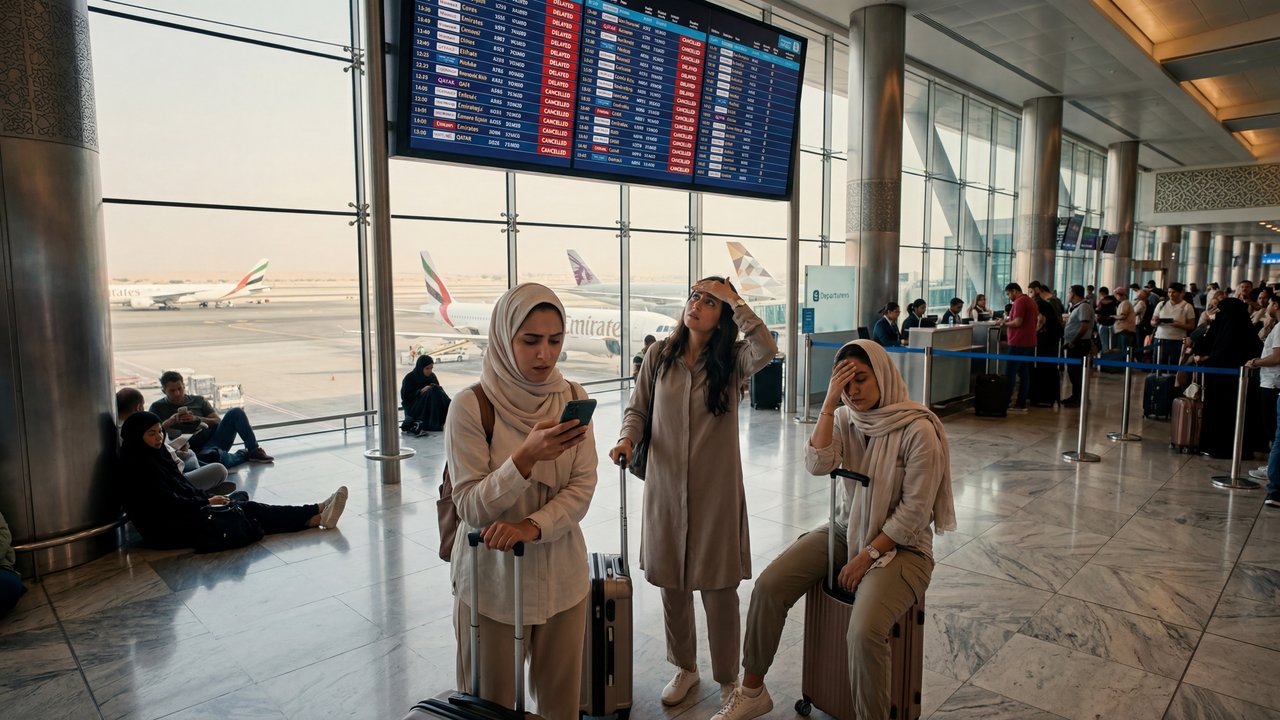
Image generated by AI
A sharp wave of aviation disruption swept across the Middle East today, striking Qatar, Saudi Arabia, Kuwait, the UAE and surrounding air corridors in a coordinated operational breakdown. The region's tightly interconnected airport networks came under simultaneous strain, producing 67 flight cancellations and 114 delays across major Gulf hubs.
The disruption was not caused by a single airport failure. Instead, it reflected a synchronized stress event across Gulf aviation systems that function as global transit gateways for intercontinental traffic.
Kuwait International Airport was the most heavily affected, recording 50 cancellations — a figure that points to significant flight removal from schedules and acute capacity stress. In contrast, Hamad International Airport in Doha and Dubai International Airport experienced delay-heavy disruption patterns, indicating congestion in aircraft movement, gate scheduling and air traffic sequencing rather than complete operational shutdowns.
Saudi Arabia's key hubs in Riyadh and Jeddah also recorded mixed disruptions, reinforcing a region-wide pattern of instability affecting both domestic and international flight flows.
Where the System Fractured
At a system level, the disruption exposed how tightly synchronized Gulf aviation has become. Modern Gulf hubs operate as transfer engines for intercontinental traffic, meaning even short disruptions can multiply rapidly.
Of the 67 total cancellations, Kuwait alone accounted for 50, making it the single largest point of operational breakdown. Delays dominated in Doha and Dubai, indicating severe congestion and schedule compression rather than full closures. Saudi Arabia's dual-airport system in Riyadh and Jeddah showed a mixed pattern of cancellations and delays, suggesting broader network strain rather than a localized failure.
Together, these figures point to a multi-hub operational disturbance affecting both departure flow and arrival sequencing across the Gulf aviation corridor.
Kuwait Emerges as the Primary Shock Point
The most striking disruption occurred at Kuwait International Airport, where cancellations far outweighed delays. This pattern typically indicates capacity constraints, airline-initiated flight suspensions, or sudden operational restrictions affecting takeoff permissions. With 50 flights cancelled, Kuwait effectively functioned as the primary shock point in the system.
Hamad International Airport showed a different stress signature: only 5 cancellations but 36 delays. Aircraft were still operating, but turnaround times, gate availability and air traffic sequencing were heavily congested. Doha's role as a major global transfer hub means even minor disruptions can cascade into large delay clusters.
At Dubai International Airport, the pattern closely mirrored Doha, with 4 cancellations and 34 delays. Dubai's tightly packed flight schedules, particularly on long-haul intercontinental routes, make it highly sensitive to timing disruptions. Once delays begin stacking, downstream flights often inherit the instability, producing system-wide knock-on effects.
Saudi Arabia's Dual-Pressure Scenario
Saudi Arabia's aviation network showed a dual-pressure scenario. King Khalid International Airport in Riyadh recorded 5 cancellations and 23 delays, while King Abdulaziz International Airport in Jeddah registered 3 cancellations and 15 delays. Together, these two airports form a critical domestic and international backbone, especially for religious travel and regional connectivity. The mixed disruption profile suggests both operational constraints and schedule reshuffling across airline rotations.
Airlines in the Crosshairs
Several carriers were directly exposed to the disruption, particularly those operating dense regional networks across Gulf hubs.
Saudia experienced significant schedule pressure, particularly on routes connecting Riyadh and Jeddah with international destinations. As a carrier deeply integrated into Saudi Arabia's hub system, even minor airport disruptions tend to cascade into network-wide delays.
Flydubai faced similar operational strain out of Dubai, where aircraft rotations and quick turnaround schedules leave little buffer for disruption. Delays at Dubai International quickly propagate across Flydubai's short- and medium-haul network, especially on high-frequency regional routes.
Airblue, operating across Gulf-linked routes, also faced disruption through missed connections and delayed departures, particularly where its schedule depends on synchronized arrivals from Gulf transit hubs.
While these carriers absorbed much of the visible operational impact, the underlying disruption likely affected a wider range of international airlines using Gulf hubs as transit points.
Four Structural Pressures Behind the Breakdown
Although no single cause has been officially confirmed, the pattern of disruption aligns with several known pressure points in global aviation systems.
First, extended suspensions by major international carriers may have contributed. When large airlines adjust schedules due to maintenance, crew constraints or route restructuring, secondary hubs often absorb displaced traffic, quickly saturating capacity at airports like Dubai, Doha and Riyadh.
Second, geopolitical spillover and airspace closures remain a persistent risk factor in the region. Even partial restrictions or precautionary rerouting can lead to longer flight paths, higher fuel burn and compressed scheduling windows, which then translate into delays and cancellations across multiple hubs.
Third, local infrastructure bottlenecks and phased resumptions likely played a role, particularly in Kuwait where cancellation levels were unusually high. When airports reintroduce capacity in phases — after weather disruptions, technical constraints or operational pauses — airlines often cancel flights outright rather than attempt unstable rescheduling.
Fourth, severe global fuel management measures can indirectly affect flight operations. When fuel supply logistics tighten or pricing volatility increases, airlines may consolidate routes, reduce frequency or cancel marginal flights to preserve network efficiency.
In practice, these factors rarely operate in isolation. They compound each other, producing system-wide instability even when the original trigger is localized.
Ripple Effects Across Global Routes
The disruption extended well beyond the Gulf. International connections to Cairo, London, Oslo and Seeb were among those affected, as missed connections and delayed arrivals reshaped onward schedules.
Seeb, closely tied to Muscat's aviation ecosystem, experienced indirect disruption through rerouted passengers and delayed feeder flights. Long-haul routes into Europe faced cascading arrival delays, particularly where Gulf hubs serve as key transfer points.
Cairo's position as a regional interchange amplified the effects, with passengers facing extended layovers and missed onward connections into North Africa and Europe. London and Oslo, both heavily linked to Gulf transit networks, saw secondary schedule adjustments as inbound flights arrived late or were rescheduled.
Passenger Impact in Real Time
For passengers, the disruption translated into uncertainty rather than complete standstill. While most airports continued operating, the balance between cancellations and delays created unpredictable travel conditions.
In Kuwait, entire itineraries were effectively rewritten due to cancellations. In Doha and Dubai, the issue was less about flight availability and more about timing instability. In Saudi Arabia, passengers experienced a hybrid situation, with some flights cancelled outright and others delayed across multiple hours. The result was a cascading travel disruption affecting both short-haul regional passengers and long-haul international travelers.
Passenger Guidance During Ongoing Disruption
For travelers navigating similar conditions, several operational strategies become critical.
Rebooking speed matters. In high-disruption environments, early contact with airlines significantly improves the chance of securing alternative routes before capacity fills.
Flexible routing through secondary hubs can reduce exposure. When primary hubs like Dubai or Doha are congested, alternative connections through less impacted airports may offer more stable schedules.
Passengers should closely monitor multi-airline itineraries. Codeshare connections are especially vulnerable during cascading delays, as downstream segments may be automatically rebooked or cancelled.
Buffer time between connections becomes essential. Under normal conditions, tight transfers may be viable, but during system stress they often fail due to minor upstream delays.
Finally, passengers should track real-time airport advisories and avoid relying solely on original booking schedules, which may not reflect operational changes during disruption windows.
Gradual Stabilization Ahead
While the aviation system across Qatar, Saudi Arabia, Kuwait and the UAE remains under pressure, the disruption is still being assessed as a temporary operational shock rather than a structural collapse. Airlines including Saudia, Flydubai and Airblue continue to operate across key hubs in Doha, Riyadh, Jeddah, Dubai and Kuwait City, though with persistent schedule adjustments as backlogs are gradually cleared.
Airports in these countries are still functioning, but recovery depends on stabilizing cascading delays tied to aircraft rotations and crew scheduling across tightly linked Gulf networks. The impact is visible across international routes connecting to Cairo in Egypt, London in the United Kingdom, Oslo in Norway and Seeb in Oman, where delayed arrivals continue to disrupt onward connections.
Given the high interdependence of Middle East aviation systems, full normalization is expected to be gradual rather than immediate, as airlines and airports work through accumulated disruptions across multiple cities and countries in the region.
| Airport | Cancellations | Delays |
|---|---|---|
| Kuwait International Airport | 50 | 6 |
| Hamad International Airport (Doha) | 5 | 36 |
| Dubai International Airport | 4 | 34 |
| King Khalid International Airport (Riyadh) | 5 | 23 |
| King Abdulaziz International Airport (Jeddah) | 3 | 15 |
| Total | 67 | 114 |
Key Takeaways
- Kuwait International Airport was the worst-affected hub, accounting for 50 of the 67 total cancellations.
- Doha and Dubai experienced delay-heavy disruption patterns, reflecting congestion rather than shutdowns.
- Saudia, Flydubai and Airblue were among the carriers most exposed to the cascading schedule disruption.
- Ripple effects reached Cairo, London, Oslo and Seeb through missed connections and delayed arrivals.
- Recovery is expected to be gradual due to the high interdependence of Gulf aviation networks.
FAQ
Which airport recorded the most cancellations? Kuwait International Airport recorded 50 cancellations, making it the single largest point of operational breakdown during the disruption.
Were Doha and Dubai airports shut down? No. Hamad International Airport in Doha and Dubai International Airport remained operational but experienced heavy delays — 36 and 34 respectively — indicating congestion rather than closure.
Which airlines were most affected? Saudia, Flydubai and Airblue were directly exposed to the disruption, particularly on routes dependent on high-frequency Gulf hub operations.
Did the disruption affect routes outside the Gulf? Yes. International connections to Cairo, London, Oslo and Seeb experienced cascading delays and missed connections as Gulf hub instability propagated outward.
Is the disruption expected to continue? Recovery is expected to be gradual. Airlines and airports continue operating with schedule adjustments as they clear accumulated backlogs across the region.
Related Travel Guides
Disclaimer
This article is for informational and educational purposes only. It does not constitute legal, financial, or professional advice. While we strive to provide accurate and up-to-date information, travel policies, regulations, and conditions change rapidly. Always verify information with official sources before making travel decisions. Nomad Lawyer makes no representations about the accuracy, reliability, completeness, or suitability of the information provided. Readers should consult qualified professionals for advice specific to their circumstances. The views expressed in this article are those of the author and do not necessarily reflect the views of Nomad Lawyer.
Preeti Gunjan
Contributor & Community Manager
A passionate traveller and community builder. Preeti helps grow the Nomad Lawyer community, fostering engagement and bringing the reader experience to life.
Learn more about our team →