
Travel Chaos Grips Miami Airport: 123 Flight Delays and Cancellations Disrupt American, LATAM, and Global Corridors
Miami International Airport faces massive airport disruptions as severe delays cascade across European, Latin American, and US domestic travel networks.

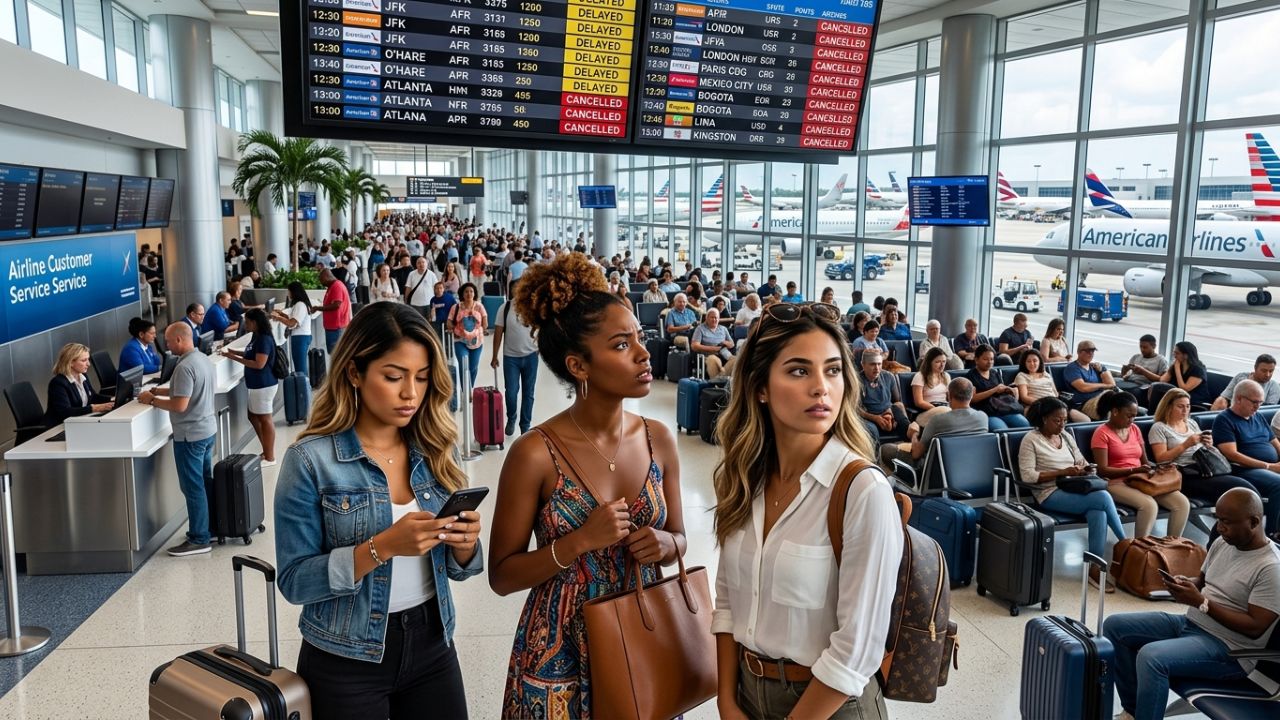
Image generated by AI
Travel Chaos Grips Miami Airport: 123 Flight Delays and Cancellations Disrupt American, LATAM, and Global Corridors
Massive operational bottlenecks at Miami International Airport sever critical transatlantic and Caribbean travel routes, leaving thousands of international passengers stranded.
A massive wave of travel chaos is actively suffocating Miami International Airport (MIA), as widespread international flight operations experience intense operational strain. Currently, officials have recorded a staggering 123 flight delays alongside 5 outright flight cancellations. This escalating logistical nightmare is violently intensifying pressure on airport infrastructure and heavily crippling passenger movement systems across one of the United States' most vital global hubs.
The sprawling airport disruptions are directly driven by a high volume of cascading schedule adjustments heavily impacting both arrivals and departures. Major operators, including United, LATAM, American Airlines, Air France, Delta, and Volaris, are frantically adjusting operations to manage the severe flow instability. This breakdown is firmly linked to a broader network imbalance aggressively destroying major aviation links between the US, the UK, Germany, Spain, France, Italy, Mexico, Colombia, Peru, Panama, and the Caribbean. For travelers caught in the crossfire of this brutal airline news event, agonizing layovers and severely severed connections have become the inescapable reality of the day.
Aviation Updates: Miami at the Center of Global Strain
The rapidly deteriorating situation clearly positions Miami International Airport at the absolute center of a multi-continental network failure. This disruption is not isolated to a single localized region; rather, it vividly reflects a massive operational imbalance spanning North America, Europe, Latin America, and the Caribbean.
With 123 delays officially recorded, Miami’s arrival system is buckling under sustained pressure. The crisis is particularly devastating during peak inbound windows, where massive international wide-bodies and domestic feeder flights dangerously converge. The 5 verified cancellations further indicate severe structural scheduling adjustments, almost certainly triggered by cascading delays that have annihilated aircraft availability and violently exceeded crew rotation limits. This intense imbalance has forced irregular arrival sequencing, generating brutal congestion at the gates and drastically increasing turnaround times for aircraft attempting to execute subsequent departures.
Section-Wise Breakdown: A Global Network Compromised
An analysis of the disruption data reveals that Miami's delays are being aggressively fed by operational failures across a massive range of global origin airports.
North America: Domestic Feeder Hubs Choked
A significant share of the disruption originates deep within the United States. Multiple high-traffic airports are actively contributing massive delay inflow directly into Miami. These heavily congested hubs include Atlanta, Dallas-Fort Worth, Chicago O’Hare, LaGuardia, Orlando, Nashville, Charlotte, Philadelphia, Houston Bush, Houston Hobby, Kansas City, Raleigh-Durham, St. Louis, Phoenix, Tampa, and Washington Reagan National. Because these airports serve as absolute critical domestic feeder points for international transfers, even minor delays cascade violently into Miami’s arrival sequencing.
Europe: Transatlantic Connectivity Under Fire
The travel chaos heavily extends across the Atlantic. European operations feeding into Miami are severely compromised, with painful delays and cancellations officially recorded at London Heathrow, Frankfurt, Madrid-Barajas, Paris Charles de Gaulle, Zurich, Milan Malpensa, and Rome Fiumicino. These airports represent the most critical long-haul gateways into Florida. Due to limited daily frequencies on these transatlantic routes, a single delay disrupts vital aircraft positioning for return journeys, mathematically guaranteeing extended schedule instability at Miami.
Latin America and the Caribbean: Leisure Routes Paralyzed
As the undisputed gateway to the south, Miami's Latin American and Caribbean travel corridors are bearing the heaviest concentration of disruption. Severely affected airports include Cancún, Mexico City, Monterrey, Bogotá, Lima, Panama City, San José, Guatemala City, Santo Domingo, Punta Cana, Nassau, Grand Cayman, Havana, Piarco, and Providenciales. The tight operational structure of short-haul Caribbean flights means delays instantaneously propagate into Miami’s scheduling, especially during these peak leisure travel windows.
Flight Details and Operational Data
While specific, granular airline-level breakdowns are not fully detailed in the primary dataset, the incredibly widespread nature of the affected origin airports clearly indicates massive multi-carrier involvement. The disruption pattern confirms that no single airline is responsible; the crisis is entirely distributed across the global aviation network actively feeding into Miami.
Confirmed Operator Impact Matrix
| Airline Operator | Regional Focus / Category | Status at Miami (MIA) |
|---|---|---|
| American Airlines | Dominant Domestic & International Hub Operations | Severe Delays & Cancellations |
| LATAM | Latin American & South American Corridors | Severe Delays |
| United Airlines | Domestic Connectivity & Feeder Routes | Severe Delays |
| Delta Air Lines | Domestic & Regional | Severe Delays |
| Air France | Transatlantic / European Operations | Schedule Adjustments & Delays |
| Volaris | Mexico & Central American Routes | Schedule Adjustments & Delays |
| Total Miami Disruptions | All Global Networks | 123 Delays, 5 Cancellations |
Data reflects verified operational interruptions. The massive volume of inbound delays has severely compromised departure scheduling for all major operators utilizing the hub.
Passenger Impact: Missed Connections and Agonizing Layovers
For the traveling public actively attempting to navigate Miami International Airport today, the immediate consequences are incredibly stressful. The massive scale of 123 delays has severely compromised domestic and international itineraries, creating a highly volatile environment within the terminals.
International travelers arriving from Europe are particularly devastated, as their tightly scheduled onward connections to Latin America and the Caribbean are being violently disrupted. Domestic passengers attempting to connect through US hubs are experiencing terrifying schedule uncertainty due to the cascading delays originating from their departure airports. At the ground level, intense gate congestion, brutal aircraft turnaround delays, and completely irregular arrival sequencing are forcing passengers into extended, uncomfortable layovers with severely reduced schedule predictability.
Industry Analysis: The Mechanics of Hub Congestion
Aviation analysts monitoring the Miami crisis point to the inherent vulnerabilities of heavily utilized, interconnected transit gateways. The current situation is definitively driven by a catastrophic combination of cascading delays from upstream airports, wildly tight aircraft rotation schedules, and immense congestion within peak travel windows. When a flight from Frankfurt or Lima arrives significantly behind schedule, the delayed offloading immediately compromises gate availability for an inbound domestic flight from Chicago or Atlanta. This inescapable domino effect perfectly illustrates how rapidly multi-region disruptions can converge at a single major international gateway, amplifying localized operational stress into a massive global travel impact.
Conclusion: A Complex and Painful Recovery
The severe travel setback at Miami International Airport brutally underscores the extreme complexity of managing one of the world’s most interconnected aviation hubs. With 123 delays and 5 cancellations actively tearing through global itineraries, the immediate operational outlook remains incredibly challenging. While airlines like American and LATAM are frantically executing recovery efforts, full network normalization will require significant time to achieve as global inbound and outbound flows slowly restabilize. Passengers must remain highly vigilant, as residual delays are mathematically guaranteed to continue throughout the subsequent operational cycles.
Key Takeaways
- Massive Disruptions: Miami International Airport is suffering a massive operational meltdown with 123 flight delays and 5 cancellations.
- Global Route Destruction: Disruptions have heavily paralyzed routes linking Miami to the US, UK, Germany, Spain, France, Italy, Mexico, Colombia, Peru, Panama, and the Caribbean.
- Major Airlines Bleeding: American Airlines, LATAM, United, Air France, Delta, and Volaris are all heavily impacted.
- Feeder Network Failure: Domestic US hubs (Atlanta, Dallas, Chicago, etc.) are cascading massive delays directly into Miami's arrival sequencing.
- Transatlantic Strain: Critical European gateways (London, Frankfurt, Paris, Rome) are severely exacerbating the crisis.
- Passenger Crisis: Travelers face agonizing wait times, completely severed international connections, and severe terminal congestion.
Related Travel Guides
Travel Chaos at SFO: 225 Flight Delays and 8 Cancellations Cripple United
Travel Chaos at Dubai Airport: Over 100 Flight Delays Disrupt Emirates
Disclaimer
This article is for informational and educational purposes only. It does not constitute legal, financial, or professional advice. While we strive to provide accurate and up-to-date information, travel policies, regulations, and conditions change rapidly. Always verify information with official sources before making travel decisions. Nomad Lawyer makes no representations about the accuracy, reliability, completeness, or suitability of the information provided. Readers should consult qualified professionals for advice specific to their circumstances. The views expressed in this article are those of the author and do not necessarily reflect the views of Nomad Lawyer.
Preeti Gunjan
Contributor & Community Manager
A passionate traveller and community builder. Preeti helps grow the Nomad Lawyer community, fostering engagement and bringing the reader experience to life.
Learn more about our team →