
Mass Flight Disruptions Hit 20+ Asian Airports: Kuala Lumpur Hub Records 3,786 Delays in 2026
A systemic operational failure across 20+ Asian airports, centered on Kuala Lumpur, has resulted in 259 cancellations and 3,786 delays, impacting major carriers including AirAsia and Malaysia Airlines.

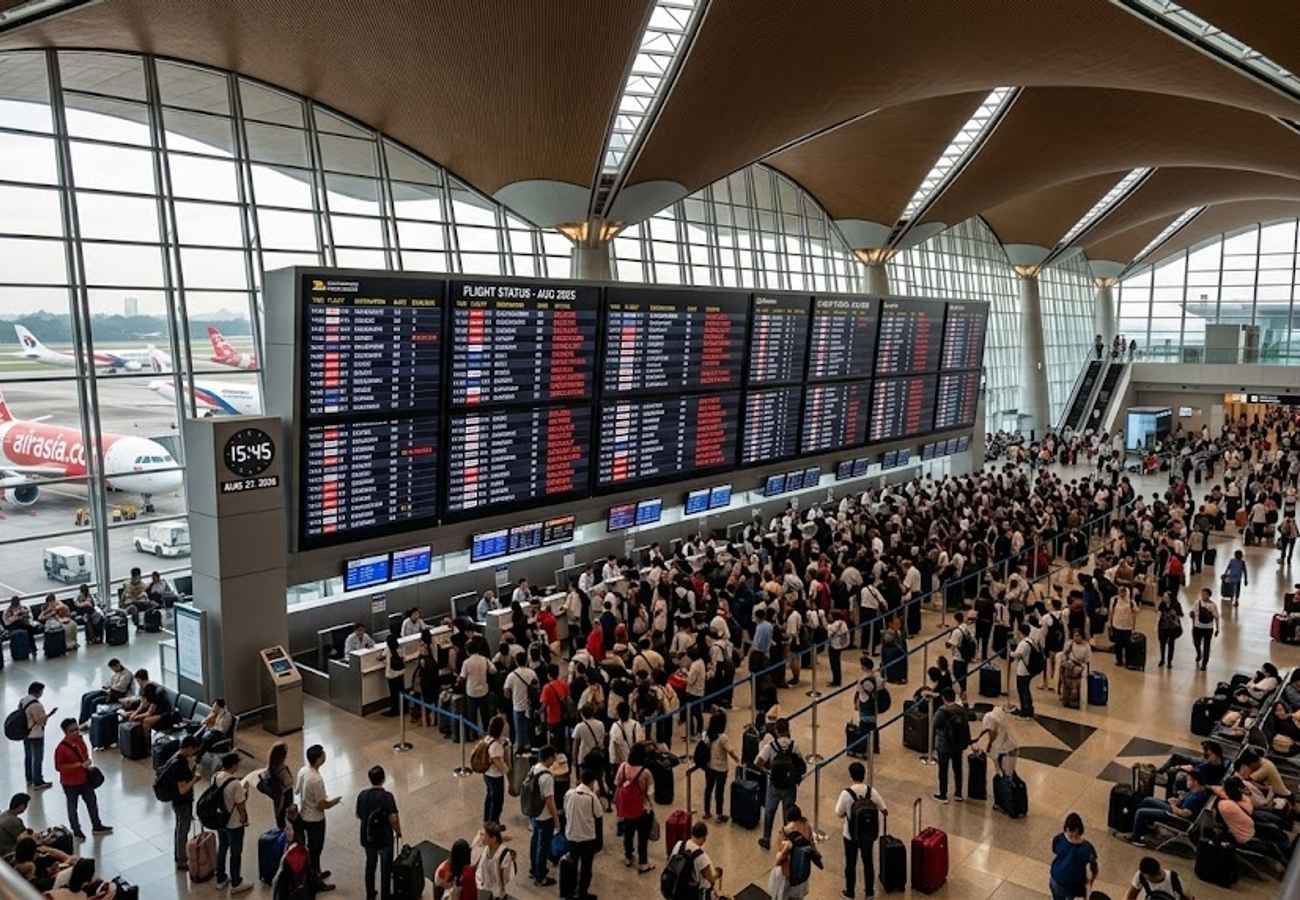
Image generated by AI
A systemic operational failure across more than 20 Asian airports has triggered a regional crisis, with Kuala Lumpur International Airport (KLIA) at the epicenter of 259 cancellations and 3,786 delays.
Systemic Operational Failures Across Asian Hubs
A concentrated wave of aviation disruptions has paralyzed transit across Asia, impacting key gateways in China, Japan, Malaysia, Indonesia, and India. According to aggregated airport data and disruption trackers, the latest cycle recorded 259 flight cancellations and 3,786 delays. The scale of this event follows a pattern of volatility seen earlier in the year; for instance, a regional disruption event in June 2026 resulted in approximately 1,440 individual disruptions.
The crisis is primarily centered at Kuala Lumpur International Airport, a critical node for both low-cost carriers and full-service airlines. Due to its status as a "mega hub"—ranking second only to London Heathrow in certain global connectivity metrics for same-day connections—any operational friction at KLIA creates a cascading effect across the entire Asia-Pacific region.
Operational data indicates that the current instability is not the result of a single failure but a convergence of four primary drivers:
- Adverse weather systems.
- Air traffic and slot constraints.
- Complex aircraft rotation schedules.
- Mandatory technical checks.
Impacted Routes and Carrier Specifications
The disruptions have hit both regional short-haul flights and long-haul international services. AirAsia, which manages roughly one-third of all movements at KLIA, and Malaysia Airlines have been most heavily impacted.
The following table outlines the primary affected hubs and the specific high-traffic routes experiencing the most significant volatility:
| Affected Hub | Key Impacted Carriers | Primary Disrupted Routes | Status |
|---|---|---|---|
| Kuala Lumpur (KLIA) | AirAsia, Malaysia Airlines | London, Melbourne, Sydney, Istanbul, Busan, Shanghai, Bali | High Volatility |
| Beijing Capital | Air China | Kuala Lumpur, Regional Asia | Moderate to High |
| Shanghai Pudong | China Eastern | Kuala Lumpur, Southeast Asia | Moderate to High |
| Jakarta (Soekarno Hatta) | Batik Air, Regional Carriers | Kuala Lumpur, Domestic Indonesia | Moderate |
| Bangkok (Suvarnabhumi) | Thai Airways | Mainland China, Regional Holiday Spots | Moderate |
| Other Regional Hubs | IndiGo, ANA Wings | India-ASEAN corridors, Japan-ASEAN | Variable |
Despite this spike, long-term punctuality reports suggest that KLIA’s general performance remains strong, with some routes maintaining delay performance better than 90% of comparable global flights. This indicates the current crisis is a concentrated episode rather than a systemic collapse of reliability.
Traveler Logistics Guide: Navigating Hub Chaos
From a ground-level perspective, the best way to navigate these disruptions is to shift from relying on airport monitors to utilizing real-time digital telemetry. When a mega hub like KLIA experiences a "cluster" of delays, rebooking desks become bottlenecks.
Optimal Connection Strategies:
- Layover Buffers: In the current climate of 2026, a minimum connecting time (MCT) of 3 hours is recommended for KLIA and Suvarnabhumi to account for rotation delays.
- Digital Transit Policies: Passengers should ensure their travel documents are updated via digital portals (such as Malaysia's MDAC or similar regional e-gates) to expedite movement once a delayed flight finally lands.
- Documentation for Redress: If you are delayed, document the specific cause provided by the airline. Keep all receipts for meals and accommodation.
Understanding Compensation Rights: Passenger rights vary wildly across Asia. While flights departing from the EU or operated by EU carriers fall under EU Regulation 261 (offering up to 600 euros in compensation), most Asian carriers operate under local civil aviation laws which may only provide basic care (meals and hotels) rather than cash compensation. Review your travel insurance policy specifically for "Travel Delay" or "Trip Interruption" clauses to recover costs.
Infrastructure and Regional Connectivity Assessment
The current disruption highlights the inherent vulnerability of the "hub-and-spoke" model employed by Southeast Asian aviation. Because KLIA serves as the primary gateway for North Asia, the Middle East, and Australia, a failure in Malaysia's flight information region creates a vacuum in connectivity for three continents.
While air traffic management reports indicate that message volumes and international routings remain within standard parameters, the intersection of crew rotations and airport capacity constraints suggests that the system is operating at a ceiling. As demand for travel between Asia, Europe, and Oceania remains strong, these "concentrated disruption days" are likely to become more frequent during peak periods.
The volatility of Asia's mega-hubs underscores the necessity for flexible ticketing in an era of high-density airspace.
Related Travel Guides
Disclaimer
This article is for informational and educational purposes only. It does not constitute legal, financial, or professional advice. While we strive to provide accurate and up-to-date information, travel policies, regulations, and conditions change rapidly. Always verify information with official sources before making travel decisions. Nomad Lawyer makes no representations about the accuracy, reliability, completeness, or suitability of the information provided. Readers should consult qualified professionals for advice specific to their circumstances. The views expressed in this article are those of the author and do not necessarily reflect the views of Nomad Lawyer.
Raushan Kumar
Founder & Lead Developer
Full-stack developer with 11+ years of experience and a passionate traveller. Raushan built Nomad Lawyer from the ground up with a vision to create the best travel and law experience on the web.
Learn more about our team →