
Los Angeles Airport Gripped by Travel Chaos as Massive 99-Flight Disruption Wave Strands Southwest and Transpacific Passengers: Latest Airline News
The West Coast aviation corridor is fracturing as Los Angeles International Airport suffers a massive operational collapse, recording 95 delays and 4 cancellations that are destroying routes to Japan, Taiwan, and Canada.

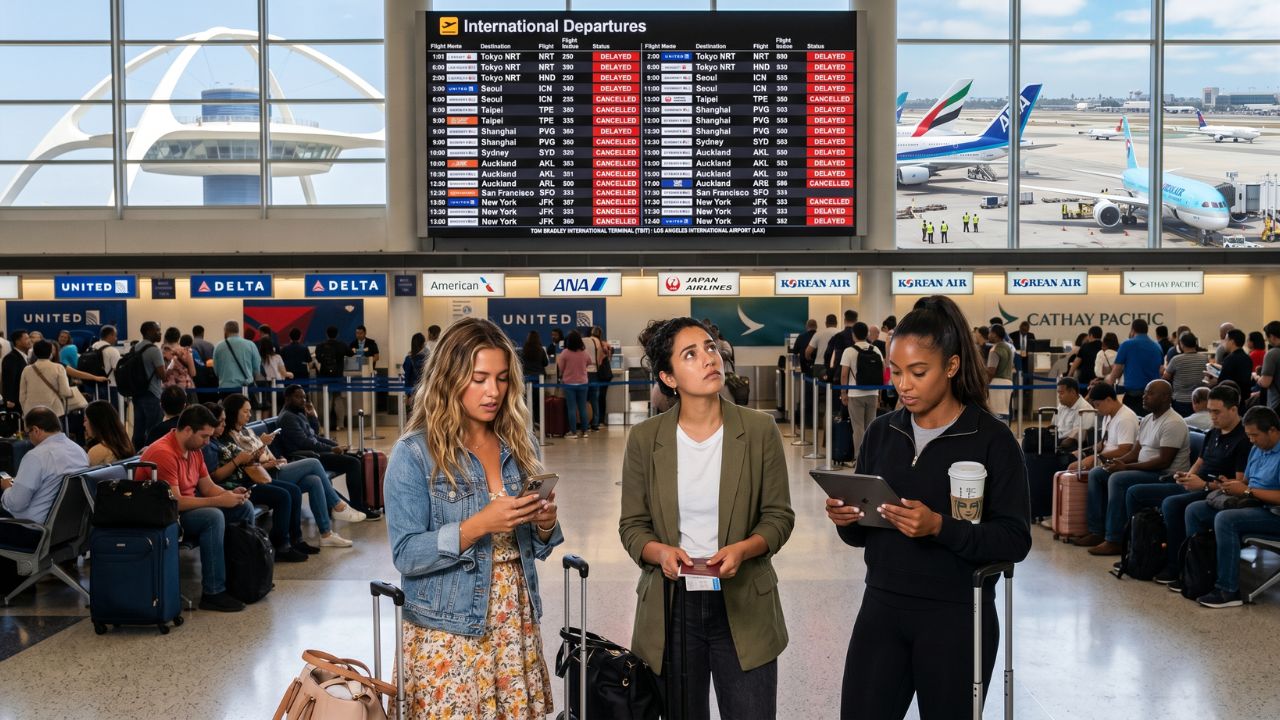
Image generated by AI
In a highly destructive operational breakdown that is currently tearing through the absolute core of the West Coast aviation infrastructure, thousands of global and domestic passengers have been completely stranded following a catastrophic wave of airport disruptions at Los Angeles International Airport (LAX). According to official flight data for the current reporting period, a sudden cascade of extreme ground backlogs and northern marine fog has resulted in a staggering 95 flight delays and 4 outright cancellations. As airlines desperately scramble to reset their routing, severe travel chaos is ravaging the schedules of major carriers, specifically impacting Southwest, All Nippon Airways, XiamenAir, American Airlines, and Korean Air. With critical transpacific and regional routes bound across the United States, Canada, Japan, Taiwan, China, and New Zealand suffering massive interruptions, this systemic capacity failure represents the premier headline in today's breaking airline news and critical global aviation updates.
By introducing direct passenger coordination and dynamic scheduling backups, the regional aviation hubs target growing passenger demand across vital commerce sectors. The choice to coordinate flight departures in phases helps to manage gate capacity, supporting the country's broader regional transportation network.
Context: The Collapse of the Transpacific Gateway
Los Angeles International Airport operates as the undisputed gateway connecting North America to the massive Asian and Pacific travel markets.
Because the facility handles incredibly dense volumes of international wide-body traffic alongside a massive domestic feeder network, any operational friction instantly generates a global ripple effect. The current 99-flight breakdown was triggered by a toxic combination of dense marine fog up the California coast—which severely restricted regional air traffic flow—and incredibly tight transpacific turnaround windows. When an inbound aircraft from Tokyo or Taipei arrives late, the airline lacks the time to clean, refuel, and re-crew the jet before its scheduled outbound departure. This dynamic creates a chaotic domino effect. For the thousands of stranded travelers, this translates directly into blown layovers, ruined vacations, and massive logistical nightmares as customer service desks become overrun with passengers demanding rebooking.
To view live flight schedules, real-time terminal maps, or specific delay protocols at the primary Californian gateway, travelers must consult the official Los Angeles International Airport (LAX) directory. For direct booking access, specific baggage rules, and delay compensation protocols, passengers should check the official Southwest Airlines portal or their respective operating carrier. To explore live flight tracking and monitor the exact severity of the transpacific airspace congestion, passengers can consult the official FlightAware tracking service.
Section-Wise Breakdown of the LAX Meltdown
The Domestic Volume Carnage
Domestic high-volume carriers absorbed the absolute largest sheer volume of delays. Southwest Airlines saw the highest total impact with a massive 22 delayed flights, accounting for 15% of its overall operations. Legacy carriers followed closely, with American Airlines logging 11 delays (5%) and Delta Air Lines taking 10 delays (4%). However, the most severe domestic structural damage occurred at the regional commuter level. SkyWest Airlines, which operates vital regional connections for several major network carriers, logged 3 crippling cancellations alongside 5 delays, severing critical outstation connectivity to smaller markets like Aspen (ASE) and Humboldt County (ACV).
The Transpacific Inbound Logjam
The international terminal suffered extreme systemic delays arriving from Asia. In Japan, Tokyo Haneda (HND) saw a brutal 57% of its LAX-bound flights delayed (4 flights), while Narita (NRT) logged a 37% inbound delay rate. Taiwan Taoyuan (TPE) matched Haneda's struggle with a 57% delay rate. The congestion hit multiple carriers with extreme severity: Japan Airlines and Sichuan Airlines both logged a stark 100% delay rate on their active LAX schedules. Air New Zealand suffered massive disruptions, taking delays on 66% of its scheduled service.
The Northern California Bottleneck
The busiest commuter corridor on the West Coast proved to be today’s primary domestic pain point. San Francisco International Airport (SFO) acted as a massive regional bottleneck due to marine fog, directly triggering 6 inbound delays to LAX and heavily delaying 8 outbound flights departing LAX for SFO (representing 20% of that outbound route's entire schedule). Furthermore, flights departing LAX toward the Pacific Northwest saw Seattle (SEA) and Vancouver (YVR) both suffer hard cancellations.
Technical Roster: Los Angeles Disruption Matrix
To ensure absolute factual accuracy regarding the immense scale of this West Coast aviation failure, the following table details the core operational metrics and the specific market impacts generated by the LAX breakdown:
| Airline / Operating Carrier | Operational Disruption Metric | Global Travel Market Impact |
|---|---|---|
| Southwest Airlines | 22 Delays (15% of Schedule) | Massive volume delays paralyzing domestic West Coast commuter routes |
| SkyWest / Air Canada | 3 Cancellations / 1 Cancellation | Severs critical regional outstation connectivity and Canadian routes |
| Japan / Sichuan Airlines | 100% Delay Rate | Total schedule disruption destroying inbound transpacific connectivity |
| Air New Zealand | 2 Delays (66% of Schedule) | Extreme friction injected into long-haul flights bound for Auckland |
| American / Delta / United | 27 Combined Delays | Hub operations fractured due to domestic cascading ground backlogs |
| ANA / Asiana / XiamenAir | 25% to 50% Delay Rates | Paralyzes premium long-haul flights connecting LAX to the Asian market |
Passenger Impact: Stranded on the Pacific Rim
For the thousands of global passengers currently trapped inside the Tom Bradley International Terminal at LAX, the logistical reality is incredibly grim.
Because transpacific flights require massive wide-body aircraft and operate only once or twice a day, a missed connection is mathematically devastating. Passengers arriving domestically from Dallas (DFW) or Chicago (ORD) who intended to connect onto a Japan Airlines flight to Tokyo are now trapped. If an international flight is severely delayed, passengers face grueling overnight waits on terminal floors because rebooking onto a competitor's transpacific flight is virtually impossible during peak summer demand. Furthermore, physical customer service desks at LAX are currently surrounded by hundreds of furious passengers, making in-person rebooking an exhausting, multi-hour ordeal.
Industry Analysis: The Fragility of the Turnaround
Aviation industry analysts view the 99-flight breakdown at Los Angeles International Airport as a textbook example of the extreme vulnerability inherent in modern transpacific scheduling.
Airlines aggressively minimize the time an international wide-body jet spends parked at a gate to maximize revenue. Analysts note that when marine fog in San Francisco delays inbound domestic feeder flights, the international wide-body jets at LAX are forced to wait at the gate for those connecting passengers. This delay rapidly consumes the aircraft's tight "turnaround window." If the flight crew's legally mandated duty hours expire while waiting, the airline faces an operational timeout, forcing a massive cancellation. Until airlines pad their transpacific schedules with realistic, robust turnaround times to absorb these regional shocks, passengers routing through LAX will remain highly exposed to these devastating cascading delays.
Actionable Advice for Surviving the LAX Chaos
If you are a traveler with an active itinerary routing through Los Angeles International Airport during this massive disruption wave, execute this extreme survival checklist immediately:
- Leverage Airline Mobile Apps First: Avoid the massive lines at the airport customer service desks. If your SkyWest or Air Canada flight is canceled, use your airline's mobile app to automatically rebook onto the next available flight or to claim electronic hotel and meal vouchers instantly.
- Understand EU261 / International Compensation: If you are flying on a European carrier (like Iberia or LOT Polish Airlines) out of LAX, stringent consumer protection laws may qualify you for massive cash compensation depending on the root cause of the delay. Never accept a low-value airline voucher without checking your legal rights.
- Bypass the San Francisco Bottleneck: Because the LAX-SFO corridor is currently suffering a massive 20% delay rate due to marine fog, do not book connecting flights through SFO today. Request that your agent reroute your itinerary through a less-affected interior hub like Denver or Phoenix to escape the coastal airspace trap.
- Track the Inbound Transpacific Jet: If you are flying out of LAX to Asia, do not rely on terminal departure boards. Use Flightradar24 to physically track your assigned aircraft arriving from Haneda, Narita, or Taipei. Since these inbound flights are experiencing 57% delay rates, your outbound departure will mathematically be delayed as well.
FAQ: Los Angeles Airport Flight Disruptions 2026
How severe are the current flight disruptions at Los Angeles International Airport?
The operational breakdown is massive, with the airport officially recording 95 flight delays and 4 outright cancellations across domestic and international terminals.
Which major airlines are suffering the most severe operational impacts?
Southwest Airlines suffered the highest domestic volume with 22 delays, while international carriers like Japan Airlines and Sichuan Airlines logged brutal 100% delay rates. SkyWest and Air Canada logged outright cancellations.
Which critical transpacific and domestic routes have been disrupted?
The delays have severely fractured inbound and outbound routes spanning the United States (SFO, SEA), Canada (YVR), Japan (HND, NRT), Taiwan (TPE), China (PVG, SZX), and New Zealand (AKL).
The Breaking Point of the Californian Hub
The catastrophic wave of 99 delayed and canceled flights ravaging Los Angeles International Airport proves definitively that the primary transpacific gateway is operating well past its safe structural limits. By devastating both the massive domestic point-to-point operations of Southwest Airlines and the highly lucrative international schedules of Japan Airlines and Air New Zealand, this disruption has ruthlessly exposed the fragility of LAX's tightly wound turnaround windows. As airlines desperately attempt to reset their aircraft rotations and thousands of stranded passengers fight for rebooking, global travelers must brace for a brutal reality: navigating major Californian gateways in 2026 requires extreme flexibility, aggressive contingency planning, and the absolute expectation of severe travel chaos.
Key Takeaways
- Massive 99-Flight Breakdown: Los Angeles International Airport is paralyzed by severe airspace and ground congestion, officially recording 95 delays and 4 flight cancellations.
- Southwest Airlines Volume Delays: The domestic giant bore the absolute brunt of the localized friction, suffering 22 delays that are generating massive knock-on effects nationwide.
- Transpacific Networks Fractured: Premium Asian carriers including Japan Airlines, Sichuan Airlines, and ANA suffered extreme delays, destroying critical inbound connectivity from Haneda, Narita, and Taipei.
- Regional Networks Severed: SkyWest and Air Canada suffered critical flight cancellations, stranding passengers attempting to connect to smaller outstations and Vancouver.
- San Francisco Bottleneck: Marine fog created a massive 20% delay rate on the critical LAX-SFO commuter corridor, actively paralyzing West Coast air traffic flows.
Related Travel Guides
Severe Travel Chaos Paralyzes San Diego Across Major Airlines
Miami Airport Gripped by Travel Chaos as 65-Flight Disruption Strands Passengers
Disclaimer
This article is for informational and educational purposes only. It does not constitute legal, financial, or professional advice. While we strive to provide accurate and up-to-date information, travel policies, regulations, and conditions change rapidly. Always verify information with official sources before making travel decisions. Nomad Lawyer makes no representations about the accuracy, reliability, completeness, or suitability of the information provided. Readers should consult qualified professionals for advice specific to their circumstances. The views expressed in this article are those of the author and do not necessarily reflect the views of Nomad Lawyer.
Kunal K Choudhary
Co-Founder & Contributor
A passionate traveller and tech enthusiast. Kunal contributes to the vision and growth of Nomad Lawyer, bringing fresh perspectives and driving the community forward.
Learn more about our team →