
Flights Cancelled Swept Europe As Rome, Catania, And 10 More Face 151 Cancellations And 1,673 Delays
Flights Cancelled Swept Europe As Rome, Catania, And 10 More Face 151 Cancellations And 1,673 Delays. Latest travel news, updates, and expert analysis.

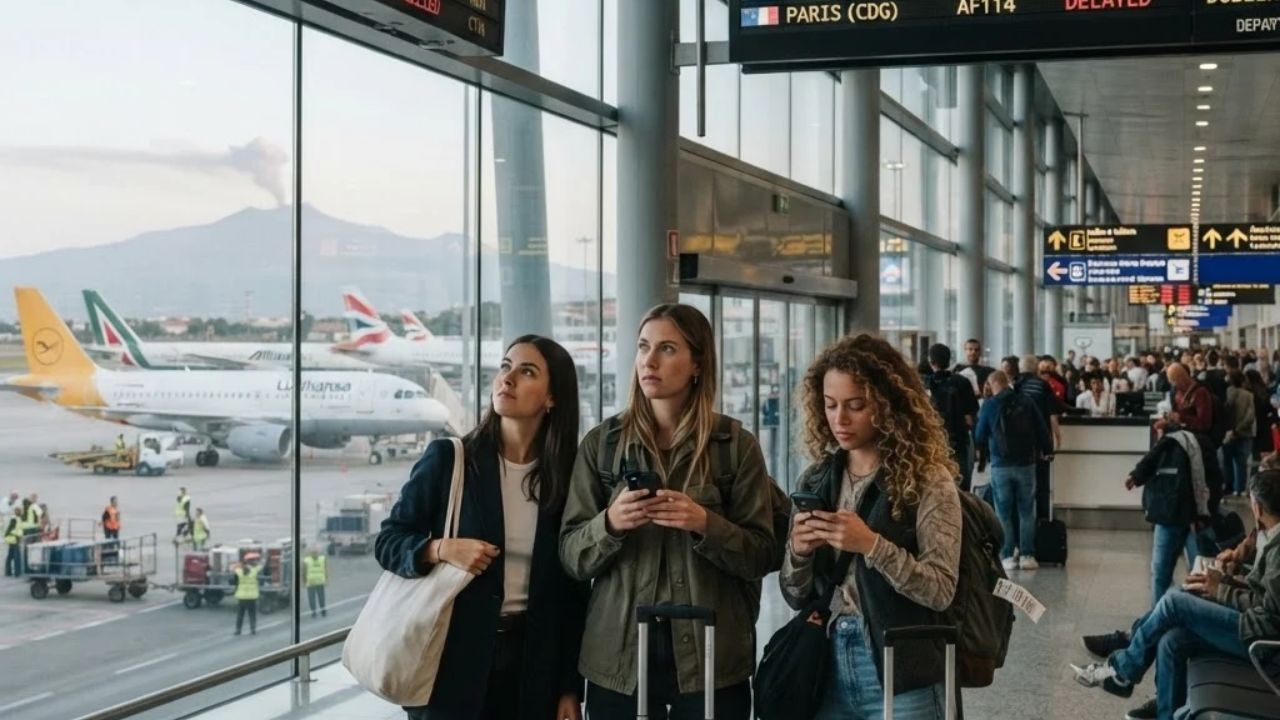
Image generated by AI
While major northern European transit gateways in Amsterdam and Rome buckled beneath cascading schedule friction, it was a towering plume of volcanic ash spewing from Mount Etna over Sicily that triggered the day's sharpest aviation shutdown. Across the continent on 14 September 2026, aviation tracking data recorded 1,673 flight delays and 151 cancellations spanning 12 primary airports in Germany, the United Kingdom, Spain, Italy, France, and the Netherlands. At Catania-Fontanarossa Airport, ongoing volcanic activity from Europe's most active stratovolcano forced authorities to suspend all flight operations initially until 4:00 PM before extending the closure to 10:00 PM, wiping out 71 flights and stranding travelers beneath rain clouds of volcanic cinder.
Mount Etna and Air Traffic Bottlenecks: Unpacking Europe's 1,824 Flight Disruptions
The disruption sweeping European skies on 14 September reflected a volatile combination of geological phenomena and heavy airspace congestion. Catania-Fontanarossa suffered the continent's most acute concentrated impact, logging 26 delays alongside 71 cancellations as abrasive airborne silica threatened jet engine turbines. Low-cost carrier Ryanair bore the heaviest cancellation brunt in Sicily with 21 grounded services, while Italy's flag carrier ITA Airways recorded nine cancellations at the airfield.
Simultaneously, severe air traffic management delays rippled through northern and western Europe's primary international hubs. Amsterdam Schiphol registered the continent's highest delay total at 297, alongside 14 cancellations. Dutch flag carrier KLM absorbed 155 delays and 12 cancellations at Schiphol, while budget operator easyJet recorded 30 delays, leaving 20% of the airport's outbound flights and 19% of inbound arrivals running behind schedule.
In Italy, Rome Fiumicino logged 226 delays and 13 cancellations, with ITA Airways registering 86 delays and nine cancellations, and Ryanair tracking 26 delays and three cancellations. In France, Paris Charles de Gaulle recorded 207 delays and nine cancellations, with Air France registering 74 delays and easyJet logging 34 delays and four cancellations. Across the English Channel, London Gatwick tracked 160 delays and seven cancellations (with easyJet absorbing 81 delays), while London Heathrow posted 148 delays and four cancellations, heavily impacting British Airways with 71 delays.
In Germany, Munich Airport recorded 156 delays and five cancellations (including 62 Lufthansa delays), Berlin-Brandenburg logged 95 delays and five cancellations, and Düsseldorf tracked 87 delays and seven cancellations driven by Eurowings. Spain’s Madrid-Barajas posted 146 delays and four cancellations, Milan Malpensa recorded 108 delays and eight cancellations, and Turin Caselle rounded out the regional tally with 17 delays and four cancellations. Across all airports, easyJet logged the highest combined airline delay figure at 213 alongside 32 cancellations, while Ryanair recorded 85 delays and 27 cancellations.
What Makes Catania and the Shadow of Mount Etna Magnetic
For travelers delayed in Sicily, waiting out volcanic flight suspensions offers an impromptu immersion into one of the Mediterranean's most extraordinary cultural territories.
Mount Etna, designated as a natural UNESCO World Heritage Centre site, is not simply a geological hazard; it is the living beating heart of eastern Sicily. Rising more than 3,300 meters above the Ionian Sea, its volcanic eruptions have shaped Sicilian architecture, agriculture, and mythology for millennia. Catania itself is built largely from dark volcanic basalt. Following the catastrophic eruption and earthquake of 1693, the city was rebuilt in exuberant Sicilian Baroque style, featuring wide lava-paved boulevards like Via Etnea, where every street vista frames the smoking, snow-dusted cone of the volcano in the distance.
Strolling through Catania’s Piazza del Duomo reveals the city’s beloved symbol: the Fontana dell'Elefante, an ancient Roman elephant carved from black lava rock carrying an Egyptian granite obelisk on its back. Steps away lies the historic A Piscaria (fish market), where shouting fishmongers slice massive swordfish and shuck briny sea urchins on wet marble slabs beneath red canvas awnings. In the shadow of an active volcano, daily life moves with an infectious, theatrical passion that turns unexpected travel delays into unforgettable memories.
Visitor Insider Tips: Rerouting Around Volcanic Closures and Savoring Sicily
- Reroute Through Alternative Sicilian Hubs: If Catania-Fontanarossa (CTA) closes due to Etna's ash cloud, do not wait aimlessly at the terminal. Major airlines frequently divert flights or arrange motorcoaches to Falcone Borsellino Airport in Palermo (PMO) on the northern coast, or Comiso Airport (CIY) in the south. Regular express coaches operated by SAIS Autolinee connect Catania central station to Palermo in two and a half hours for approximately €14.
- Experience the Historic Messina Train Ferry: If flights across southern Italy are grounded, take the train. Board a Trenitalia Intercity or Frecciarossa service from Catania Centrale. At Messina, the entire passenger train is shunted directly onto a massive maritime ferry to cross the Strait of Messina to Villa San Giovanni on the Italian mainland, allowing passengers to step onto the ship's open deck for panoramic sea views before the train continues to Naples and Rome.
- Know Your EC 261 Rights During Natural Events: Under European passenger rights regulations, volcanic ash is categorized as an "extraordinary circumstance," meaning airlines are exempt from paying cash compensation for cancellations. However, the airline's "duty of care" remains legally mandatory: carriers must provide complimentary hotel lodging, ground transit, meals, and free rebooking onto the next available flight. Keep all food and accommodation receipts.
- Base Yourself in Historic Quarters: If grounded overnight in Catania, avoid sterile roadside airport motels. Head to the historic center near Piazza Teatro Massimo or Via Crociferi. Boutique guesthouses housed inside 18th-century palazzi offer frescoed ceilings, stone balconies, and peaceful courtyards within walking distance of wine bars.
- Savor Authentic Catanese Gastronomy: Turn a delay into a feast of regional culinary icons promoted by Italia.it. Order a plate of authentic pasta alla Norma—rigatoni tossed with rich tomato sauce, crispy fried eggplant cubes, fresh basil, and generous shavings of salted baked ricotta (ricotta salata). In the morning, breakfast like a true Sicilian with an icy almond granita paired with a warm, brioche pastry (granita con brioce).
Cultural and Environmental Context: Living in Harmony With an Active Volcano
The recurring dance between modern aviation and Mount Etna highlights the delicate balance between high-tech transit networks and dynamic natural forces. Volcanic ash is composed of microscopic pulverized rock, glass, and mineral crystals; when sucked into jet engines operating at extreme combustion temperatures, the ash melts into molten glass, coating turbine blades and triggering catastrophic engine stalls. Precautionary airport closures, while frustrating for schedules, are essential safety measures that aviation authorities enforce without compromise.
Yet for local Sicilians, Etna (Muncibbeḍḍu) is revered as a benevolent mother rather than a destructive monster. Volcanic ash and weathered basalt enrich the surrounding soil with potassium, phosphorus, and iron, creating an agricultural paradise. The slopes of Etna yield world-renowned mineral-rich wines made from native Nerello Mascalese grapes, sweet blood oranges, and the green pistachios of Bronte. By respecting the natural temperament of the volcano and embracing slow travel across the Mediterranean, voyagers witness how human culture has adapted to thrive alongside the Earth’s elemental power.
FAQ: Navigating European Flight Disruptions and Mount Etna 2026
Why does Mount Etna volcanic ash cause flight cancellations at Catania Airport? Volcanic ash contains microscopic abrasive silica crystals that melt inside hot jet engines, causing turbine failure, and scratch cockpit windshields, making flying dangerous until the ash cloud disperses and runways are swept clean.
Do airlines provide hotels when flights are canceled due to volcanic ash? Yes. Under European Regulation EC 261/2004, while airlines do not pay cash compensation for volcanic eruptions, they are legally required to provide free hotel accommodation, meals, and alternative transport.
How can I travel between Sicily and Rome if flights are canceled? You can take a Trenitalia Intercity or high-speed Frecciarossa train from Catania Centrale directly to Roma Termini. The train rolls directly onto a specialized ship ferry to cross the Strait of Messina.
Which airport in Europe suffered the most flight delays during this disruption? Amsterdam Schiphol recorded the highest delay total in Europe with 297 delayed flights, heavily impacting Dutch flag carrier KLM.
When elemental nature pauses the frenetic pace of European aviation, Sicily invites travelers to slow down and savor the timeless art of living.
Related Travel Guides
- AirBaltic Restructuring Sparks Europe Airline Warning as Wizz Air and Others Face Tough Financial Challenges
- Turkey Stuns Global Aviation With Istanbul Airport’s New Runway Set to Reshape Flights, Cut Travel Times and Boost Its Global Hub Power
- Emirates Brings Premium Economy to France With Retrofitted A380 From October 25, 2026
Disclaimer
This article is for informational and educational purposes only. It does not constitute legal, financial, or professional advice. While we strive to provide accurate and up-to-date information, travel policies, regulations, and conditions change rapidly. Always verify information with official sources before making travel decisions. Nomad Lawyer makes no representations about the accuracy, reliability, completeness, or suitability of the information provided. Readers should consult qualified professionals for advice specific to their circumstances. The views expressed in this article are those of the author and do not necessarily reflect the views of Nomad Lawyer.
Raushan Kumar
Founder & Lead Developer
Full-stack developer with 11+ years of experience and a passionate traveller. Raushan built Nomad Lawyer from the ground up with a vision to create the best travel and law experience on the web.
Learn more about our team →