
Korean Air Maps a 92-Destination Global Network Through Seoul, Linking Asia, Europe and the Americas
Korean Air Maps a 92-Destination Global Network Through Seoul, Linking Asia, Europe and the Americas

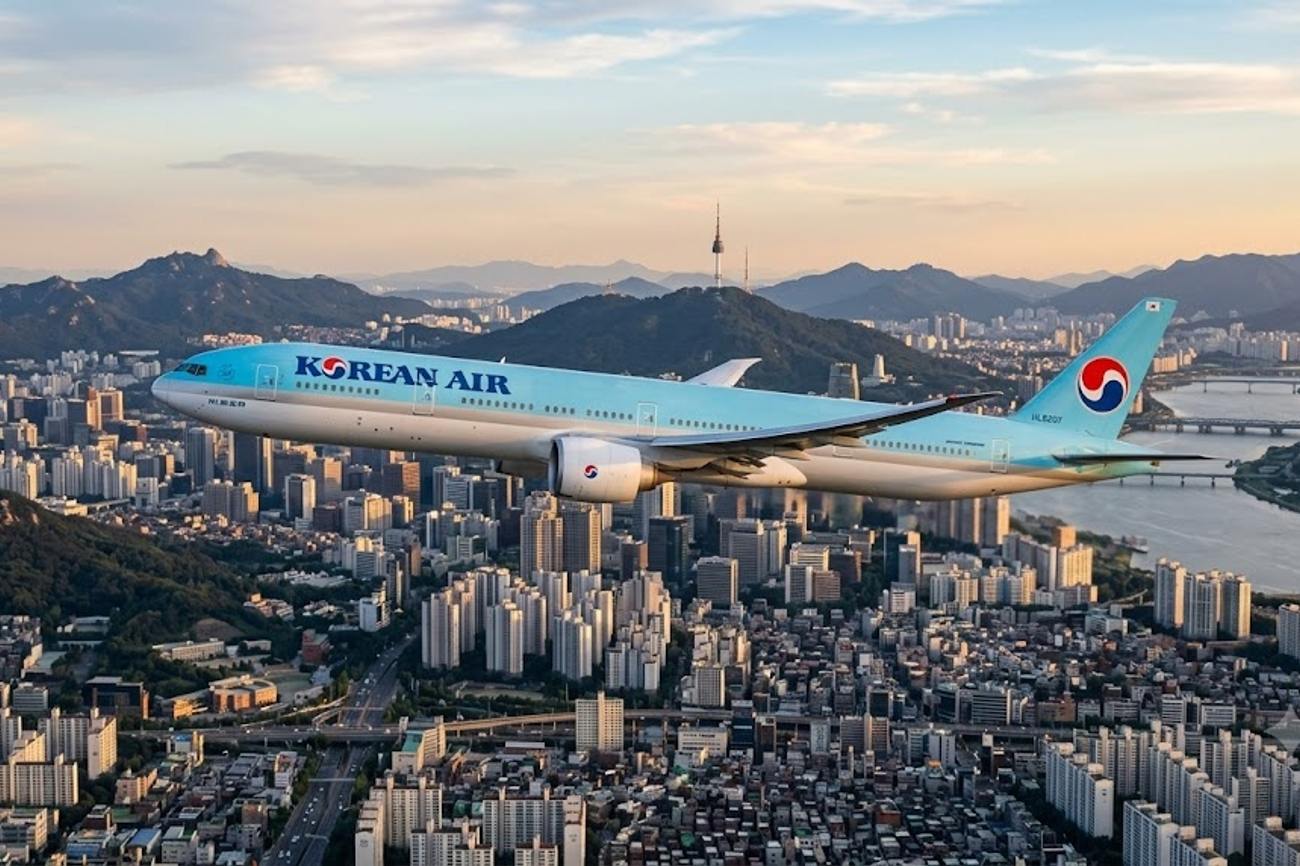
Image generated by AI
title: "The Incheon Pivot: Analyzing Korean Air's Network Expansion and Seoul's Rise as a Global Transit Hub" date: 2025-05-20 tags: [Incheon-Passenger-Growth-2025, Korean-Air-Network-Analysis, Northeast-Asia-Transit-Trends, SkyTeam-Hub-Dynamics] Incheon International Airport recorded a massive 74.07 million total passengers in 2025, with international traffic alone reaching 73.55 million—a volume that positions Seoul as a direct competitor to the world's most established transit hubs. This surge in throughput is not merely a recovery of pre-pandemic volumes but a structural shift in how transpacific and Eurasian traffic is routed, with Korean Air acting as the primary engine for this growth.
The Seoul Hub in Numbers: Network Density and Reach
The current operational data for Korean Air reveals a highly diversified international web comprising 92 international destinations across 34 countries. When combined with its 10 domestic destinations, the carrier manages a total of 102 departure airports globally. While the destination count is impressive, the real story lies in the passenger flow data from Incheon, which highlights a heavy reliance on the "Asian Core."
In 2025, the distribution of international passenger traffic at Incheon showed a clear regional preference:
- Southeast Asia: 19.79 million passengers (26.7% of total international traffic)
- Japan: 18.58 million passengers (25.1% of total international traffic)
- China: 12.36 million passengers (16.7% of total international traffic)
This data indicates that over 68% of Incheon's international traffic is concentrated within these three Asian markets. This density allows Korean Air to leverage Seoul not just as a destination, but as a high-frequency switching station for travelers moving between the Americas, Europe, and secondary Asian cities. According to IATA, such hub-and-spoke efficiency is the primary driver for airline profitability in the current high-fuel-cost environment.
Comparative Context: Seoul vs. Global Transit Benchmarks
The evolution of Seoul Incheon is best understood when compared to other "super-hubs" like Singapore Changi. By the end of 2025, Incheon offered connections to 159 international cities, reaching parity with Changi in a CAPA comparison cited by the Incheon Airport Corporation. This represents a significant shift in the competitive landscape of Southeast and Northeast Asia.
Historically, transpacific travel was dominated by hubs in Tokyo or Hong Kong. However, the current data shows a strategic pivot toward Seoul, supported by Korean Air's aggressive expansion into the US and European markets.
| Metric | Korean Air / Incheon (2025) | Regional Benchmark (Typical Hub) | Trend Direction |
|---|---|---|---|
| Total Annual Passengers | 74.07 Million | 60-80 Million | Increasing |
| International Destinations | 92 (Carrier specific) | 70-110 | Expanding |
| Global City Connectivity | 159 Cities | 150-170 | Parity Reached |
| Primary Market Share | 26.7% (SE Asia) | 20-30% | Stable |
The carrier's approach to Europe differs fundamentally from its Asian strategy. While Asia is characterized by "density" (e.g., 15 airports in Japan), Europe is characterized by "strategic gateways." By targeting 13 key cities including London Heathrow, Paris Charles de Gaulle, and Frankfurt, Korean Air is optimizing for high-yield business traffic and major transfer points rather than exhaustive regional coverage. This is a mirrored strategy often seen in Statista's analysis of long-haul carrier efficiency, where focusing on primary hubs reduces operational overhead while maintaining market reach.
Practical Traveler Advisory and Strategic Insights
For the individual traveler, the data suggests that Seoul is now a viable, and often superior, alternative to traditional hubs for three specific types of itineraries:
- The "Deep Asia" Route: If you are traveling from North America or Europe to secondary cities in Vietnam (such as Da Nang or Nha Trang) or Indonesia (Denpasar), routing through Seoul is now more efficient. The high density of the Asian core means fewer connection options and shorter layovers.
- The Transpacific Bridge: With 11 US destinations and 2 Canadian cities (Toronto and Vancouver), the North American network is robust. Specifically, travelers to the US Southeast should note the high frequency to Atlanta; the 2026 schedule shows two daily Incheon–Atlanta services from 11 May through 31 August. This frequency reduces the "risk" of a missed connection and provides significantly more flexibility than routes operating only 3-4 times per week.
Korean Air leverages its primary hub at Incheon International Airport to facilitate seamless transfers between its extensive networks in Asia, Europe, and North America. This strategic positioning allows passengers to utilize world-class transit facilities while connecting to 92 global destinations. 3. Oceania-Asia Links: The ability to book Melbourne–Seoul services as far out as September 2026 indicates long-term stability on the Oceania route. For travelers in Sydney, Melbourne, or Brisbane, Seoul serves as a streamlined gateway into the European and North American markets without needing to transit through Singapore or Dubai.
Booking Advice: Given the record passenger volumes (74.07 million), Incheon is becoming increasingly crowded. Travelers should prioritize "minimum transfer time" checks when booking through Seoul, as the sheer volume of passengers can impact transit efficiency during peak windows.
Forward Projection: The 2026 Trajectory
Based on the current trajectory, Korean Air is moving toward a "Hyper-Hub" model. The transition from 92 international destinations to a broader global footprint is likely to focus on increasing frequency rather than just adding new cities. The Atlanta example—doubling daily flights—is the blueprint for 2026.
We can expect a continued shift in market share away from traditional Northeast Asian hubs as Incheon leverages its 159-city connectivity. If the growth rate of the Southeast Asian corridor (currently at 26.7% of traffic) continues, we will likely see Korean Air add more "tertiary" cities in Thailand and the Philippines to capture the growing middle-class travel market in those regions. Furthermore, the parity with Singapore Changi suggests that Incheon is no longer just a regional player but a global contender for the title of the world's most efficient transit point.
FAQ: Seoul Transit Trends 2025-2026
Will flight prices increase due to record passenger numbers at Incheon? Not necessarily. While 74.07 million passengers indicate high demand, the increased frequency of flights (such as the double-daily Atlanta service) increases seat capacity, which can stabilize or even lower prices through competitive pricing.
Is Seoul a better connection point than Tokyo or Hong Kong? For travelers heading to Southeast Asia or the US East Coast, the data suggests yes. With 159 international city connections, Incheon currently matches the connectivity of Singapore Changi, offering a more streamlined transit experience for long-haul routes.
Which airlines are expanding most aggressively through Seoul? Korean Air remains the dominant force, utilizing its SkyTeam alliance to funnel traffic into 34 countries. However, the overall airport growth to 159 cities shows that a diverse ecosystem of partner carriers is expanding alongside the flagship carrier.
When is the best time to book flights via Seoul for 2026? For high-frequency routes like Melbourne–Seoul or Incheon–Atlanta, booking 6-9 months in advance is recommended. The 2026 schedules are already appearing on booking platforms, indicating that capacity is being locked in early.
The data is clear: Seoul is no longer just a stopover—it is the new center of gravity for global aviation.
Related Travel Guides
Disclaimer
This article is for informational and educational purposes only. It does not constitute legal, financial, or professional advice. While we strive to provide accurate and up-to-date information, travel policies, regulations, and conditions change rapidly. Always verify information with official sources before making travel decisions. Nomad Lawyer makes no representations about the accuracy, reliability, completeness, or suitability of the information provided. Readers should consult qualified professionals for advice specific to their circumstances. The views expressed in this article are those of the author and do not necessarily reflect the views of Nomad Lawyer.
Kunal K Choudhary
Co-Founder & Contributor
A passionate traveller and tech enthusiast. Kunal contributes to the vision and growth of Nomad Lawyer, bringing fresh perspectives and driving the community forward.
Learn more about our team →