
Korean Air Flight Delays Explained: How Weather and Airport Congestion Disrupt South Korea Travel
Korean Air Flight Delays Explained: How Weather and Airport Congestion Disrupt South Korea Travel

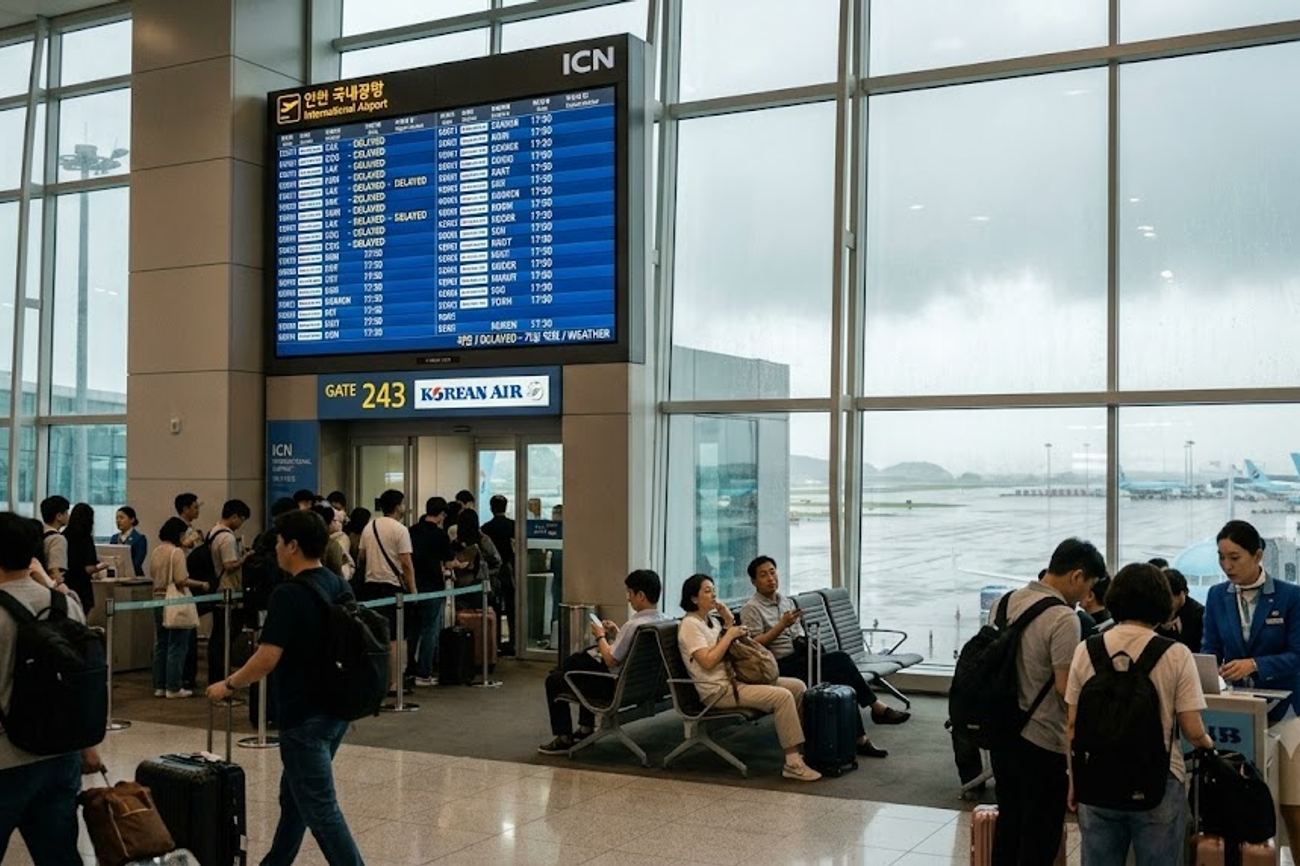
Image generated by AI
[Seoul, June 2026] — Korean Air is navigating a high-pressure operational environment at Seoul Incheon International Airport, where a surge in passenger traffic and aircraft movements is intensifying the "domino effect" of flight disruptions. New data reveals that the scale of Incheon's operations—handling 74.07 million passengers and 425,760 aircraft movements in 2025—creates a complex chain where a single delay in one sector can cascade across an entire international network.
The current operational climate is defined by a tightening window for aircraft turnarounds. When an inbound flight arrives late, it shrinks the critical time allocated for refueling, cleaning, catering, and baggage handling. This systemic pressure is mirrored in global aviation trends; according to the U.S. Bureau of Transportation Statistics (BTS), late-arriving aircraft operations recorded 32,942 instances through June 2026, resulting in more than 2.27 million minutes of total delay.
The Incheon Volume Surge
The immediate cause of increased operational fragility is the sheer volume of traffic flowing through South Korea's primary gateway. The growth at Seoul Incheon is not merely incremental but represents a significant scaling of logistics.
In 2025, aircraft movements at Incheon climbed to 425,760, a 3.0% increase over the 413,200 movements recorded in 2024. Simultaneously, passenger volume rose by 4.1%, jumping from 71.16 million to 74.07 million. This growth puts immense pressure on the coordination between runways, gates, and ground crews.
The monthly volatility highlights the peak-load challenges:
- August 2025: 37,553 aircraft movements and 6.60 million passengers.
- December 2025: 37,318 aircraft movements and 6.57 million passengers.
While cargo remained stable at 2.95 million tonnes across both years, the increase in passenger-carrying flights means Korean Air and other carriers are operating with less margin for error. Any disruption in the sequence of these 425,760 movements can lead to immediate delays for connecting passengers.
Affected Travelers, Airlines and Logistics
The impact of these systemic delays is not distributed evenly but follows the path of aircraft rotations and regional weather patterns.
| Impact Category | Specific Driver | Result for Passenger |
|---|---|---|
| Long-Haul Routes | Late-arriving aircraft from previous sectors | Delayed boarding and pushback |
| Regional Asian Hubs | Typhoons in Japan or Taiwan | Rotation disruptions despite clear skies in Seoul |
| U.S. Bound Flights | FAA National Airspace System congestion | Holding patterns and arrival delays |
| Connecting Passengers | Reduced turnaround windows | Missed connections and rebooking needs |
For those flying Korean Air, the risk is highest during the peak months of August and December. Because the airline operates as a hub-and-spoke model out of Incheon, a delay on a regional flight from a neighboring city can prevent a long-haul aircraft from departing on time for North America or Europe.
Practical Traveler Advisory and Strategic Insights
For the average passenger, these statistics translate into a reality where the cause of a delay is often invisible. You may be sitting at a gate in Seoul with perfect weather and a fully functional aircraft, yet your flight is delayed because the plane is "carrying yesterday's disruption."
Plain-Language Impact Assessment:
- The "Ghost" Delay: Your flight may be delayed even if there are no mechanical issues or local weather problems. If the aircraft coming from a previous destination was late, your departure is automatically pushed back.
- Weather Displacement: You should monitor weather reports for cities other than your departure point. A storm in Tokyo or Taipei can displace the aircraft assigned to your Seoul flight.
- The Buffer Erosion: With Incheon operating at near-maximum capacity, there is very little "spare" time in the system. A 20-minute delay in taxiing can snowball into a two-hour delay if the aircraft misses its assigned departure slot.
- Connection Risks: Passengers with tight connections at Incheon are at higher risk. As passenger volume hits 74.07 million, terminal congestion can slow the movement between gates.
The Invisible Bottlenecks of Airspace
Beyond the airport fences, the Federal Aviation Administration (FAA) data highlights that air traffic management is a primary driver of delays. In the U.S. National Airspace System, weather accounted for 74.26% of delays exceeding 15 minutes between June 2017 and May 2023, while volume accounted for 14.92%.
When an airport like Incheon or a major U.S. hub operates close to its absolute capacity, any weather event creates a disproportionate disruption. Air traffic controllers must implement "metering"—essentially slowing down the flow of aircraft—which creates a bottleneck. This means an airline cannot simply "speed up" to make up for lost time; they are bound by the sequencing of the entire airspace.
The "rotation domino effect" is further complicated by the breakdown of delay causes. Within the specific category of late-arriving aircraft, BTS data attributes 62.26% of delay minutes to air-carrier issues, 12.82% to volume, 10.69% to weather, and 7.92% to extreme weather. This indicates that while weather starts the chain, the airline's internal scheduling and recovery capacity often determine how long the delay lasts.
FAQ: Korean Air & Incheon Operations 2026
Why is my flight delayed if the weather in Seoul is clear? Aviation operates on a rotation. Your aircraft likely arrived from another city. If that previous flight encountered weather or congestion elsewhere, the plane arrives late to Seoul, delaying your departure regardless of local conditions.
How does Incheon's growth affect my travel time? With passenger numbers rising to 74.07 million, the airport is more crowded. This increases the likelihood of taxiway congestion and longer boarding processes, reducing the "buffer" time airlines have to recover from small delays.
What should I do if I have a tight connection at Incheon? Given the current volume of 425,760 annual aircraft movements, the risk of cascading delays is high. Travelers are advised to allow maximum connection time and monitor their inbound flight status via the Incheon Airport official portal.
Are most delays the fault of the airline? Not necessarily. While some are carrier-related, a significant portion stems from "volume" (too many planes for the available airspace) and "late-arriving aircraft," which are often triggered by external factors like weather or airport congestion.
In the high-stakes game of hub aviation, one late landing in Seoul can trigger a global chain reaction.
Related Travel Guides
Disclaimer
This article is for informational and educational purposes only. It does not constitute legal, financial, or professional advice. While we strive to provide accurate and up-to-date information, travel policies, regulations, and conditions change rapidly. Always verify information with official sources before making travel decisions. Nomad Lawyer makes no representations about the accuracy, reliability, completeness, or suitability of the information provided. Readers should consult qualified professionals for advice specific to their circumstances. The views expressed in this article are those of the author and do not necessarily reflect the views of Nomad Lawyer.
Naina Thakur
Contributor & Travel Specialist
Travel enthusiast and legal writer covering visa regulations, responsible tourism, and cultural journeys across global destinations.
Learn more about our team →