
Pre-Flight Prep: Japan Travel Advisory Warns of Summer Airport Congestion
Japan Safe Travel issues a summer airport warning as July 2026 international visitor arrivals reach a record-breaking 3,442,100.

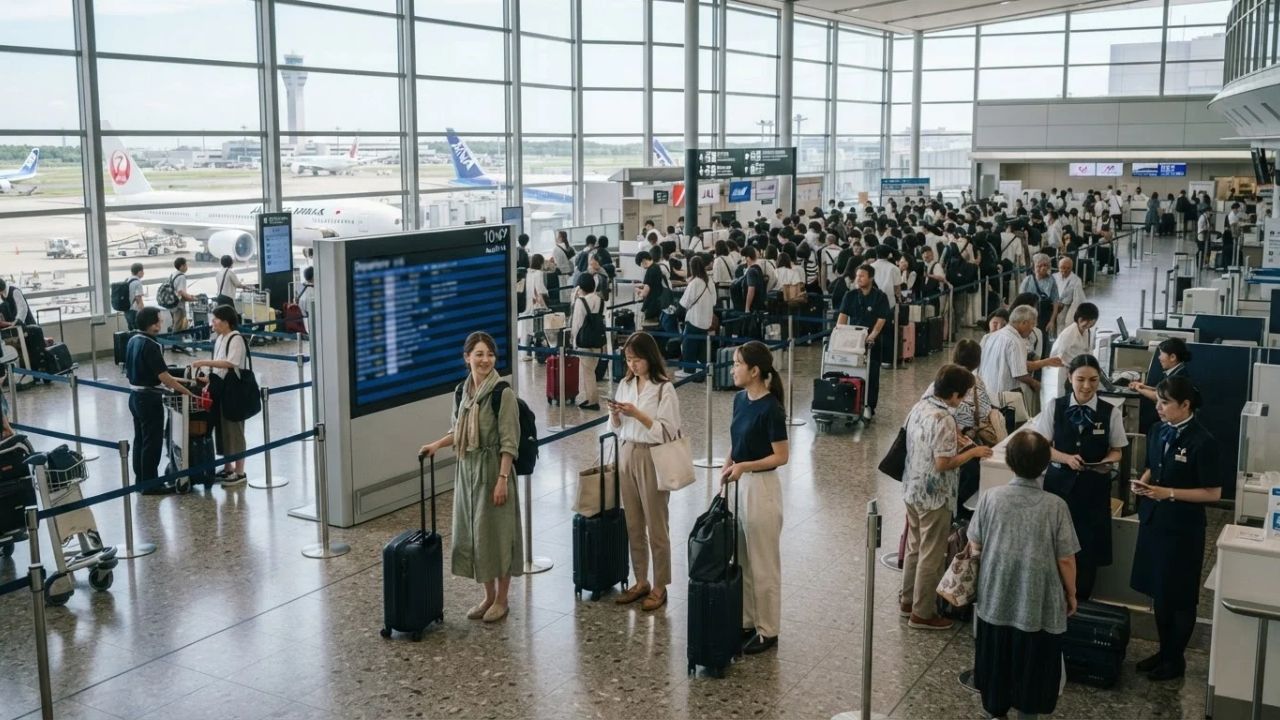
Image generated by AI
Recording an all-time monthly high of 3,442,100 international visitor arrivals in July 2026, Japan has issued an official travel congestion warning advising summer travelers to arrive early to mitigate growing airport security queues. With major terminals experiencing heavy peak-hour demand, authorities recommend utilizing public transit networks to bypass road congestion.
Evolving Visitor Flow Management at Japan's Gateways
A major shift in terminal operations across Japan's primary gateways focuses on dynamic passenger flow management. Driven by record-breaking international arrivals and active domestic holiday travel, the traditional check-in and security model faces operational pressure during peak flight windows. The Japan Safe Travel warning, issued on August 21, 2026, advises both domestic and international passengers to build larger time buffers into their departure plans.
Congestion is rarely uniform throughout the day. Instead, it concentrates during morning and evening departure waves when airlines schedule simultaneous flights. By encouraging travelers to use public transit and arrive prepared for security checks, authorities aim to spread processing demand and maintain terminal efficiency.
Analyzing July 2026 International Arrival Metrics
The need for airport passenger management is illustrated by the visitor arrivals recorded in the Japan National Tourism Organization's (JNTO) July 2026 statistical release:
- Total Monthly Arrivals: July international visitor arrivals reached an estimated 3,442,100, representing a 0.1 percent increase over July 2025 and establishing a new record for the month.
- Leading Source Markets: South Korea supplied 894,700 visitors (up 31.9% year on year), while Taiwan generated 763,800 arrivals (up 26.4%), exceeding 700,000 for the first time.
- Other Key Markets: The United States generated 286,200 arrivals (up 3.3%), Hong Kong produced 272,500 (up 54.8%), Thailand recorded 53,800 (up 10.8%), and Singapore generated 28,800 (up 18.5%).
- Contrasting Trends: Mainland China arrivals dropped 56.1 percent to 428,200, showing that growth was led by specific regional and long-haul markets rather than a uniform increase.
- Year-to-Date Volume: JNTO recorded approximately 24.53 million international arrivals from January through July 2026, which sits 1.7 percent below the corresponding period in 2025 but represents substantial summer demand.
These figures show that millions of international visitors are utilizing the same passenger-processing terminals as domestic travelers, who frequently use air corridors to connect from Tokyo and Osaka to Hokkaido, Kyushu, and Okinawa.
Narita Airport specific Congestion Warnings
Narita International Airport has issued specific guidance supporting the national travel advisory:
- High-Demand Window: Crowded check-in counters and security screening points are expected between July 18 and August 31.
- Busiest Daily Periods: Congestion typically peaks from early morning to noon and during evening departure waves, varying based on weather and flight schedules.
- Parking Infrastructure: Airport parking facilities frequently reach capacity during holiday periods, resulting in long entry queues even for travelers with pre-booked spots.
Consequently, airport operators recommend using express rail links over private vehicles or taxis to avoid traffic delays on terminal approach roads.
Source Market Performance: July 2026
The table below breaks down international visitor arrivals to Japan in July 2026 compared with the previous year, as reported by JNTO:
| Country of Origin | Estimated July 2026 Arrivals | Annual Year-on-Year Change |
|---|---|---|
| South Korea | 894,700 | +31.9% |
| Taiwan | 763,800 | +26.4% |
| Mainland China | 428,200 | -56.1% |
| United States | 286,200 | +3.3% |
| Hong Kong | 272,500 | +54.8% |
| Thailand | 53,800 | +10.8% |
| Singapore | 28,800 | +18.5% |
This uneven market performance illustrates why terminal managers must coordinate with specific regional airlines to manage passenger volumes during peak arrival windows.
Integrating Rail Networks and Digital Check-In
For the traveler, the real impact of terminal congestion is the need to plan the journey to the airport as carefully as the flight itself. Taking rail transport helps bypass highway delays and parking queues:
- Tokyo Gateways: Haneda Airport is served by the Tokyo Monorail and the Keikyu Line, while Narita is linked to Tokyo station via high-speed express trains.
- Regional Gateways: Kansai International (serving Osaka), Chubu Centrair (Nagoya), and Fukuoka Airport feature direct rail or rapid subway connections to their respective city centers.
- Online Services: Completing online check-in prior to arrival and utilizing self-service bag drop points reduces the steps required at terminal counters.
By transitioning tasks like check-in and boarding pass retrieval to mobile devices, travelers can proceed directly to security lanes, minimizing terminal dwell times.
Japan's Strategic Tourism Goals: Basic Plan to 2030
The high summer passenger volume highlights the context of Japan's fifth Tourism Nation Promotion Basic Plan, adopted on March 27, 2026. The official plan, covering fiscal years 2026 through 2030, sets ambitious national targets:
- Arrival Goals: Targeting 60 million international visitors annually by 2030.
- Spending Goals: Aiming for ¥15 trillion in inbound visitor spending by 2030, comparing to the historical baseline of 31.88 million arrivals in 2019.
- Overtourism Management: Developing regional dispersal programs to encourage visitors to explore destinations beyond Tokyo, Kyoto, and Osaka, protecting the quality of life for local residents.
Achieving these goals requires highly efficient airport infrastructure capable of processing high passenger volumes without compromising safety or service quality.
For example, you can explore the changing dynamics of Bypassing Hubs: T'way Air Connects Kumamoto and Jeju via Charter Route to see how direct regional flights are growing. For budget-conscious travelers, aligning slow city travel with municipal transit options mirrors similar regional initiatives, such as the Free Admission at Select US State Parks programs. This trend is similar to the tourism growth seen in other destinations, as detailed in our guide on how Utica, New York Emerges as an Affordable Northeast Tourism Hub.
Visitor Insider Tips: Navigating Japan's Airports
To navigate Japan's busy airport terminals during peak travel periods, keep these practical tips in mind:
- Double-Check Your Airport: Tokyo is served by both Haneda (HND) and Narita (NRT). Verify your flight confirmation carefully, as arriving at the wrong airport can result in a missed flight.
- Identify Your Terminal: Major carriers at Haneda and Narita operate from separate terminals. Check your airline's terminal assignment before boarding your train.
- Pre-Sort Security Items: When approaching security, place keys, coins, and smartphones in your carry-on bag or a tray. Remove jackets and place laptops in separate bins to speed up the queue.
- Return Rental Devices Early: If you rented a pocket Wi-Fi device, return it at the designated airport counter or mail slot before joining the security line.
- Keep Travel Documents Accessible: Keep your passport, boarding pass, and required travel visas together in an easily accessible pocket rather than packed deep inside your hand luggage.
Long-Term Outlook for Airport passenger Processing
The long-term outlook for Japan's aviation gateways is focused on the implementation of biometric processing and automated security lanes. As airports transition to "OneID" systems that use facial recognition for check-in, security, and boarding, processing times are expected to stabilize.
By maintaining high infrastructure standards and encouraging public transport, Japan can continue to welcome global visitors while supporting its national tourism strategy.
FAQ
Why did Japan issue an airport congestion warning?
The advisory was issued on August 21, 2026, due to high summer travel volumes and a record July arrival of 3,442,100 international visitors, causing longer queues at check-in and security.
Which dates are busiest for Narita Airport?
Narita Airport expects peak congestion at check-in counters and security screening checkpoints between July 18 and August 31.
What transport options are recommended?
Authorities advise travelers to use rail networks—such as the Tokyo Monorail, Keikyu Line, or regional express trains—to avoid traffic gridlock and full parking facilities.
What are Japan's long-term tourism targets?
Under the fifth Tourism Nation Promotion Basic Plan, Japan targets 60 million international visitors and ¥15 trillion in inbound spending by 2030.
Stay updated on the travel advisories and transit updates shaping journeys in Japan.
Related Travel Guides
Disclaimer
This article is for informational and educational purposes only. It does not constitute legal, financial, or professional advice. While we strive to provide accurate and up-to-date information, travel policies, regulations, and conditions change rapidly. Always verify information with official sources before making travel decisions. Nomad Lawyer makes no representations about the accuracy, reliability, completeness, or suitability of the information provided. Readers should consult qualified professionals for advice specific to their circumstances. The views expressed in this article are those of the author and do not necessarily reflect the views of Nomad Lawyer.
Raushan Kumar
Founder & Lead Developer
Full-stack developer with 11+ years of experience and a passionate traveller. Raushan built Nomad Lawyer from the ground up with a vision to create the best travel and law experience on the web.
Learn more about our team →