
Italy vs Thailand for Remote Workers: Costs, Taxes, and Lifestyle in 2026
New 2026 data shows Thailand remains 30-40% cheaper than Italy for remote workers, but Italy's tax incentives and lifestyle benefits appeal to medium-term digital nomads seeking stability.

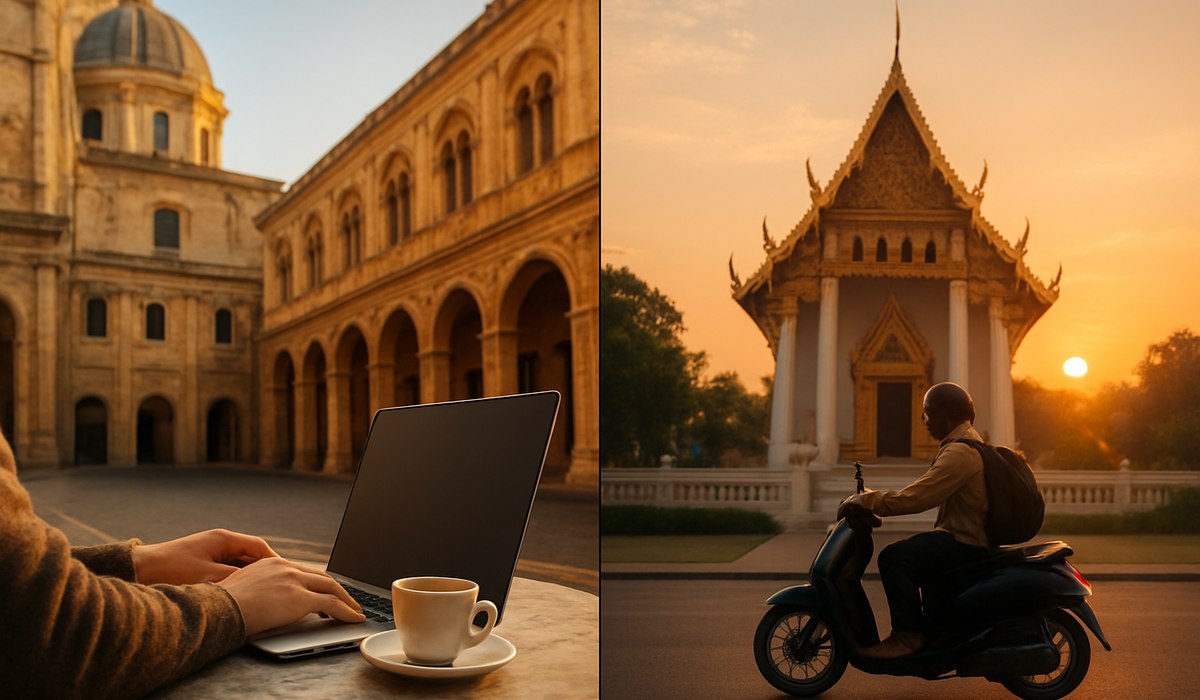
Image generated by AI
Italy and Thailand Diverge on Remote Worker Economics in 2026
Italy and Thailand compete aggressively for location-independent professionals, yet recent economic data reveals sharply different value propositions. Thailand maintains a substantial cost advantage—roughly 30-40% cheaper monthly budgets—while Italy increasingly attracts medium-term remote workers through residential tax programs and superior lifestyle amenities. A fresh analysis of 2026 pricing, work environments, and tax treatment shows neither destination universally wins; rather, your income level, career timeline, and personal priorities determine the optimal choice.
Cost of Living: Where Your Remote Income Stretches Furthest
Thailand's affordability edge remains decisive for budget-conscious remote workers. In Bangkok, monthly expenses for comfortable solo living range from $1,000 to $1,800, with secondary hubs like Chiang Mai dropping to $800–$1,400. Housing dominates this calculation: modern one-bedroom condos in Bangkok rent for 15,000–30,000 Thai baht monthly ($400–$850), while Chiang Mai apartments cost 10,000–20,000 baht ($280–$560).
Italy demands substantially higher outlays. Rome and Milan require €1,800–€2,500 monthly for comparable comfort, with one-bedroom central apartments alone consuming €900–€1,400. Regional Italian cities offer relief at €1,400–€1,700, yet still exceed Thailand's typical budgets. Utilities, coworking (€150–€300/month), and dining costs reinforce Italy's premium positioning. For remote workers earning USD $3,000–$4,500 monthly, Thailand delivers greater discretionary savings; above $5,000, Italy's lifestyle premium becomes more justifiable.
Learn more about Thailand remote work visa options and Italy's digital nomad permits through official government sources.
Lifestyle and Work Environment Comparison
Italy excels in cultural infrastructure, dining quality, and historical ambiance—factors that matter increasingly for long-term stays. European healthcare systems, established expatriate communities in major cities, and EU-standard internet reliability create stability attractive to professionals planning 1–3 year relocations. Italian workspaces foster face-to-face collaboration; coworking culture in Milan and Rome emphasizes networking over isolation.
Thailand prioritizes affordability, adventure, and flexibility. Bangkok and Chiang Mai cater explicitly to digital nomads with purpose-built coworking hubs (Hubba, HUBBA, Ministry of Work), lower-friction visa pathways, and vibrant expat social calendars. However, Thailand's work environment carries trade-offs: inconsistent utilities during monsoon seasons, visa uncertainty tied to annual renewals, and fewer integration pathways into local professional networks. Thailand suits remote workers seeking maximal geographic freedom; Italy appeals to those wanting anchored community roots.
See detailed comparisons of Asian remote work visas versus European residency programs.
Tax Treatment for Digital Nomads and Remote Workers
Tax obligations dramatically reshape the cost-benefit equation. Italy introduced the Decreto Crescita framework (updated through 2026), allowing non-Italian tax residents to claim a 90% income tax deduction for 5 years. This incentive targets high-earning remote workers, effectively cutting tax rates to 10% on foreign employment income. The catch: you must establish Italian tax residency and maintain it throughout the incentive period. For remote workers earning €40,000–€150,000 annually, this mechanism recovers €18,000–€67,500 over five years—a transformative benefit unavailable in Thailand.
Thailand imposes no personal income tax on foreign-sourced income if you don't remit funds domestically. However, once you transfer money into Thai bank accounts or establish tax residency (typically after 180 days), Thailand taxes worldwide income at rates reaching 37% at the highest bracket. The Thai government increasingly scrutinizes digital nomads; ambiguity around tax residency thresholds creates compliance risk absent in Italy's transparent system.
Remote workers earning under €30,000 annually benefit minimally from Italy's tax incentives; conversely, high earners (€80,000+) find the Italian pathway substantially cheaper over medium-term horizons despite higher living costs.
Which Destination Suits Your Long-Term Plans?
Choose Thailand if: You earn $2,000–$4,000 monthly, prioritize adventure and cost minimization, and plan stays under 12 months. Thailand maximizes purchasing power and offers unmatched geographic flexibility.
Choose Italy if: Your income exceeds €40,000 annually, you desire community stability, and you're willing to establish tax residency for 3+ years. Italy's tax incentives, healthcare, and cultural amenities create long-term value.
Hybrid approach: Many remote workers split time—spending winters in Thailand (6 months, avoiding tax residency) and summers in Italy (establishing residency gradually). This strategy captures Thailand's affordability while building Italian tax eligibility incrementally.
Cost and Taxation Comparison Table
| Category | Thailand (Bangkok) | Thailand (Chiang Mai) | Italy (Rome/Milan) | Italy (Regional) |
|---|---|---|---|---|
| Monthly Rent (1BR) | $400–$850 | $280–$560 | €900–$1,400 | €600–€900 |
| Monthly Budget (Solo) | $1,000–$1,800 | $800–$1,400 | €1,800–€2,500 | €1,400–€1,700 |
| Coworking/Month | $120–$350 | $80–$200 | €150–€300 | €100–€200 |
| Lunch Cost (Local) | $2–$5 | $1.50–$3 | €10–€15 | €7–€12 |
| Income Tax (Foreign) | 0% (non-resident) | 0% (non-resident) | 10% (Decreto Crescita) | 10% (Decreto Crescita) |
| Visa Duration | 60–180 days (tourist) | 60–180 days (tourist) | Residency (multi-year) | Residency (multi-year) |
| Healthcare Quality | Good (private paid) | Good (private paid) | Excellent (EU standard) | Excellent (EU standard) |
What This Means for Travelers
-
Calculate your effective monthly spend: Compare your lifestyle expectations against both destinations' price bands. Thailand typically saves $300–$700 monthly for comfortable mid-range living.
-
Model tax scenarios: If earning over €40,000 annually, request a preliminary tax consultation covering Italy's Decreto Crescita mechanism. Potential five-year savings (€18,000–€67,500) often justify Italy's higher baseline costs.
-
Evaluate visa runway: Thailand's 60–180 day tourist visas force frequent border runs; Italy's residency pathways create multi-year stability. Factor visa administration costs (flights, paperwork) into long-term budgeting.
-
Assess community priorities: Seeking deep cultural integration and professional networks? Italy wins. Prioritizing budget optimization and nomadic freedom? Thailand prevails.
-
Consider hybrid timing: Maximize savings by spending monsoon season (May–September) in Thailand, then establish Italian residency during calendar year residency-building windows. This approach captures both destinations' economic and lifestyle advantages.
Frequently Asked Questions
Q: Can I claim Italy's 90% tax deduction while living outside Italy?
A: No. The incentive requires establishing Italian tax residency, meaning spending over 183 days in Italy annually. Non-residents don't qualify. This structure ensures the benefit targets genuine long-term relocators, not short-term visitors.
Disclaimer
This article is for informational and educational purposes only. It does not constitute legal, financial, or professional advice. While we strive to provide accurate and up-to-date information, travel policies, regulations, and conditions change rapidly. Always verify information with official sources before making travel decisions. Nomad Lawyer makes no representations about the accuracy, reliability, completeness, or suitability of the information provided. Readers should consult qualified professionals for advice specific to their circumstances. The views expressed in this article are those of the author and do not necessarily reflect the views of Nomad Lawyer.
Raushan Kumar
Founder & Lead Developer
Full-stack developer with 11+ years of experience and a passionate traveller. Raushan built Nomad Lawyer from the ground up with a vision to create the best travel and law experience on the web.
Learn more about our team →