
Italy Follows Spain as Overtourism in Europe Spreads From Famous Cities to Mediterranean Regions
Italy Follows Spain as Overtourism in Europe Spreads From Famous Cities to Mediterranean Regions

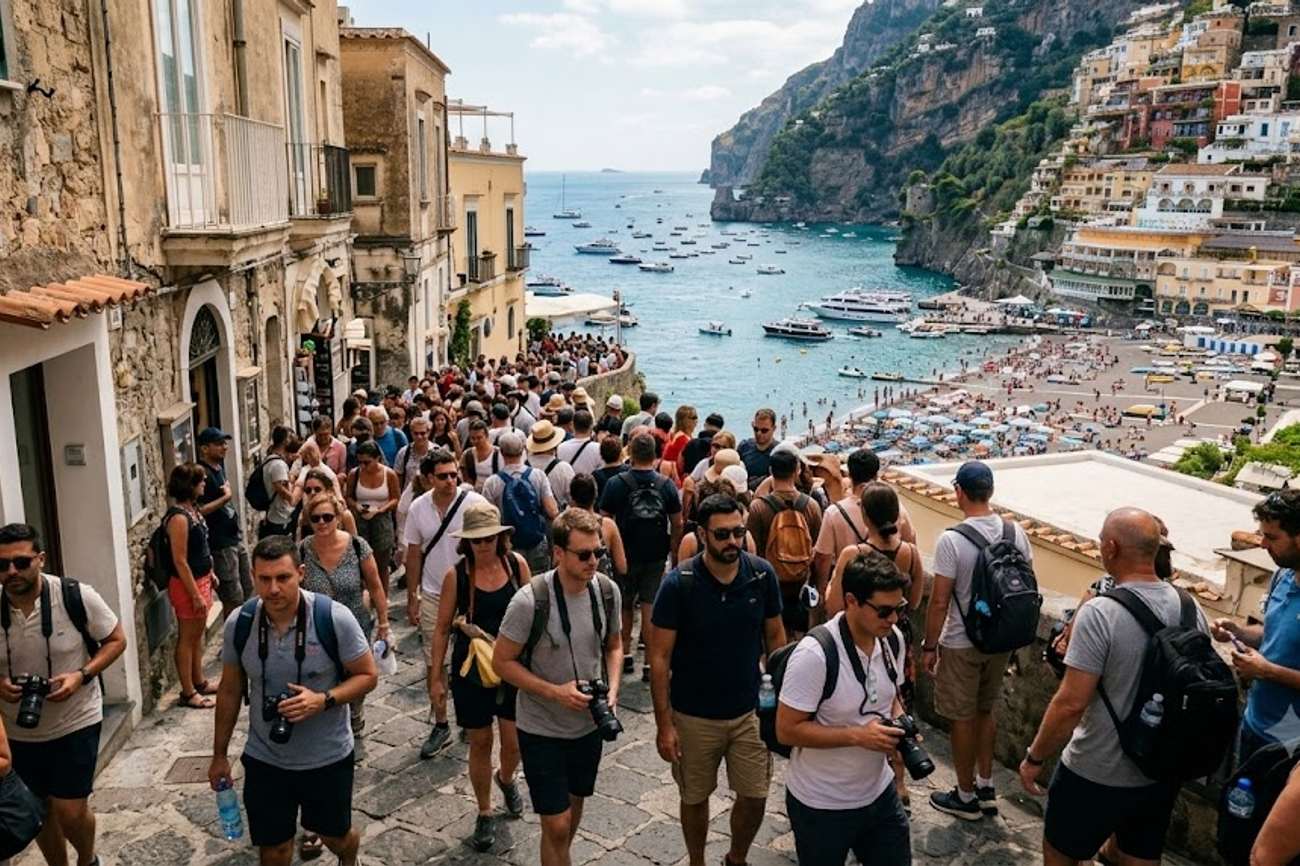
Image generated by AI
126,817 tourist nights per 1,000 residents in Greece’s Notio Aigaio region represents a level of visitor intensity that transcends traditional "overtourism" and enters the realm of systemic infrastructure strain. This figure, extracted from recent European Union data, underscores a fundamental shift in the continental travel map. The pressure is no longer confined to the historic centers of Venice or Barcelona; it has migrated toward the periphery, specifically targeting coastal provinces and islands where the ratio of visitors to locals is profoundly skewed.
The Migration of Tourism Pressure
The traditional narrative of European travel focuses on the "Big Four" cities—Rome, Paris, London, and Madrid. However, 2024 data reveals a more complex distribution of demand. The European Union recorded more than 3 billion nights in tourist accommodation throughout the year, a 2.2% increase over 2023. While national totals suggest a balanced growth, the regional granularity tells a different story.
Spain, Italy, France, and Germany remain the primary magnets, recording 500 million, 458 million, 451 million, and 441 million nights respectively. Yet, these aggregate numbers mask an intense concentration in specific geographies. Out of 244 regions analyzed by Eurostat, 84 exhibited tourism intensity levels well above the EU average. The most extreme cases are not cities, but coastal territories. In regions across Istria, the Greek islands, and the Spanish Balearics, the intensity reached between 115 and 145 nights per resident.
This shift is driven by a change in traveler behavior and a diversification of accommodation. The rise of non-hotel stays—including short-term rentals and rural campsites—has pushed visitors into areas that lack the urban infrastructure to handle sudden surges. The European Commission warns that overnight statistics are an underestimate; they fail to account for day-trippers and second-home owners who place equal or greater stress on local water networks, waste management, and transport hubs.
Coastal Infrastructure and Capacity Limits
The burden of Europe's record-breaking tourism year fell disproportionately on its coastlines. Coastal areas absorbed nearly 1.5 billion nights in 2024, representing a 3.6% year-over-year increase. To support this, the EU maintains approximately 12.5 million bed places in coastal zones, which accounts for 42% of the total bed capacity across the Union.
The distribution of this capacity is heavily weighted toward the Mediterranean south:
| Region/Metric | 2024 Coastal Bed Capacity | 2024 Overnight Stays/Intensity |
|---|---|---|
| Italy | 3.1 million places | 466.2 million nights (National) |
| France | 2 million places | 451 million nights (National) |
| Spain | 1.2 million places | 500 million nights (National) |
| Greece | 1.2 million places | 126,817 nights/1k residents (Notio Aigaio) |
| EU Total (Coastal) | 12.5 million places | Nearly 1.5 billion nights |
In Croatia, the Jadranska Hrvatska region alone recorded 80.8 million foreign nights in 2023, illustrating how specific coastal strips can become international hubs that dwarf the local population's capacity to provide services. For the traveler, this means that "off-the-beaten-path" coastal destinations may actually be more congested than major cities, simply because their baseline infrastructure is smaller.
Italy is implementing stricter crowd-control measures in hotspots like Venice to mitigate the environmental and social impact of mass tourism. Travelers are encouraged to consult the ENIT official portal for updated guidelines on sustainable visiting practices and regional entry requirements.
Expert Analysis: The Infrastructure Paradox
For travelers booking Mediterranean routes, the direct consequence of this data is the "Infrastructure Paradox": a destination may have fewer total visitors than a city like Rome, but a higher perceived level of crowding and lower service quality. This happens because the capacity of a small island or a coastal village is not linear.
When Notio Aigaio records over 126,000 nights per 1,000 residents, the pressure is not just on hotel rooms—which can be built—but on "hard" infrastructure: sewage plants, electricity grids, and potable water. In these regions, the pricing pressure is no longer driven by hotel demand alone, but by the scarcity of resources. We are seeing a transition where the cost of travel in these zones will increasingly include "environmental or management fees" to offset the cost of maintaining basic utilities under extreme seasonal load.
Furthermore, the shift toward non-hotel accommodation is creating a legal and logistical vacuum. In Spain, non-hotel stays reached 146.3 million nights in 2025, with tourist apartments alone accounting for over 76 million. This decentralizes the tourist population, spreading the pressure across residential neighborhoods rather than concentrating it in hotel districts. For the nomad or long-term traveler, this means higher rental costs and more stringent local regulations as municipalities attempt to reclaim housing for residents.
The policy response in Venice—the 2026 access-fee trial with rates of €5 for early payment and €10 for late payment—is the blueprint for the future. We should expect similar "entry permits" or "congestion pricing" to move from cities to islands and coastal provinces. The goal is no longer to grow the industry, but to manage the flow.
To manage the surge in Mediterranean arrivals, regional hubs are optimizing passenger flow and digital check-in processes. Real-time flight schedules and terminal logistics can be verified through the Aeroporti di Roma official website to avoid peak-hour congestion.
Key Takeaways
- Peripheral Pressure: Overtourism has migrated from metropolitan centers to coastal regions, with some Greek and Spanish islands seeing over 140 nights per resident.
- Capacity Imbalance: Coastal areas now hold 42% of all EU bed capacity, absorbing 1.5 billion nights annually.
- Hidden Demand: Official accommodation stats undercount the actual pressure, as day-visitors and second-home owners are not captured in overnight totals.
- Diversified Lodging: The surge in tourist apartments (over 76 million nights in Spain) is pushing tourism pressure deeper into residential coastal zones.
- Management Shift: Regulatory trends are moving toward visitor-flow management, such as Venice's access fees, which will likely expand to other high-intensity regions.
FAQ: European Coastal Tourism 2025
Is it better to visit a small island or a big city to avoid crowds? Not necessarily. Data shows that small islands, like those in the Balearics or Greece, often have higher "tourism intensity" (nights per resident) than cities, meaning infrastructure like roads and water may be more overwhelmed despite lower total visitor numbers.
What are the new rules for visiting Venice in 2026? Venice has implemented an access-fee experiment for day visitors on specific dates. The fees are set at €5 for those who pay in advance and €10 for those who pay later, aiming to manage the volume of non-overnight guests.
Why are hotel prices rising in coastal areas even if I stay in an apartment? The overall demand for the region puts pressure on all services. When a region like Notio Aigaio sees extreme visitor volume, the cost of labor, food, and transport rises for everyone, regardless of the type of accommodation used.
Which countries have the most tourist beds on their coasts? Italy leads the European Union with approximately 3.1 million coastal bed places, followed by France with 2 million, and Spain and Greece with approximately 1.2 million each.
The map of Europe is no longer defined by its capitals, but by the fragile equilibrium of its coastlines.
Tags: Notio Aigaio, Mallorca Tourism 2025, Eurostat Tourism Data, Venice Access Fee 2026, Mediterranean Overtourism, Jadranska Hrvatska
Related Travel Guides
- Sri Lanka Welcomes Travelers With Seamless Travel Access Direct Routes And Dreamy Island Escapes You Cannot Miss
- Canary Islands Steps Up With Galicia And More Places In Spain To Transform Sustainable Tourism Through Coastal Care And Visitor Control
- Malaysia Boosts Philippines Tourism Growth Despite Rising Fuel Surcharges and Higher Travel Costs for Visitors
Disclaimer
This article is for informational and educational purposes only. It does not constitute legal, financial, or professional advice. While we strive to provide accurate and up-to-date information, travel policies, regulations, and conditions change rapidly. Always verify information with official sources before making travel decisions. Nomad Lawyer makes no representations about the accuracy, reliability, completeness, or suitability of the information provided. Readers should consult qualified professionals for advice specific to their circumstances. The views expressed in this article are those of the author and do not necessarily reflect the views of Nomad Lawyer.
Naina Thakur
Contributor & Travel Specialist
Travel enthusiast and legal writer covering visa regulations, responsible tourism, and cultural journeys across global destinations.
Learn more about our team →