
India’s High Speed Rail Revolution Accelerates With First Indigenous Bullet Train Set for 2027 Launch Set to Transform Travel Experience, Connectivity, and Modern Rail Infrastructure Across the Country
India’s High Speed Rail Revolution Accelerates With First Indigenous Bullet Train Set for 2027 Launch Set to Transform T

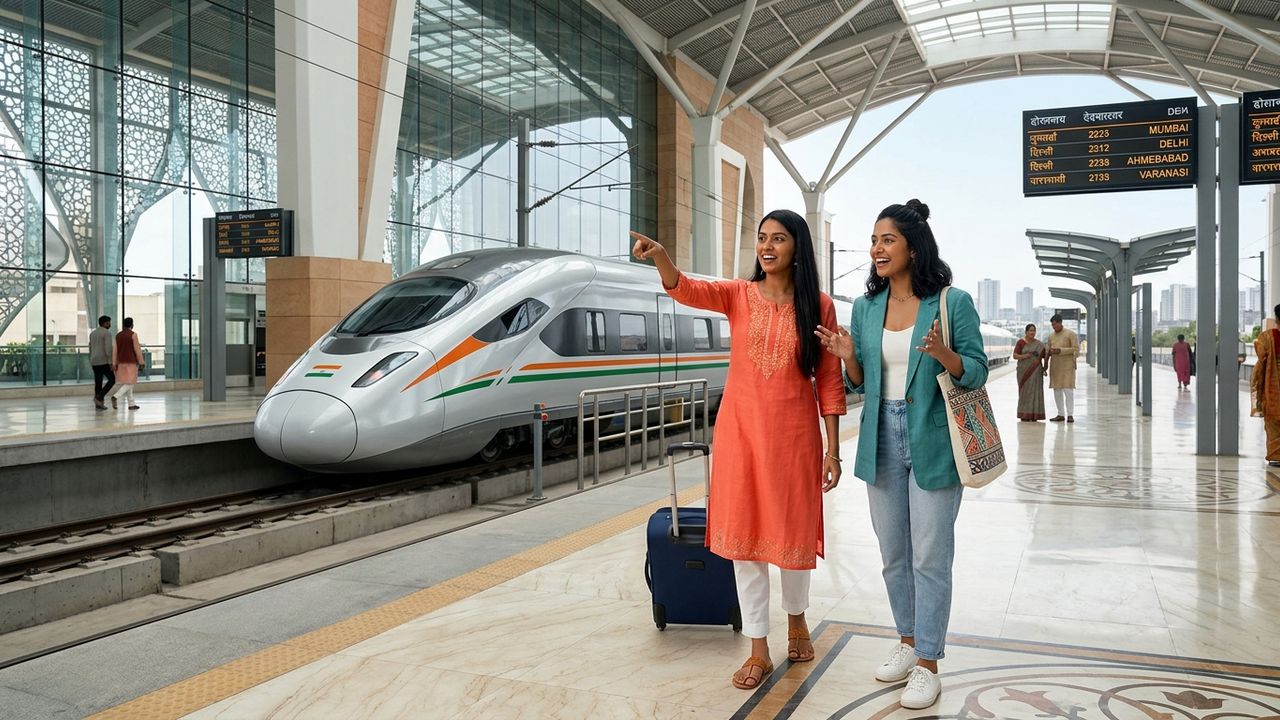
Image generated by AI
NEW DELHI, June 22, 2026 — India’s indigenous B28 bullet train project accelerates toward an early 2027 prototype completion, positioning the nation for a rapid transit overhaul. Government officials and industry observers confirm that the 280-kilometer-per-hour vehicle will initially deploy on a 97-kilometer Surat–Vapi segment before expanding across the broader Mumbai–Ahmedabad corridor. This accelerated timeline aims to compress intercity travel duration from nearly nine hours to under two hours while establishing a fully domestic high-speed manufacturing ecosystem.
The strategic pivot toward localized rail engineering gained formal momentum following a 2024 contract awarded by the Chennai-based Integral Coach Factory (ICF). Rather than depending on foreign suppliers, Indian authorities directed state-owned manufacturer Bharat Earth Movers Limited (BEML) to design and assemble two advanced trainsets tailored for domestic operational requirements. This initiative reflects a broader national objective to build sustainable aerospace and railway production capabilities while reducing long-term technology import dependencies.
BEML Advances B28 Prototype Production at Bengaluru Facility
Assembly operations are currently underway at BEML’s Aditya manufacturing complex in Bengaluru, a site officially inaugurated on April 25, 2026 by Railway Minister Ashwini Vaishnaw. The facility functions as the central hub for next-generation rolling stock, marking a decisive shift toward localized high-speed rail production. Corporate planning documents indicate that the B28 prototype will roll off the assembly line by early 2027, with the designation reflecting both its 280 km/h operational target and its “Bharat-made” classification.
Surat Depot Orchestrates Rigorous System Validation
Following final assembly, the trainset will relocate to a specialized depot in Surat developed by the National High-Speed Rail Corporation Limited (NHSRCL). Technicians will immediately initiate integration testing and system validation before the vehicle undergoes a comprehensive four-to-six-month verification cycle. This extended testing period covers internal performance diagnostics, controlled depot trials, and preliminary runs on mainline infrastructure. Aviation and rail certification experts note that such a rigorous schedule is standard for high-speed vehicles requiring strict safety compliance.
Mumbai-Ahmedabad Corridor Establishes Twelve Multimodal Stations
Initial commercial operations will launch along the Surat–Vapi stretch in August 2027, pending successful trial completion and regulatory clearance. This 97-kilometer segment serves as the foundational phase of the Mumbai–Ahmedabad High-Speed Rail (MAHSR) project, a 508-kilometer route bridging Maharashtra, Gujarat, and the Union Territory of Dadra and Nagar Haveli. Planners have designated twelve strategic locations to function as integrated transport nodes:
| Station Name | Primary Function |
|---|---|
| Mumbai (BKC) | Financial gateway integration point |
| Thane | Suburban connectivity node |
| Virar | Northern Mumbai metropolitan expansion zone |
| Boisar | Industrial corridor access point |
| Vapi | Gujarat entry gateway |
| Bilimora | Regional commuter hub |
| Surat | Major textile and commercial centre |
| Bharuch | Industrial river belt node |
| Vadodara | Central Gujarat transport hub |
| Anand | Dairy and regional connectivity station |
| Ahmedabad | Metropolitan terminal hub |
| Sabarmati | Multimodal interchange terminal |
Planners have specifically designed the Sabarmati station to merge high-speed rail with metro networks, bus rapid transit routes, and conventional rail lines, creating a seamless urban transit ecosystem.
Advanced Engineering Defines 350 km/h Infrastructure Design
The corridor accommodates a maximum design speed of 350 km/h, with an operational ceiling set at 320 km/h. This specification dwarfs India’s current semi-high-speed Vande Bharat Express, which maintains a top speed of approximately 180 km/h. Once fully active, the service will compress the Mumbai-Ahmedabad journey to roughly 1 hour 58 minutes, a drastic reduction from the 8–9 hours required by road or the 4–5 hours demanded by air travel when accounting for airport security and boarding procedures. Engineers are implementing Japanese Shinkansen technology, utilizing a J-slab ballastless track system alongside a 2×25 kV electrification framework. The electrical grid relies on extensive traction infrastructure, including substations, overhead equipment networks, and thousands of distribution poles.
Elevated Viaducts and Subsea Tunnels Reshape Construction Methods
Approximately 90% of the entire route rests on elevated viaducts, constructed using the Full Span Launching Method, a technique newly scaled for Indian railways. This approach accelerates structural assembly significantly compared to traditional segmental construction. To mitigate acoustic disruption in densely populated areas, authorities are installing comprehensive noise barriers along all elevated stretches. The project also demands complex crossing solutions, featuring 25 major river bridges spanning waterways across Gujarat and Maharashtra. Engineers have already completed substantial river crossings over the Meshwa, Kim, Tapi, and Narmada, while active work continues across the Sabarmati and Vaitarna rivers. Steel bridges simultaneously traverse highways, irrigation canals, and existing rail corridors.
A defining engineering achievement remains India’s first undersea railway tunnel in Maharashtra. The 21-kilometer tunnel includes a 7-kilometer segment running beneath Thane Creek. Construction teams are deploying both Tunnel Boring Machine (TBM) technology and the New Austrian Tunnelling Method (NATM). The deployed TBM features a 13.6-meter cutting diameter, representing the largest deployed diameter for railway infrastructure in the country.
Integrated Safety Networks Monitor Environmental Conditions
Rail authorities have installed a comprehensive environmental monitoring grid to ensure uninterrupted high-speed operations. Real-time rainfall tracking stations operate at six strategic locations, while wind speed sensors monitor conditions at 14 points across the corridor. These sensors can detect gusts reaching 252 km/h and automatically enforce speed reductions between 72 and 130 km/h when thresholds are breached. Additionally, a dedicated earthquake detection network spans 28 seismometers that trigger immediate automatic power shutdowns upon detecting seismic activity, prioritizing passenger safety during geological events.
Workforce Expansion and Technical Training Programs Accelerate
Beyond transit improvements, the initiative functions as a large-scale industrial capability project. Authorities project the creation of 4,000 direct employment positions alongside 35,000 to 40,000 indirect roles throughout the construction and operational phases. Peak construction periods will mobilize approximately 40,000 workers across multiple sites. To sustain long-term technical proficiency, a dedicated high-speed rail training institute in Vadodara is actively developing specialized curricula for signalling, tunneling, viaduct maintenance, and train operations.
Future Corridors Outline National High-Speed Expansion
Government planning documents for 2026–2027 identify seven additional routes currently under evaluation for national high-speed rail development. Proposed alignments include the Delhi–Varanasi corridor, the Varanasi–Patna–Siliguri corridor, the Chennai–Bengaluru corridor, the Bengaluru–Hyderabad corridor, the Chennai–Hyderabad corridor, the Mumbai–Pune corridor, and the Pune–Hyderabad corridor. Railway officials view the Mumbai–Ahmedabad line as the structural template for these subsequent networks, establishing standardized engineering protocols and operational frameworks.
National Infrastructure Impact Assessment
The integration of indigenous high-speed rail technology fundamentally alters India’s transport economics. By compressing intercity travel times and establishing localized manufacturing hubs, the project reduces dependency on imported aerospace and railway components. The standardized safety protocols, advanced electrification grids, and automated monitoring systems will serve as replicable models for future provincial rail upgrades. Industry analysts anticipate that successful deployment will stimulate regional commercial growth, optimize freight routing alternatives, and accelerate urban decentralization across western India.
The B28 prototype completion and subsequent August 2027 commercial launch will establish India’s first fully domestic high-speed rail benchmark. As the Mumbai–Ahmedabad corridor transitions from construction to active service, the established engineering frameworks will directly enable the rollout of seven additional intercity routes. National transit networks will increasingly rely on localized manufacturing, automated safety systems, and integrated multimodal hubs to sustain long-term mobility expansion.
Related Travel Guides
Disclaimer
This article is for informational and educational purposes only. It does not constitute legal, financial, or professional advice. While we strive to provide accurate and up-to-date information, travel policies, regulations, and conditions change rapidly. Always verify information with official sources before making travel decisions. Nomad Lawyer makes no representations about the accuracy, reliability, completeness, or suitability of the information provided. Readers should consult qualified professionals for advice specific to their circumstances. The views expressed in this article are those of the author and do not necessarily reflect the views of Nomad Lawyer.
Raushan Kumar
Founder & Lead Developer
Full-stack developer with 11+ years of experience and a passionate traveller. Raushan built Nomad Lawyer from the ground up with a vision to create the best travel and law experience on the web.
Learn more about our team →