
Hyderabad Metro and TGSRTC to Launch Unified Multi-Modal Travel Pass
Hyderabad Metro Rail and TGSRTC are launching a unified travel pass for buses and trains. Get details on daily and monthly pass options and the rollout timeline

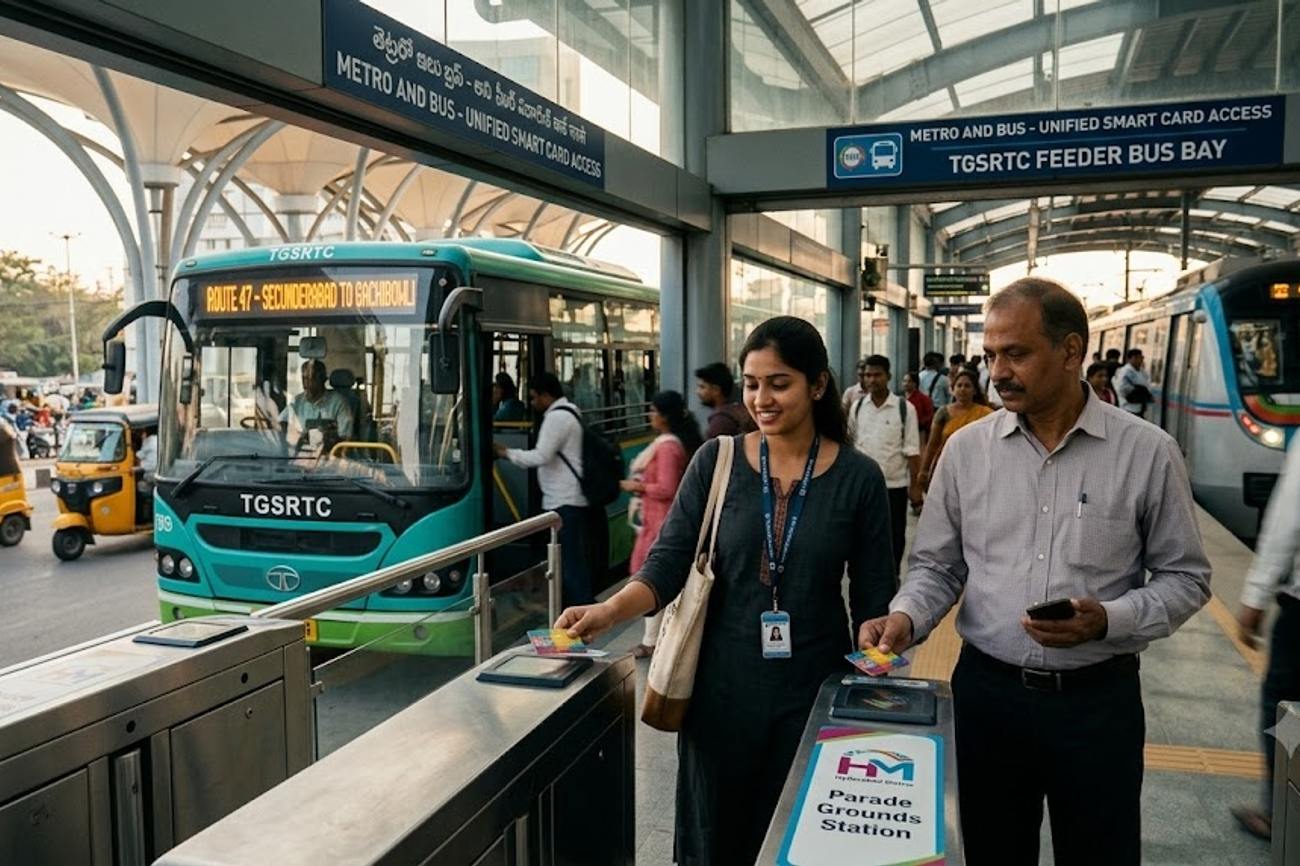
Image generated by AI
Integrated Ticketing to Streamline Hyderabad Commute
Hyderabad is moving toward a holistic urban mobility model as Hyderabad Metro Rail Limited and the Telangana State Road Transport Corporation (TGSRTC) prepare to launch a common travel pass. This initiative aims to merge the ticketing frameworks of the city's rapid rail and regional bus networks into one seamless system.
The decision follows a high-level coordination meeting at Metro Rail Bhavan in Begumpet. During the session, Chief Secretary Sanjay Jaju directed administrative bodies to finalize the fare structure and technical deployment without delay to ensure rapid implementation.
Officials from TGSRTC and L&T Hyderabad Metro Rail have confirmed that the technical groundwork is complete. The integration is designed to remove the operational silos that previously forced passengers to navigate two entirely different payment ecosystems.
Direct Benefits for Daily Commuters
The shift to a unified pass addresses long-standing friction points for students and working professionals who rely on multi-modal transit.
- Elimination of Redundancy: Travelers no longer need to maintain separate smart cards, paper passes, or tokens for different legs of their journey.
- Reduced Transit Time: By removing the need to queue at multiple ticket windows, the system is expected to lower congestion at transit hubs during peak hours.
- Flexible Options: The system will offer both daily and monthly pass configurations to suit different usage frequencies.
Strategic Urban Transit Upgrades
Beyond ticketing, the state is pursuing a broader strategy to maximize the efficiency of the capital's transit assets. Administrative reviews are currently focusing on several key infrastructure goals:
- Capacity Expansion: Increasing train frequency and capacity to manage heavy passenger surges.
- Network Growth: Expediting the development of the proposed 7.5-kilometer Old City Metro corridor.
- Facility Optimization: Improving parking and commercial space utilization at major stations.
Urban planners note that while technical integration is straightforward, the creation of a harmonized fare matrix is the most complex stage, as it requires balancing commuter subsidies with operational revenue for both agencies.
Implementation Timeline and Technical Readiness
The unified ticketing mechanism is projected to go live within the next 15 days. Technical compatibility tests between L&T Hyderabad Metro Rail and TGSRTC have already been verified, ensuring that electronic scanners and verification devices can process the joint credentials.
| Feature | Previous System | New Integrated System |
|---|---|---|
| Ticketing | Separate cards/tokens for Bus & Metro | Single Unified Pass |
| Payment Process | Independent payments per mode | Integrated fare mechanism |
| Pass Options | Modal-specific season tickets | Joint Daily & Monthly passes |
| Planning Approach | Fragmented/Siloed | Multi-modal/Holistic |
| User Experience | High friction during transfers | Seamless mode switching |
Key Takeaways
- Unified Access: A single pass will work for both TGSRTC buses and Hyderabad Metro Rail.
- Launch Window: The system is expected to be operational within 15 days.
- Pass Types: Commuters can choose between daily and monthly options.
- Infrastructure Focus: The move coincides with the push for the 7.5km Old City Metro corridor and increased train capacities.
FAQ
When will the joint pass be available? The system is expected to launch within the next 15 days following directives from state leadership.
Will I still need a separate card for the Metro? No, the new unified pass is designed to replace the need for separate ticketing when switching between buses and the Metro.
What pass options will be available? Commuters will be able to purchase either daily or monthly passes depending on their travel frequency.
Related Travel Guides
Disclaimer
This article is for informational and educational purposes only. It does not constitute legal, financial, or professional advice. While we strive to provide accurate and up-to-date information, travel policies, regulations, and conditions change rapidly. Always verify information with official sources before making travel decisions. Nomad Lawyer makes no representations about the accuracy, reliability, completeness, or suitability of the information provided. Readers should consult qualified professionals for advice specific to their circumstances. The views expressed in this article are those of the author and do not necessarily reflect the views of Nomad Lawyer.
Naina Thakur
Contributor & Travel Specialist
Travel enthusiast and legal writer covering visa regulations, responsible tourism, and cultural journeys across global destinations.
Learn more about our team →