
Boeing 777X Set to Dethrone Airbus A380 as World's Largest Commercial Aircraft—Here's the Crucial Difference
Breaking airline news and aviation industry updates for 2026.

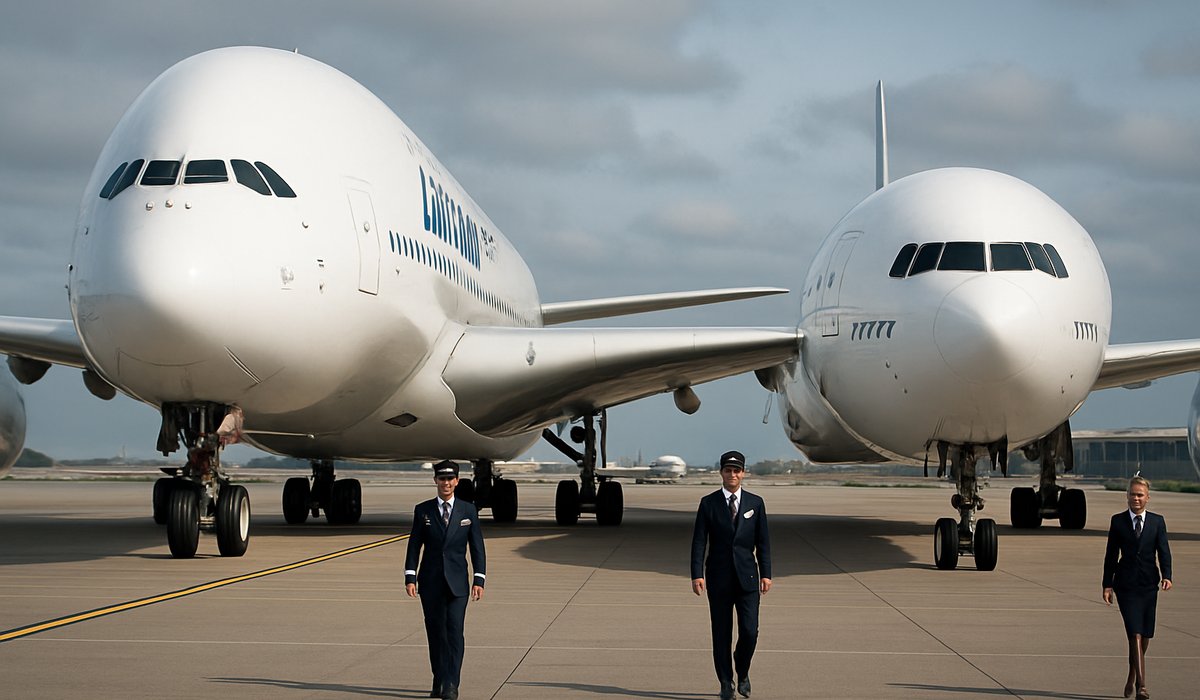
Image generated by AI
Boeing 777X Set to Dethrone Airbus A380 as World's Largest Commercial Aircraft—Here's the Crucial Difference
The imminent arrival of Boeing's wide-body giant signals a major shift in the competitive landscape of ultra-large aircraft manufacturing
A New Contender for Aviation's Heavyweight Crown
The aviation industry is bracing for a significant milestone: Boeing's 777-9 is poised to capture the title of the world's largest commercial passenger aircraft, ending the Airbus A380's decade-long reign as the undisputed heavyweight champion of commercial aviation. The dimensional differences between these two engineering marvels reveal not just technical specifications, but a fundamental evolution in how airlines and manufacturers approach capacity and efficiency in long-haul travel.
The Measurement That Matters
The Boeing 777-9 surpasses its predecessor's original design parameters considerably. When development of the 777 family commenced during the 1990s, Boeing did not envision it as the largest aircraft in its portfolio—let alone the commercial aviation sector. That distinction belonged to the iconic 747, which the manufacturer subsequently upgraded to the 747-8 variant. While the freighter configuration of the 747-8 achieved moderate market acceptance, the passenger iteration struggled to gain traction with carriers seeking efficient alternatives to manage operating costs.
The Strategic Pivot in Aircraft Development
The evolution from the 777 to the 777-9 reflects a fundamental industry shift. Rather than pursuing sheer size above all else, manufacturers have increasingly focused on operational efficiency, fuel economy, and profitability per seat. The 777-9's emergence as the market leader signals that airlines prioritize modern avionics, advanced engine technology, and lower per-unit operating expenses over maximizing raw passenger capacity in a single fuselage.
The Airbus A380, while still operational with numerous carriers worldwide, has faced production challenges and limited new orders in recent years. Its massive double-deck configuration served a specific market need during an era when growth relied primarily on capacity expansion. Conversely, the 777-9 represents a next-generation approach: achieving competitive capacity through refined aerodynamics and state-of-the-art propulsion systems rather than simply building bigger hulls.
Industry Implications and Market Reality
This transition underscores broader aviation trends, including changing passenger preferences for frequency over destination concentration, environmental regulations demanding fuel efficiency, and financial pressures on airlines managing jet fuel prices and operational overhead. The 777-9's technological advantages position it as the preferred choice for carriers planning fleet modernization across major international routes.
As the aviation sector continues recovering from pandemic-related disruptions, the choice between ultra-large aircraft like the A380 and efficiently-scaled wide-bodies like the 777-9 increasingly favors the latter. Manufacturers and operators have learned that adaptability and operational economics trump absolute size in today's competitive landscape.
Frequently Asked Questions
Q: When will the Boeing 777-9 enter commercial service? A: Boeing is conducting final testing and certification procedures, with deliveries expected to begin in the coming years, pending regulatory approval.
Q: How many passengers can the Boeing 777-9 accommodate compared to the A380? A: Configuration varies by airline, but the 777-9 typically carries 400-425 passengers in three-class layouts, compared to the A380's 575+ capacity, depending on configuration.
Q: Why is the 777-9 considered "larger" if the A380 carries more passengers? A: The 777-9 holds the distinction of being the longest and widest commercial aircraft currently in production, though the A380's double-deck configuration provides greater total volume.
Q: Are airlines still ordering the Airbus A380? A: A380 production has slowed significantly, with Airbus focusing development resources on more fuel-efficient models as airlines prioritize operational costs over maximum capacity.
Q: What advantages does the 777-9 offer over older wide-body aircraft? A: The 777-9 features advanced engines delivering superior fuel efficiency, reduced emissions, lower jet fuel consumption, and modern avionics—all critical factors in controlling airline operating expenses.
Related Travel Guides
External Resources
Disclaimer
This article is for informational and educational purposes only. It does not constitute legal, financial, or professional advice. While we strive to provide accurate and up-to-date information, travel policies, regulations, and conditions change rapidly. Always verify information with official sources before making travel decisions. Nomad Lawyer makes no representations about the accuracy, reliability, completeness, or suitability of the information provided. Readers should consult qualified professionals for advice specific to their circumstances. The views expressed in this article are those of the author and do not necessarily reflect the views of Nomad Lawyer.
Preeti Gunjan
Contributor & Community Manager
A passionate traveller and community builder. Preeti helps grow the Nomad Lawyer community, fostering engagement and bringing the reader experience to life.
Learn more about our team →