
Green Bank: The West Virginia Sanctuary Where Silence Fuels Space Discovery
In a world of constant connectivity, one West Virginia town has turned silence into its greatest asset. Here, the absence of Wi-Fi and cell signals isn't a li

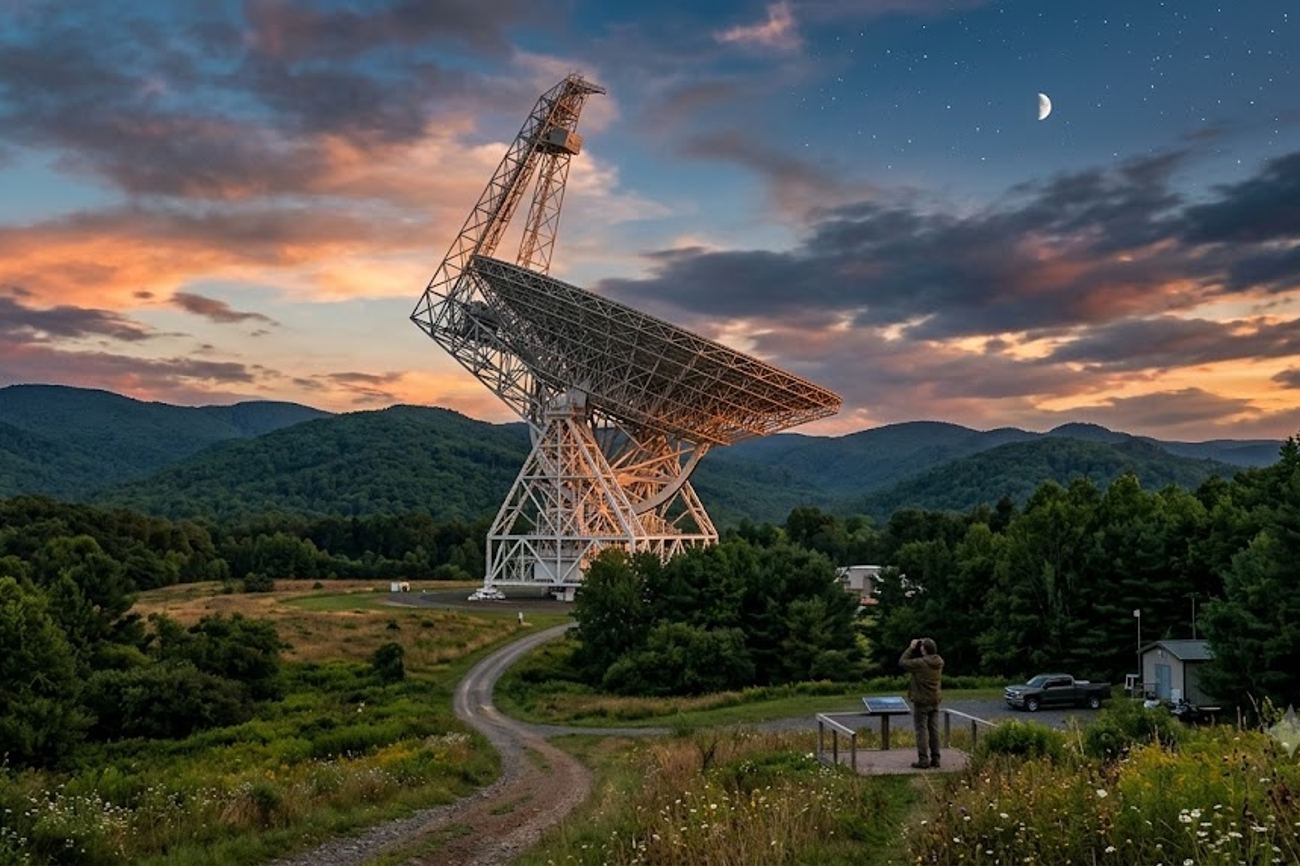
Image generated by AI
A Scientific Sanctuary in the Appalachians
Green Bank, West Virginia, stands as one of the most unconventional travel destinations in the United States. Located in Pocahontas County, the town exists within the National Radio Quiet Zone (NRQZ), a 13,000-square-mile protective perimeter established in 1958.
The NRQZ was designed to eliminate radio frequency interference (RFI), ensuring that sensitive scientific observations remain undisturbed. While most global destinations compete for the fastest 5G speeds, Green Bank leverages its "quietness" to attract science enthusiasts, stargazers, and travelers seeking a total digital detox.
Protecting the Gateway to the Cosmos
The primary driver for these strict environmental controls is the Green Bank Observatory, home to the Robert C. Byrd Green Bank Telescope (GBT). As the world’s largest fully steerable radio telescope, the GBT captures invisible radio waves from pulsars, distant galaxies, and interstellar gas clouds.
Because these cosmic signals are incredibly weak by the time they reach Earth, they are easily drowned out by human-made electronic noise. This makes the surrounding radio silence a critical component of astrophysical research, transforming a rural mountain town into a global hub for space discovery.
The Impact of the National Radio Quiet Zone (NRQZ)
Established by the Federal Communications Commission (FCC), the NRQZ spans parts of West Virginia, Virginia, and Maryland. The zone is not a total ban on technology, but rather a highly coordinated management system.
Any new or modified fixed radio transmitters within this 13,000-square-mile area must be coordinated to ensure they do not compromise the integrity of the National Radio Astronomy Observatory or the radio receiving facilities at Sugar Grove, West Virginia.
Redefining the Tourism Experience
Green Bank rejects the traditional tourism model of urban hubs and high-tech attractions. Instead, it offers a "slow travel" experience where the attraction is the environment itself.
Visitors typically engage with the destination through several distinct lenses:
- Educational Astronomy: Guided tours of the Green Bank Observatory.
- Scientific Landmarks: Up-close views of the Robert C. Byrd Green Bank Telescope.
- Eco-Tourism: Exploring the rugged Appalachian mountain scenery.
- Digital Wellness: An organic opportunity for a forced disconnect from wireless devices.
Managing Technology in a Radio-Silent Town
The "quietest town in America" is not primitive; it is precisely managed. Residents and businesses utilize wired internet and landline telephones to avoid emitting the radio frequencies that plague sensitive equipment.
The following technologies are strictly managed or limited, particularly near the observatory:
| Technology | Management Status in Green Bank |
|---|---|
| Mobile Phone Networks | Infrastructure is strictly limited near sensitive areas |
| Wi-Fi Routers | Require careful management and coordination |
| Smart Doorbells | Limited due to Wi-Fi/Bluetooth signal emissions |
| Cordless Phones | Restricted due to radio frequency transmissions |
| Microwave Ovens | Monitored, as faulty units cause interference |
| Drones/Wireless Devices | Heavily controlled near scientific facilities |
The High-Tech Effort to Maintain Silence
Maintaining this void of electronic noise requires sophisticated surveillance. The observatory employs interference protection teams who use spectrum analyzers and specialized monitoring vehicles to hunt for "radio leaks."
Most interference is accidental, stemming from malfunctioning electronics or visitors unknowingly bringing active wireless devices into protected zones. This constant vigilance ensures that the GBT can continue to detect signals that have traveled billions of miles across the vacuum of space.
Key Takeaways
- The NRQZ: A 13,000-square-mile zone established in 1958 to protect radio astronomy.
- The GBT: The Robert C. Byrd Green Bank Telescope is the world's largest fully steerable radio telescope.
- Tech Limitations: Cell towers and Wi-Fi are limited to prevent interference with deep-space signals.
- Tourism Shift: The town attracts a niche market of "science travelers" and those seeking digital detoxes.
FAQ
Is there any internet in Green Bank? Yes, but it is primarily delivered via wired connections rather than wireless Wi-Fi to prevent radio interference.
Can I visit the Robert C. Byrd Green Bank Telescope? Yes, the Green Bank Observatory offers educational visits and exhibits for the public.
Are all electronics banned in the National Radio Quiet Zone? No. The zone manages transmitting electronics. Most passive electronics are fine, but wireless transmitters are strictly regulated, especially near the telescope.
Related Travel Guides
- Barbados Tourism Hits Record Highs as Cruise and Stay-Over Arrivals Surge
- Denver Fall 2026 Transit and Cultural Calendar
- [Short-Haul Travel Trends: Rise of Four-Day ](/indian-traveler-four-day-short-haul-trends)
Disclaimer
This article is for informational and educational purposes only. It does not constitute legal, financial, or professional advice. While we strive to provide accurate and up-to-date information, travel policies, regulations, and conditions change rapidly. Always verify information with official sources before making travel decisions. Nomad Lawyer makes no representations about the accuracy, reliability, completeness, or suitability of the information provided. Readers should consult qualified professionals for advice specific to their circumstances. The views expressed in this article are those of the author and do not necessarily reflect the views of Nomad Lawyer.
Preeti Gunjan
Contributor & Community Manager
A passionate traveller and community builder. Preeti helps grow the Nomad Lawyer community, fostering engagement and bringing the reader experience to life.
Learn more about our team →