
Greater Anglia Network Paralyzed by Trespass Incident Between Witham and Hatfield Peverel, Disrupting London-Essex-Norfolk Rail Services June 2026
A railway trespass incident between Witham and Hatfield Peverel in Essex has forced Greater Anglia to suspend services on its main London-Norwich corridor, affecting thousands of passengers across Essex, Suffolk, and Norfolk.

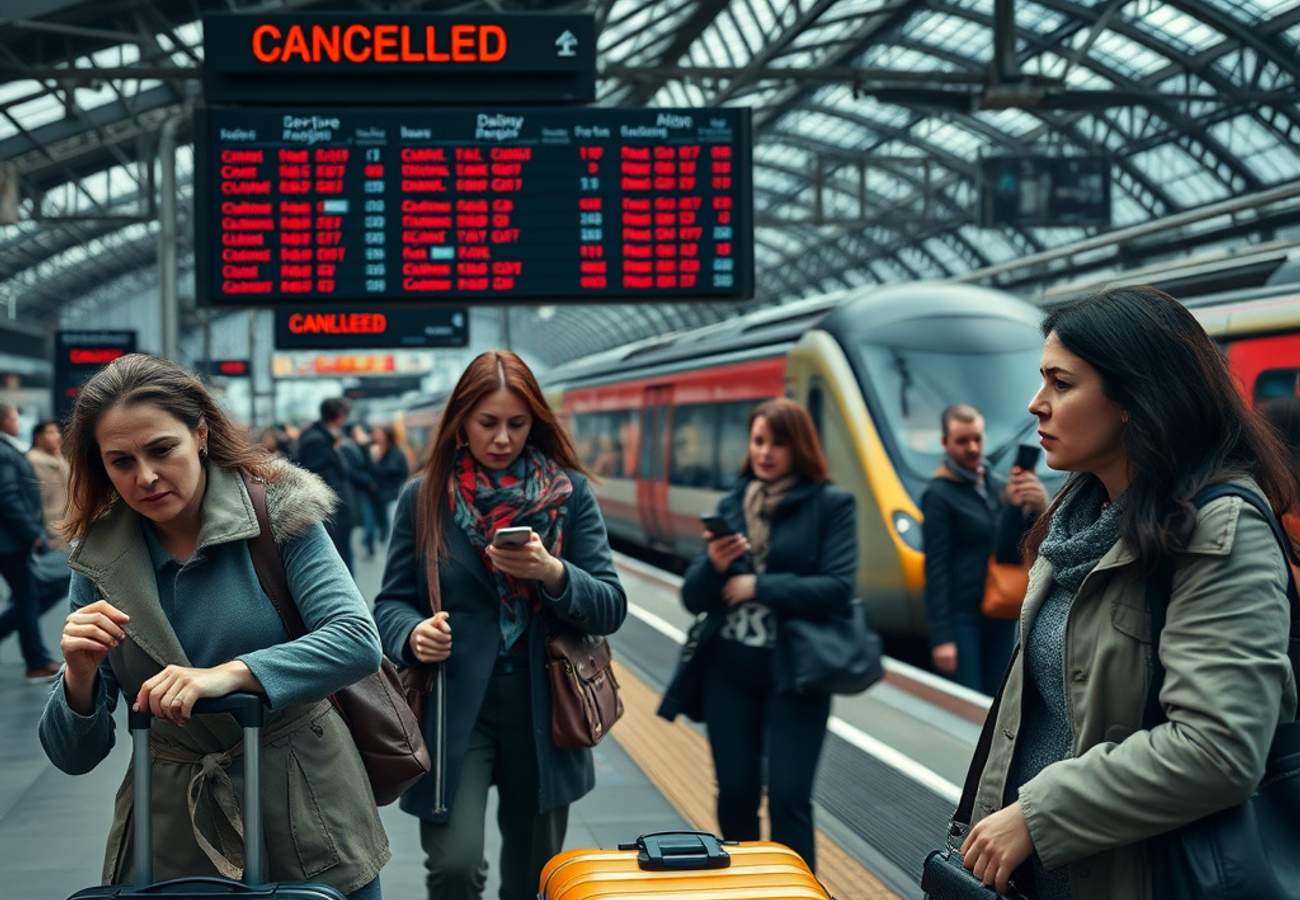
Image generated by AI
The Incident That Stopped an Entire Network
It started before 08:00 BST on June 29, 2026, when a single trespass incident brought one of Britain's busiest regional rail networks to a grinding halt. A person on the tracks between Witham and Hatfield Peverel in Essex forced Greater Anglia to suspend all services on the main corridor connecting London Liverpool Street with Norwich, Suffolk, and Norfolk. Thousands of commuters and leisure travellers found themselves stranded, delayed, or scrambling for alternative transport.
British Transport Police responded immediately to the scene while railway crews worked alongside emergency services. But here's what most travellers don't realize: closing a single stretch of track for a safety incident doesn't just delay trains passing through that section—it cascades across an entire network, trapping rolling stock, displacing crews, and unraveling tightly coordinated timetables.
Reddit: "One trespass incident and suddenly I'm an hour late to work. The knock-on effect is absolutely brutal." — r/BritishProblems
Which Routes Took the Hit Hardest?
The disruption rippled far beyond the closed section between Witham and Hatfield Peverel. Services operating between London Liverpool Street and Ipswich, Clacton-on-Sea, Colchester Town, and Braintree all experienced severe delays, cancellations, and revised timetables.
The main London-Norwich intercity corridor—one of eastern England's most critical transport arteries—became essentially non-operational. Trains that couldn't pass through the blocked section accumulated delays, then crews and rolling stock fell out of sequence. Even routes that didn't directly traverse the incident location suffered from the knock-on effect. Service recovery remained challenging because modern railways operate with almost zero slack built into their schedules.
Why Does Railway Safety Work This Way?
Train drivers operate vehicles travelling at speeds up to 100 mph with stopping distances measured in hundreds of metres. A person on the tracks creates an immediate and extreme safety hazard that railway operators simply cannot ignore.
When British Transport Police must locate and secure an individual on active railway lines, operators have no choice but to suspend all services in that area. It's not bureaucratic caution—it's physics. Modern rail safety protocols require absolute confirmation that every section is clear before trains resume operation.
This is why even relatively brief trespass incidents create hours of disruption. The incident itself might last 30 minutes, but restoring normal operations requires repositioning trains, crews, and equipment across a network that's been thrown into chaos.
The Passenger Experience: Chaos and Uncertainty
Greater Anglia issued standard guidance: check before travelling, expect delays, allow additional time. But what does that mean for someone with a business meeting in Norwich, a family visiting the Norfolk coast, or a commuter who relies on the railway to get to work?
For time-sensitive travellers, there were no good options. Alternative bus services became overwhelmed. Regional roads absorbed overflow traffic. Hotel check-ins were missed. Visitor attractions dealt with late arrivals all day.
Reddit: "Rail disruption is fine if it's 20 minutes. But when police are involved and you don't know when trains will run again, you're essentially making transport decisions blind." — r/trains
The real impact extends beyond the immediate frustration. Travel disruption research shows that passengers often abandon planned journeys after major delays, affecting regional tourism, retail activity, and local business operations.
The Domino Effect on Eastern England's Tourism
Greater Anglia serves some of England's most popular leisure destinations: coastal towns like Great Yarmouth and Lowestoft, historic city Norwich, country attractions across Suffolk, and seaside resorts that depend on reliable rail connectivity.
A major disruption during the busy travel season doesn't just inconvenience commuters—it disrupts visitor economies. Hotels report late or cancelled arrivals. Tourist attractions see reduced footfall. Business conferences and events face attendance complications. Even temporary rail closures can encourage travellers to postpone journeys or choose alternative destinations with more reliable transport.
During summer 2026, when travel demand peaks, every hour of rail disruption translates to lost revenue for businesses dependent on tourist rail traffic.
The Long Road to Recovery
At the time of reporting, there was no confirmed timeline for reopening the affected section. Police remained on-scene. Railway controllers were coordinating the gradual restoration of services—not all at once, but progressively as the network was declared safe and crews could be repositioned.
Even after the first trains began running again, passengers should expect the railway to operate below full capacity for several hours. The published timetable wouldn't resume immediately. Passengers needed to monitor live updates because restoration wouldn't be instant.
What This Reveals About Modern Rail Networks
The Greater Anglia disruption exposes a fundamental vulnerability in modern railway operations: the system runs so efficiently that any disruption cascades instantly. There's no buffer. No flexibility. A single incident at Witham-Hatfield Peverel affects every passenger trying to reach London, East Anglia, and beyond.
It also underscores why railway safety protocols exist: trespass incidents kill or injure people every year, and operators must treat every track intrusion as a life-or-death emergency.
For regular rail users, the takeaway is clear—allow extra time, check live service information before travelling, and understand that rail disruptions, however brief the incident, can reshape your entire day.
The railway waits for no one, but it stops for everyone when safety is at stake.
Related Travel Guides
Disclaimer
This article is for informational and educational purposes only. It does not constitute legal, financial, or professional advice. While we strive to provide accurate and up-to-date information, travel policies, regulations, and conditions change rapidly. Always verify information with official sources before making travel decisions. Nomad Lawyer makes no representations about the accuracy, reliability, completeness, or suitability of the information provided. Readers should consult qualified professionals for advice specific to their circumstances. The views expressed in this article are those of the author and do not necessarily reflect the views of Nomad Lawyer.
Preeti Gunjan
Contributor & Community Manager
A passionate traveller and community builder. Preeti helps grow the Nomad Lawyer community, fostering engagement and bringing the reader experience to life.
Learn more about our team →