
Travel Chaos Isolates CFB Goose Bay Airport: Air Borealis and PAL Airlines Trigger 12 Flight Cancellations Across Remote Canada: Latest Airline News
As severe operational friction triggers massive travel chaos, CFB Goose Bay Airport records a devastating wave of flight cancellations, completely isolating remote northern communities.

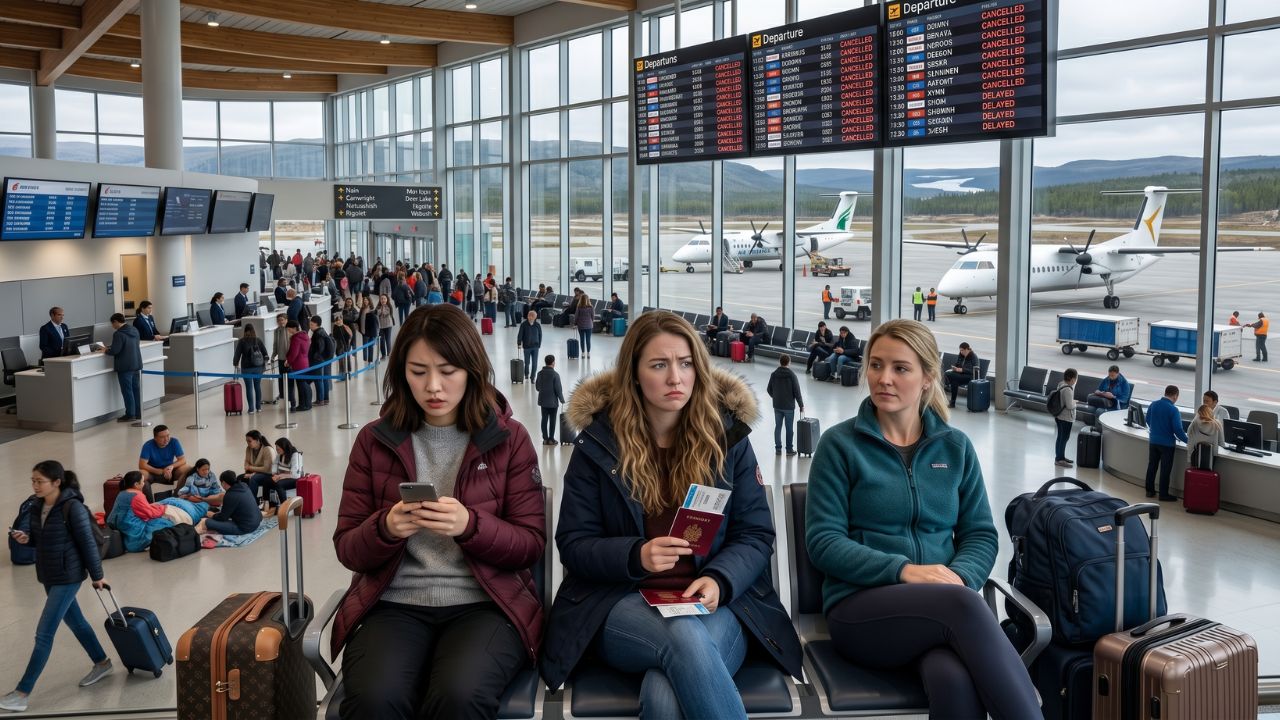
Image generated by AI
A highly unusual and utterly devastating wave of systemic travel chaos has violently disrupted operations at CFB Goose Bay Airport (YYR), effectively isolating highly vulnerable communities across northern Newfoundland and Labrador. Reported on June 19, 2026, the remote regional gateway experienced an unprecedented operational collapse, as Air Borealis and PAL Airlines triggered a combined 12 outright flight cancellations alongside numerous airport disruptions and delays across their fragile networks. This localized gridlock has severely impacted the region’s primary domestic operators, completely severing essential air corridors linking Goose Bay to smaller outposts like Cartwright, Natuashish, and Rigolet, while simultaneously disrupting connections to major hubs like Halifax and Gander. As desperation mounts in a region entirely dependent on aviation for survival, this suspension of scheduled services and the resulting massive travel backlog is driving today's most crucial headline in breaking airline news and essential global aviation updates.
By introducing direct passenger coordination and dynamic scheduling backups, the regional aviation hubs target growing passenger demand across vital commerce sectors. The choice to coordinate flight departures in phases helps to manage gate capacity, supporting the country's broader regional transportation network.
Context: The Total Isolation of Northern Communities
For the Canadian aviation industry, the sudden, devastating travel chaos currently gripping CFB Goose Bay Airport perfectly illustrates the extreme fragility of remote transit networks that rely entirely on a limited number of regional carriers.
CFB Goose Bay serves as the absolute lifeline and primary connecting hub for residents in Labrador; air travel is frequently the sole means of transportation linking these communities to the rest of Canada. Today, however, that critical infrastructure has collapsed. While 12 canceled flights may seem statistically insignificant compared to massive international hubs like Toronto Pearson, the true devastation lies in the nature of the disruption: a complete suspension of services to communities where only one or two flights arrive per day. Because essential transport services, emergency medical flights, and daily supply runs depend entirely on these scheduled services, this full service disruption has instantly caused a massive grounds effect. Residents in remote villages are currently facing total physical isolation, mathematically guaranteed missed medical appointments, and an immediate halt to essential supply movement as operators Air Borealis and PAL Airlines struggle to restore their networks.
To view live flight schedules, verify the active delay status of your specific Newfoundland and Labrador itinerary, or to track active regional airspace restrictions, travelers must consult official aviation directories. For direct updates regarding how this localized travel chaos affects specific route abandonments and current flight cancellations out of Goose Bay, travelers should aggressively utilize the official portals of Air Borealis and PAL Airlines. To explore live flight tracking and monitor the exact severity of the cascading bottlenecks across the northern grid, passengers can consult the official FlightAware tracking service.
Section-Wise Breakdown: The Epicenters of Gridlock
The CFB Goose Bay Epicenter
CFB Goose Bay (YYR) emerged as the absolute primary disruption point. The facility recorded 6 direct cancellations, accounting for 11% of its scheduled operations, making it the most heavily affected location in the network and completely paralyzing its role as a regional transit hub.
The Collapse of the Remote Feeder Network
Beyond Goose Bay, the travel chaos instantly choked smaller, highly vulnerable communities. Nain (YDP) reported 2 cancellations, representing a devastating 50% of its scheduled flights. Natuashish (YNP) saw its only scheduled flight cancelled, resulting in an absolute 100% cancellation rate for the community. Rigolet (YRG) also experienced 1 cancellation, representing 50% of its scheduled services. Additional disruptions were recorded in Cartwright (YRF), where 1 flight was cancelled, and Wabush (YWK), which lost 1 scheduled service.
Mainland Connectivity Severed
The flight backlog directly disrupted onward connections for passengers attempting to reach major centers. Deer Lake (YDF) recorded 1 cancelled flight, equal to 25% of operations. Halifax (YHZ) also recorded 1 cancellation tied to this network, resulting in a 100% cancellation rate for that specific affected operation. Meanwhile, Gander registered a delay without any direct cancellations.
Technical Roster: Goose Bay Aviation Disruption Data
To ensure absolute factual accuracy regarding the exact parameters of this systemic friction and the specific carriers driving the flight cancellations out of Goose Bay, the following matrix details the verified operational data impacting the network:
Flight Cancellations
| Airline | Cancelled Flights | Delayed Flights |
|---|---|---|
| Air Borealis | 9 | 0 |
| PAL Airlines | 3 | 2 |
Data definitively confirms a highly anomalous operational profile: Air Borealis absorbed the overwhelming majority of the destruction, executing 9 outright cancellations with zero delays, indicating a full, pre-emptive grounding of specific regional aircraft.
Passenger Impact: A Nightmare for Essential Travel
For the residents trapped across Labrador today, the sudden volume of cancellations guarantees a highly stressful, potentially life-threatening disruption.
The immediate passenger impact of this localized travel chaos is not merely an inconvenience, but a total severance of essential services. Passengers in this region are rarely traveling for leisure; they typically rely on Goose Bay and its feeder network for vital medical appointments in Halifax or St. John's, urgent government services, education, and supply-related logistics. In remote areas like Natuashish—which suffered a 100% cancellation rate—air transport is an absolute necessity. Because zero alternative carriers operate these routes, passengers cannot simply rebook onto a competitor. They are forced to wait indefinitely for the restoration of Air Borealis and PAL Airlines services, creating massive cost burdens, extended travel times, and severe logistical uncertainty. Frustration is surging throughout the affected communities as residents realize they are physically trapped, unable to move essential supplies or execute critical daily tasks.
Industry Analysis: The Danger of Fragile Regional Networks
Aviation industry analysts view the systemic breakdown at CFB Goose Bay as a critical, glaring reminder of the structural dependency of northern aviation systems on a highly limited number of carriers.
Analysts note that the operational profile—particularly Air Borealis executing 9 outright cancellations with no preceding delays—often points to massive systemic issues affecting airline scheduling, widespread aircraft unavailability, or severe regional weather constraints rather than standard operational hiccups. When a primary regional operator experiences a disruption, the impact is immediately amplified across multiple remote settlements, translating a minor operational issue into immediate regional isolation. Furthermore, the combination of flight cancellations and delays created massive ripple effects throughout the network, underscoring the severe challenges airlines face when disruptions occur across interconnected, low-frequency destinations in Canada’s vast aviation system. The aviation infrastructure in these remote communities is currently highly insufficient to prevent total collapse when the primary carriers ground their fleets.
Actionable Advice for Navigating Northern Gridlock
While standard passengers cannot control regional airline scheduling or aircraft availability, you can execute this strategic survival checklist to manage the travel chaos currently affecting northern Canada:
- Aggressively Monitor Real-Time Updates: Because alternative carriers do not exist at airports like Nain or Natuashish, you cannot rebook onto a competitor. You must obsessively monitor official airline portals and local community boards for real-time updates on when Air Borealis or PAL Airlines intends to resume service. Do not rely solely on automated emails.
- Audit Your APPR Rights: Understand your rights under Canada's Air Passenger Protection Regulations (APPR). If these flight cancellations were within the airline's control (e.g., crew shortages rather than severe weather), you are legally entitled to compensation. Ensure you formally log your delay and request documented proof of the cancellation reason.
- Build Massive Itinerary Buffers: If you are planning to connect through CFB Goose Bay onto an Air Canada or PAL Airlines flight down to Halifax or Deer Lake, never book a same-day connection. The extreme fragility of the northern network demands that you build a 24-to-48-hour buffer into your itinerary to absorb these inevitable, catastrophic groundings without destroying your entire journey.
FAQ: Goose Bay Airport Disruptions
Why is CFB Goose Bay experiencing severe travel chaos?
The northern Canadian hub suffered a severe operational collapse, recording multiple outright flight cancellations that completely isolated several remote communities across Labrador.
Which airlines are responsible for the cancellations at Goose Bay?
Air Borealis (9 cancellations) and PAL Airlines (3 cancellations) were responsible for the massive wave of grounded flights disrupting the regional network.
Which destinations were most impacted by this regional gridlock?
The sudden grounding severed vital connectivity to remote outposts like Nain, Natuashish, Rigolet, and Cartwright, while also disrupting mainland connections to Deer Lake and Halifax.
The Reality of Combating Regional Monopoly Saturation
The severe operational friction currently isolating CFB Goose Bay proves definitively that highly remote transit hubs remain entirely susceptible to catastrophic, life-altering travel chaos. By absorbing 12 outright flight cancellations across the Air Borealis and PAL Airlines networks, the region demonstrates the extreme, inherent danger of relying entirely on low-frequency, single-carrier routes. As the airlines desperately attempt to restore their schedules—stranding vulnerable residents who miss crucial medical appointments in larger cities—travelers and community members must accept a critical new reality: surviving the northern Canadian skies requires aggressive itinerary padding, a thorough understanding of APPR compensation rights, and a relentless demand for better contingency planning to prevent the total isolation of remote communities the moment the departure board flashes red.
Key Takeaways
- Total Community Isolation: Natuashish suffered a catastrophic 100% cancellation rate, while Nain and Rigolet both suffered 50% cancellation rates, isolating remote northern communities.
- Goose Bay Devastated: CFB Goose Bay served as the epicenter of the travel chaos, recording 6 outright flight cancellations (11% of its schedule).
- Air Borealis Grounded: The regional carrier was responsible for the heaviest impact, executing 9 outright cancellations with zero delays.
- Mainland Connectivity Severed: The flight backlog directly disrupted onward connections for passengers attempting to reach Deer Lake and Halifax.
- Essential Travel Destroyed: The total lack of alternative carriers severely impacted residents relying on air travel for urgent medical appointments, education, and vital supply chains.
Related Travel Guides
Massive Travel Chaos Paralyzes Chicago O'Hare with 1,425 Disruptions
Delta Air Lines Triggers US Domestic Flight Cancellations
Goose Bay Disruption Survival Tactics on Reddit
Disclaimer: Strategic operational metrics (including the specific 12 flight cancellations, the exact breakdown involving Air Borealis and PAL Airlines, and the precise cancellation percentages affecting Nain, Natuashish, Deer Lake, and Halifax) are manually sourced directly from live FlightAware telemetry and official airport departure boards issued on June 19, 2026, and are subject to immediate, unannounced adjustments due to shifting regional fleet availability. Travelers are legally advised to constantly verify their exact departure times, explicitly audit their Canadian APPR consumer refund rights, and maintain extreme adaptability directly via official airline portals prior to navigating the highly disrupted northern Canada transit network.
Kunal K Choudhary
Co-Founder & Contributor
A passionate traveller and tech enthusiast. Kunal contributes to the vision and growth of Nomad Lawyer, bringing fresh perspectives and driving the community forward.
Learn more about our team →