
Google to Acquire Spirit Airlines Internal Data for $10M to Train Gemini AI Models in 2026
Google has outbid AI firm Mercor to acquire a $10 million dataset of internal Spirit Airlines communications and operational records to fuel AI training and enterprise product development.

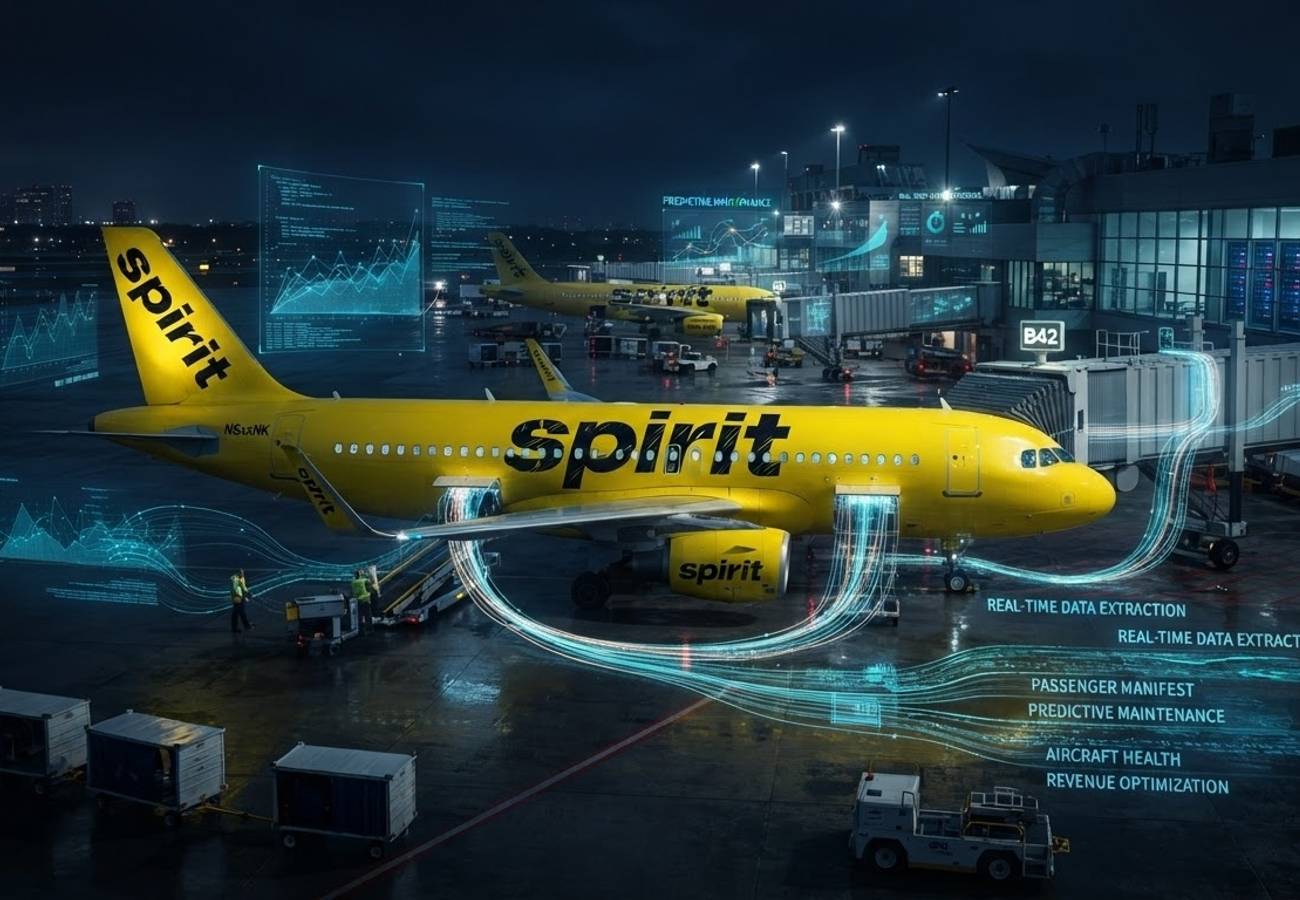
Image generated by AI
Google has reached an agreement to pay $10 million for a massive repository of internal Spirit Airlines business data. The acquisition, emerging from the carrier's bankruptcy proceedings, signals a shift in how defunct travel brands are viewed—not just as a collection of aircraft and slots, but as "corporate memory" used to fuel artificial intelligence.
Google successfully outbid AI data specialist Mercor to secure the package. Unlike the sale of physical assets, this transaction focuses entirely on the digital "brain" of the former ultra-low-cost carrier.
The Spirit Dataset: Composition and Scale
The acquired data is not a customer list, but a comprehensive archive of how a major airline functioned internally. Our analysis of the court filings indicates the dataset includes:
- Email Volume: Approximately 100 million internal emails.
- Communication Logs: Hundreds of millions of Microsoft Teams messages.
- Operational Records: Years of spreadsheets, calendars, and internal documents.
- Technical Assets: Code repositories and detailed operational histories.
- Human Capital Data: HR records and productivity metrics.
A federal bankruptcy judge must still rule on the transaction in an upcoming hearing before the sale is finalized.
AI Integration and Product Development
Google intends to utilize this "messy," real-world enterprise data to refine its Gemini platform and other enterprise-grade AI tools. From a logistical perspective, this provides Google with a rare glimpse into the decision-making hierarchies of a high-volume airline.
The data allows AI models to learn how Spirit:
- Priced specific routes and managed demand forecasting.
- Scheduled aircraft and handled irregular operations (IROPS).
- Managed frontline staff and responded to systemic disruptions.
If these insights are integrated into Google Cloud products, the operational efficiencies derived from Spirit's history could eventually be marketed to other airlines and airport operators.
Privacy Safeguards and Legal Friction
The deal hinges on the "deidentification" of the data. Court documents specify that personally identifiable information (PII)—including customer credit card details and direct passenger profiles—must be stripped before Google takes possession.
However, the sale raises significant E-E-A-T (Experience, Expertise, Authoritativeness, and Trustworthiness) concerns regarding employee privacy. While bankruptcy law permits the sale of data as an asset, legal commentators argue that employees did not consent to have their internal workplace communications repurposed as training material for a third-party AI.
For travelers, the risk is more subtle. Even without names, the behavioral clues and booking patterns within these datasets allow AI to model consumer demand at a scale that blurs the line between operational analytics and personal privacy.
Asset Valuation in Aviation Bankruptcy
The Spirit case marks a turning point in aviation insolvency. Historically, bankruptcy auctions focused on tangible assets. Now, intangible digital assets—reservation systems, loyalty databases, and internal workflows—are becoming contested high-value items.
| Asset Category | Traditional Value | New AI-Era Value |
|---|---|---|
| Physical Assets | Aircraft, Spare Parts, Slots | Liquidation for Creditors |
| Customer Data | Direct Marketing / Lead Gen | Behavioral Modeling / Demand AI |
| Internal Logs | Liability / Storage Cost | AI Training Fuel / Process Optimization |
Why This Matters: Industry Implication
For the aviation industry, this deal proves that the "back office" is now a strategic asset. We are seeing the emergence of a new risk vector: Data Leakage via Insolvency.
When an airline fails, its internal operational secrets—the exact logic used for pricing, staffing, and disruption management—can now be sold to the highest bidder. This creates a competitive imbalance where a technology giant can "absorb" the operational experience of a failed carrier and sell those optimized processes back to the surviving competitors.
From a traveler's perspective, this won't change ticket prices tomorrow. However, it will likely lead to more aggressive ancillary fee optimization and highly automated customer service bots that have "learned" from millions of real Spirit Airlines interactions.
Forward Outlook
We expect this transaction to trigger a regulatory review of how deidentification is handled in corporate bankruptcies. If technology firms continue to target these datasets, expect:
- Tighter Labor Contracts: Future airline employee agreements may include clauses prohibiting the sale of internal communications to AI firms.
- Data Minimization: Carriers may adopt more aggressive data deletion policies to prevent their operational "playbook" from becoming a marketable asset during financial distress.
- Regulatory Standards: Watchdogs may demand clearer notification processes for employees and customers when corporate archives are repurposed for machine learning.
The travel industry's past is no longer just a record—it is the raw material for the next generation of aviation AI.
Related Travel Guides
Disclaimer
This article is for informational and educational purposes only. It does not constitute legal, financial, or professional advice. While we strive to provide accurate and up-to-date information, travel policies, regulations, and conditions change rapidly. Always verify information with official sources before making travel decisions. Nomad Lawyer makes no representations about the accuracy, reliability, completeness, or suitability of the information provided. Readers should consult qualified professionals for advice specific to their circumstances. The views expressed in this article are those of the author and do not necessarily reflect the views of Nomad Lawyer.
Raushan Kumar
Founder & Lead Developer
Full-stack developer with 11+ years of experience and a passionate traveller. Raushan built Nomad Lawyer from the ground up with a vision to create the best travel and law experience on the web.
Learn more about our team →