
GOL Cargo Boeing 737-800 Freighter Overruns Runway at Salvador International Airport in Wet Weather — No Injuries, CENIPA Investigation Launched, Airport Operations Continue on May 9, 2026
A GOL Cargo Boeing 737-800ERX freighter overran the runway at Salvador International Airport (SSA) on May 9, 2026 in rainy conditions. No injuries were reported, one runway was closed for aircraft removal, and Brazil's CENIPA has launched a formal investigation.

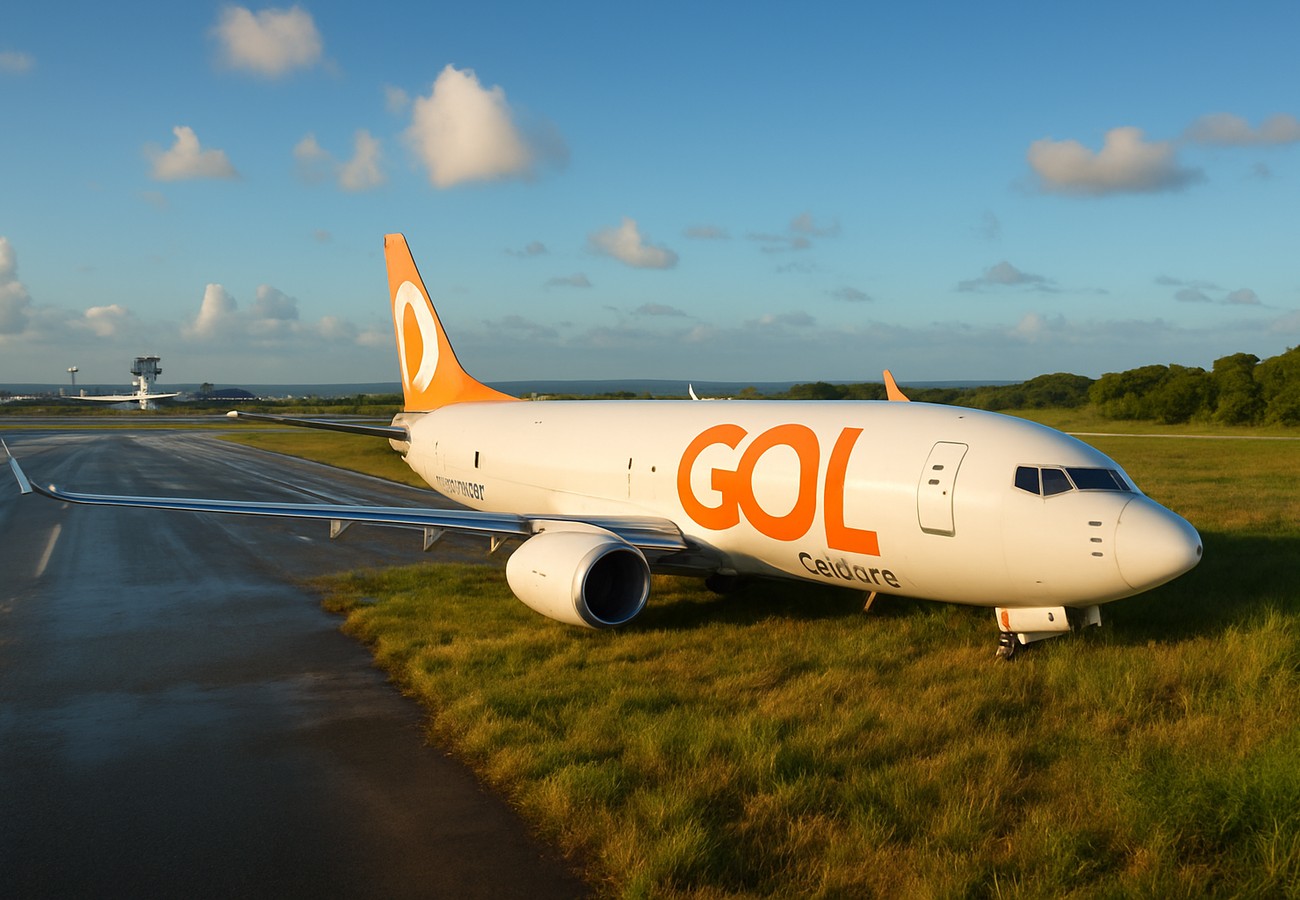
Image generated by AI
A GOL Cargo Boeing 737-800ERX (BCF) freighter overran the runway at Salvador International Airport (SSA) in northeastern Brazil in the early hours of Saturday, May 9, 2026, after landing in wet conditions left by rain showers across the region — an incident that triggered an immediate runway closure, a formal safety investigation by Brazil's aviation authority, and a swift response from airport operator Vinci Airports, while thankfully leaving both crew members unharmed and commercial passenger operations uninterrupted.
What Happened: A Wet Runway, a Cargo Freighter, and a Controlled Overrun
The sequence of events was contained but consequential. The GOL Cargo freighter — a Boeing 737-800 converted to a Boeing Converted Freighter (BCF) configuration, repurposed from a passenger jet for dedicated cargo operations — was completing its landing roll at Salvador International Airport when it failed to decelerate within the available runway length.
Meteorological observations for the airport area at the time of the incident indicated variable breeze and cloudy conditions with rain showers affecting parts of the region. The wet runway surface is understood to have reduced braking effectiveness at the moment of touchdown, a known contributing factor in runway excursion events across global aviation.
The aircraft came to rest beyond the paved runway surface, but did not collide with any structures, perimeter fencing, or other aircraft. No fire and no secondary hazards were reported following the overrun — a reflection of both robust aircraft safety systems and sound crew procedure under pressure. Both crew members, the only occupants of the all-cargo flight, walked away without injury.
Airport Response: One Runway Closed, One Operational
Vinci Airports, the international concessionaire operating Salvador International Airport, moved immediately. The runway involved in the overrun was closed to all traffic to allow ground crews and investigators safe access for aircraft removal operations and an initial examination of the landing surface and surrounding area.
Critically, Salvador International Airport operates with more than one runway. Commercial passenger flights and general aviation operations continued normally on the unaffected runway throughout the incident period, with no reported delays or cancellations to scheduled services. Airlines operating into and out of SSA were advised to monitor official airport communications for any updates on runway availability.
For freight customers and logistics operators with cargo moving through Salvador, the advice is direct: contact your freight forwarder or GOL Cargo directly for status on any shipments that may have been on the affected aircraft or routed through SSA in the immediate aftermath.
The Investigation: CENIPA Takes Charge
In Brazil, runway overrun incidents of this nature fall under the mandatory investigation jurisdiction of the Aeronautical Accidents Investigation and Prevention Centre (CENIPA) — the national authority responsible for investigating aviation occurrences and publishing safety recommendations. CENIPA coordinates all evidence collection and analysis, drawing on:
- Flight data recorder (FDR) and cockpit voice recorder (CVR) data from the aircraft
- Air traffic control communications and radar records
- Runway surface condition reports from the airport at the time of landing
- Meteorological data from weather stations serving the SSA area
- Aircraft maintenance and technical records from GOL Cargo
The airline will work in parallel with CENIPA, civil aviation regulators, and Vinci Airports to compile a comprehensive incident record. Preliminary findings may be released within weeks; a full technical safety report typically follows within 12 months for incidents of this classification.
GOL Cargo and the BCF Fleet: Context
GOL Linhas Aéreas Inteligentes — Brazil's major low-cost carrier — operates a cargo division that has expanded significantly as air freight demand in Brazil's domestic market has grown. The Boeing 737-800 BCF at the centre of this incident is a converted passenger aircraft repurposed for freight operations, a common and cost-effective approach to cargo capacity expansion used by carriers worldwide.
The BCF configuration preserves the structural airframe of the 737-800 while adding freight door reinforcements, cargo liner systems, and modified interior configurations. Because the aircraft was operating as a pure freighter, no passengers were aboard at the time of the overrun — a factor that contributed directly to the absence of passenger injuries, though the safety of flight crew and ground personnel is always equally paramount.
GOL Cargo's operations are integral to Brazil's domestic freight network, connecting major economic and population centres including São Paulo, Rio de Janeiro, Brasília, Salvador, and Manaus. Any disruption to GOL Cargo's fleet availability has downstream implications for time-sensitive freight across the country.
Weather and Runway Safety: The Broader Risk Picture
Runway overruns are among the most statistically common categories of serious aviation incidents globally. The Aviation Safety Network classifies runway excursions — which include overruns, undershoots, and veer-offs — as significant safety occurrences requiring mandatory investigation under ICAO Annex 13 standards.
The contributing risk factors are well-established in aviation safety literature:
| Risk Factor | Relevance to Salvador Incident |
|---|---|
| Wet or contaminated runway | Confirmed — rain showers reported at time of landing |
| Reduced braking friction coefficient | Likely — wet surface degrades tyre-to-pavement grip |
| Landing speed at touchdown | Under investigation by CENIPA |
| Aircraft weight and configuration | Under investigation — BCF conversion may affect landing performance data |
| Runway length and slope | Part of CENIPA's runway surface examination |
Airports operating in tropical and subtropical climates — Salvador sits at 13 degrees south latitude and experiences regular rainfall — routinely monitor runway conditions and issue braking action reports to arriving crews. The accuracy and timeliness of those reports on the night of May 9 will be among the specific elements CENIPA examines.
What Travelers and Freight Customers Should Know
The immediate practical picture for travelers passing through Salvador International Airport is reassuring: commercial passenger flights continue to operate normally on the unaffected runway, and no cascading delays have been reported.
For freight and logistics stakeholders:
- Contact GOL Cargo or your freight forwarder directly for status on any cargo shipments routed through SSA on May 9, 2026
- Monitor Vinci Airports' official communications for any updates on the affected runway's return to service
- No passenger flight disruptions have been reported as a result of this incident — travelers with scheduled SSA departures or arrivals should proceed normally unless advised otherwise
- CENIPA investigation updates will be published through Brazil's civil aviation authority channels as they become available
FAQ: GOL Cargo Runway Overrun at Salvador Airport 2026
Q: Were any passengers injured in the GOL Cargo runway overrun at Salvador? No. The Boeing 737-800 BCF was operating as a cargo-only freighter with no passengers aboard. Both crew members on the flight walked away without injury. No fire or secondary hazards were reported following the overrun.
Q: Is Salvador International Airport still open after the incident? Yes. Salvador International Airport (SSA) continues to operate normally on its unaffected runway. Commercial passenger flights have not been disrupted. Only the runway involved in the overrun was closed, for aircraft removal and investigation access.
Q: Who is investigating the GOL Cargo runway overrun in Brazil? Brazil's CENIPA (Aeronautical Accidents Investigation and Prevention Centre) has jurisdiction over the investigation. CENIPA will analyse flight recorder data, air traffic control records, runway surface conditions, and meteorological data. The airline and airport operator are cooperating fully.
The Bigger Picture: Aviation Safety in Brazil's Growing Freight Market
Brazil's air cargo market has expanded sharply in the post-pandemic period, driven by e-commerce growth, pharmaceutical cold-chain logistics, and the country's vast internal geography — which makes air freight economically essential for connecting remote regions with major urban centres. GOL Cargo's BCF fleet sits at the operational heart of that expansion.
Runway safety in Brazil's diverse airport network — spanning tropical coastal airports like Salvador to high-altitude Andean approaches in the west — presents genuinely varied meteorological and infrastructure challenges. ANAC (Brazil's National Civil Aviation Agency) and CENIPA work in coordination to ensure that incident learnings are translated into updated operational procedures and infrastructure investment priorities. The Salvador overrun will feed into that process, contributing to the evidence base that shapes runway safety protocols for wet-weather operations across the country's freight network.
Key Takeaways
- A GOL Cargo Boeing 737-800 BCF freighter overran the runway at Salvador International Airport (SSA) on May 9, 2026 during landing in wet conditions
- No injuries — both crew members walked away unharmed; no passengers were aboard
- No fire or secondary hazards were reported; the aircraft came to rest beyond the paved surface without structural collision
- Vinci Airports closed the affected runway for aircraft removal and investigation; SSA continues normal operations on its unaffected runway
- CENIPA (Brazil's aviation investigation authority) has launched a formal investigation covering flight data, runway conditions, weather data, and aircraft records
- Wet runway surface from regional rain showers is the primary suspected contributing factor; all variables are under investigation
- Commercial passenger operations at SSA are unaffected — travelers should proceed normally
Related Travel Guides
- United Express Flight RPA3672 Embraer E175LR Diverts to Indianapolis International Airport from Newark to Detroit in 2026
- United States Expands Connectivity: JetBlue Launches Daily Fort Lauderdale-Cleveland Service
- Lufthansa Accelerates Retirement of Four-Engine Jets Amid Aviation Industry Restructuring
Disclaimer
This article is for informational and educational purposes only. It does not constitute legal, financial, or professional advice. While we strive to provide accurate and up-to-date information, travel policies, regulations, and conditions change rapidly. Always verify information with official sources before making travel decisions. Nomad Lawyer makes no representations about the accuracy, reliability, completeness, or suitability of the information provided. Readers should consult qualified professionals for advice specific to their circumstances. The views expressed in this article are those of the author and do not necessarily reflect the views of Nomad Lawyer.
Kunal K Choudhary
Co-Founder & Contributor
A passionate traveller and tech enthusiast. Kunal contributes to the vision and growth of Nomad Lawyer, bringing fresh perspectives and driving the community forward.
Learn more about our team →