
Brazil Flight Crisis: LATAM, Gol, Azul Cancel 9 Flights, Delay 24 at São Paulo-Congonhas on April 14, 2026
Major disruptions hit São Paulo-Congonhas Airport as LATAM, Gol, and Azul cancel 9 flights and delay 24 others, affecting Rio de Janeiro, Salvador, and Recife.

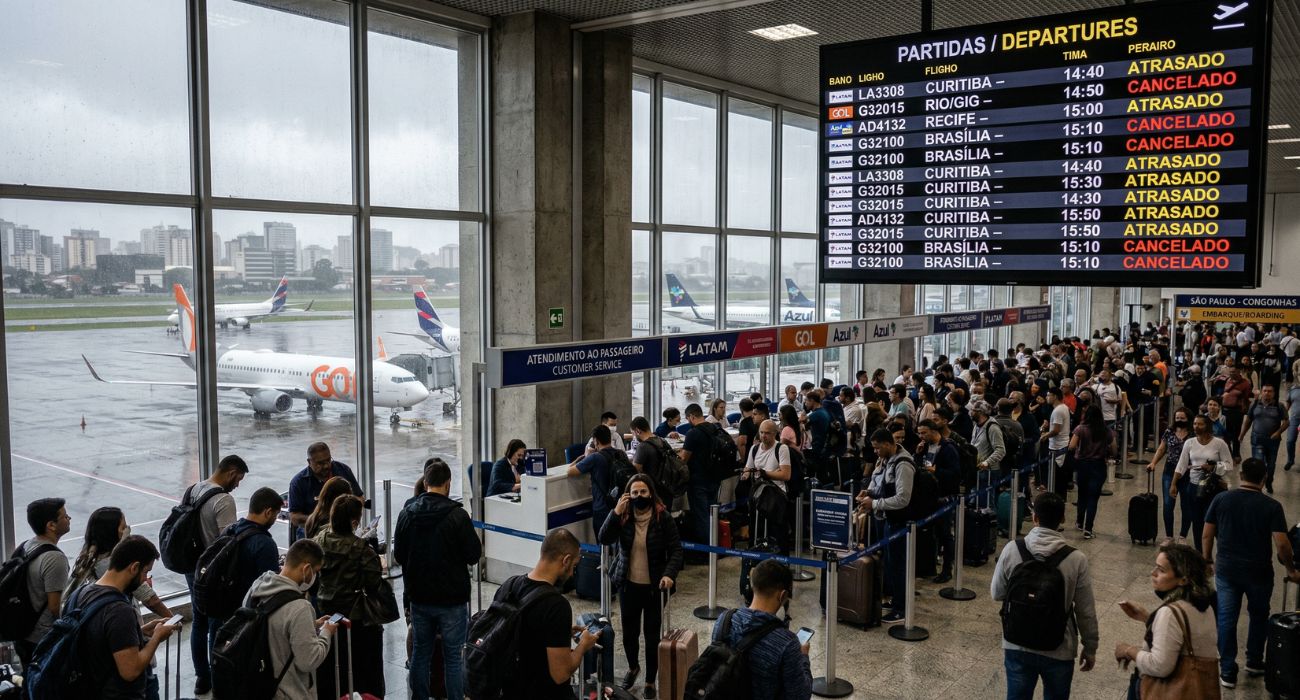
Image generated by AI
Widespread Flight Chaos Grips Brazil's Major Aviation Hub
São Paulo-Congonhas Airport experienced significant operational disruptions on April 14, 2026, as three of Brazil's largest carriers—LATAM, Gol Linhas Aéreas, and Azul Brazilian Airlines—were forced to cancel 9 flights and delay 24 others. The cascading disruptions rippled across Brazil's domestic aviation network, affecting major hubs including Rio de Janeiro, Salvador, Recife, and numerous regional destinations. Thousands of passengers faced uncertain travel plans as operational challenges and severe weather conditions strained the country's busiest aviation infrastructure.
Understanding the Scale of Disruptions at Congonhas
São Paulo-Congonhas Airport (CGH), one of South America's most centrally located and busiest aviation hubs, bore the brunt of the disruptions. The airport recorded a combined total of 24 delays and 9 complete cancellations on the morning of April 14, 2026.
As a critical connector in Brazil's domestic aviation network, the backlog at Congonhas created a domino effect across regional routes, with certain connections seeing nearly their entire daily service compromised. The situation tested the operational resilience of major carriers and regional operators alike, leaving passengers scrambling for alternative arrangements.
Airline-by-Airline Impact Analysis
The disruption data reveals distinct operational challenges across Brazil's three largest carriers:
LATAM Brasil emerged as the most severely affected airline:
- 8 cancellations (representing 3% of its daily schedule)
- 16 delays (accounting for 6% of its operations)
- As the largest operator at Congonhas, LATAM's struggles were largely responsible for crowded terminal conditions
GOL Linhas Aéreas maintained relatively better operational stability:
- 1 cancellation (statistically 0% of operations)
- 5 delays (representing 2% of scheduled flights)
Azul Brazilian Airlines avoided cancellations entirely:
- 0 cancellations
- 3 delays (accounting for 3% of scheduled flights)
Geographic Vulnerability: Regional Routes Face Disproportionate Impact
The disruption data reveals a critical divide between high-frequency business routes and more vulnerable regional connections. While Congonhas is situated in the heart of São Paulo, the impact was distributed across Brazil's entire domestic network, with specific regions bearing disproportionate burdens.
South Corridor Challenges
Regional hubs in Brazil's South faced significant percentage-based disruptions:
- Ministro Victor Konder International (NVT) in Navegantes reported the highest regional disruption rate: 10% cancellations paired with 10% delays
- Afonso Pena International (CWB) in Curitiba recorded 4% cancellations and 4% delays
- Salgado Filho International (POA) in Porto Alegre reported 4% cancellations and 4% delays
Northeast Region Struggles
The Northeast experienced notable disruptions affecting key tourism and business destinations:
- Salvador International (SSA) faced a 6% cancellation rate
- Maceió International (MCZ) and Campo Grande International (CGR) reported 50% delay rates
- Pelotas Airport (PET) suffered the most extreme disruption: a 100% delay rate, meaning no flights departed for this destination on time
The "Air Bridge" Resilience: Rio-São Paulo Route Remains Stable
A striking contrast emerged in the data: the famous Ponte Aérea (Air Bridge) connecting São Paulo to Rio de Janeiro – Santos Dumont (SDU) remained remarkably resilient despite the widespread disruptions.
Despite 24 total delays recorded at Congonhas, the SDU route reported only:
- 1% delay rate
- 0% cancellations
This disparity suggests that airlines prioritize their highest-yield, highest-frequency routes during operational constraints. Passengers traveling to regional secondary markets like Navegantes or Salvador faced significantly higher cancellation and consolidation risks, as carriers preserved schedules for the lucrative Rio-São Paulo shuttle service.
What This Means for Travelers
If you were among the hundreds of passengers affected by the 9 cancellations or 24 delays at Congonhas on April 14, 2026, you have legal protections and recourse options.
Your Rights Under Brazilian Aviation Law
Affected passengers are protected under ANAC Resolution 400, Brazil's primary aviation consumer protection regulation. This resolution establishes mandatory assistance requirements and compensation thresholds for airlines operating in Brazilian airspace.
Immediate Action Steps
For delayed flights:
- Check your flight status via airline mobile apps before heading to the airport
- If your flight is delayed beyond two hours, do not leave the boarding area without obtaining a voucher from the airline
- Request meal vouchers, accommodation (if applicable), and communication assistance from your carrier
For cancelled flights:
- Seek rebooking options immediately through your airline's customer service
- Consider alternative routing via Guarulhos International (GRU), which typically has higher capacity to absorb passengers during Congonhas operational peaks
- Request compensation in accordance with ANAC Resolution 400 if the cancellation was within the airline's control
Verification Resources
Monitor real-time flight status updates through FlightAware, which provides independent tracking of flight operations across Brazilian airports. For official regulatory information, consult the National Civil Aviation Agency (ANAC) website.
Key Takeaways
The disruptions at São Paulo-Congonhas on April 14, 2026 highlighted critical vulnerabilities in Brazil's domestic aviation network:
- LATAM bore the largest operational burden with 8 cancellations and 16 delays
- Regional routes in the South and Northeast experienced disproportionately higher disruption rates
- The Rio-São Paulo Air Bridge maintained exceptional stability, suggesting airline prioritization of high-yield routes
- Passengers have legal protections under ANAC Resolution 400 and should verify flight status before traveling
As Brazil's aviation sector continues to manage operational challenges, travelers are advised to monitor their flight status closely and maintain flexibility in their travel plans.
Related Travel Guides
Disclaimer
This article is for informational and educational purposes only. It does not constitute legal, financial, or professional advice. While we strive to provide accurate and up-to-date information, travel policies, regulations, and conditions change rapidly. Always verify information with official sources before making travel decisions. Nomad Lawyer makes no representations about the accuracy, reliability, completeness, or suitability of the information provided. Readers should consult qualified professionals for advice specific to their circumstances. The views expressed in this article are those of the author and do not necessarily reflect the views of Nomad Lawyer.
Kunal K Choudhary
Co-Founder & Contributor
A passionate traveller and tech enthusiast. Kunal contributes to the vision and growth of Nomad Lawyer, bringing fresh perspectives and driving the community forward.
Learn more about our team →