
Global Flight Turmoil in Q1 2026 Exposes Aviation Infrastructure Fragility
Over 31,000 delays and cancellations in early 2026 reveal how global flight turmoil stems from centralized hub dependency, IT failures, and thin contingency buffers. Travelers face cascading disruptions across major routes.

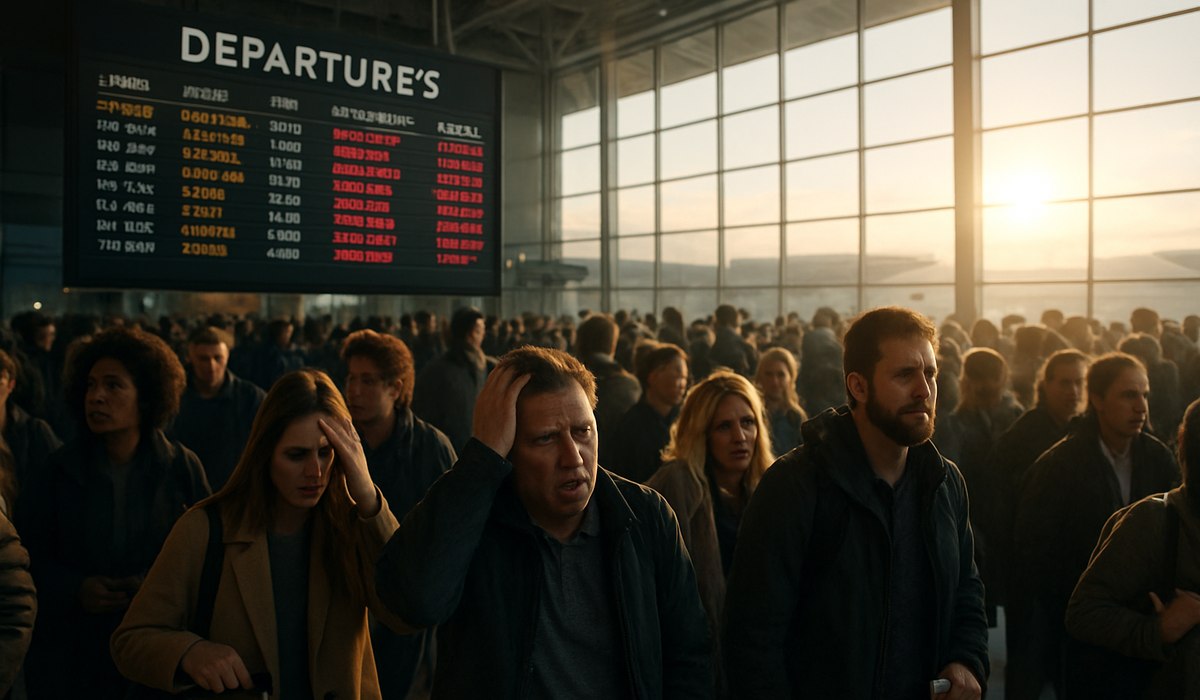
Image generated by AI
The Perfect Storm: How Q1 2026 Became Aviation's Crisis Quarter
Global flight turmoil has reached unprecedented levels in early 2026, with over 31,000 combined delays and cancellations documented in North and South America alone during March. The convergence of IT infrastructure failures, extreme weather events, and geopolitical airspace closures has exposed how dangerously centralized modern aviation has become. From Atlanta and Dallas to Toronto and major hubs across Asia Pacific and Europe, the cascading failures reveal that contingency buffers designed to absorb disruptions have worn dangerously thin, leaving passengers stranded and airlines scrambling for recovery solutions.
Weather Chaos and Network Gridlock Converge
March 2026 witnessed an unusually dense cluster of severe weather events striking major aviation hubs simultaneously. Storm systems repeatedly disrupted operations across the Americas, with thunderstorms battering corridors serving Mexico, the Caribbean, and South America during peak travel season. The combination of full aircraft, minimal spare capacity, and compressed crew scheduling meant that single weather delays multiplied into system-wide gridlock within hours.
Asia Pacific Experiences Crisis Day with 2,300 Cancellations on March 11 demonstrated how quickly regional disruptions escalate into global consequences. That single day saw more than 18,000 delays worldwide, with 774 cancellations concentrated in Asia Pacific as thunderstorms, operational strain, and knock-on effects from Middle East airspace restrictions overwhelmed airline and airport contingency plans. For travelers, routine connections became multi-day ordeals. Track real-time disruptions using FlightAware to understand how weather impacts propagate through your planned routes.
Asia Pacific Reveals How Thin Operating Margins Have Become
The region's exposure during March's crisis day highlighted a critical vulnerability in modern aviation strategy. Airlines operating between Asia and Europe depend heavily on Gulf corridor routes and limited alternative pathways. When weather compounds with airspace restrictions, passengers discover that seemingly redundant flight options have evaporated, leaving only expensive rebooking alternatives or multi-day delays.
Load factors—the percentage of available seats filled—have climbed to historically high levels across major Asia Pacific carriers. This efficiency metric, celebrated in investor reports, translates to zero slack when disruptions occur. A single cancellation cascades through a network where aircraft and crews have virtually no buffer time between rotations.
Middle East Chokepoint Exposes Aviation's Structural Vulnerability
The late February geopolitical crisis involving Iran, Israel, and the United States provided the clearest recent example of how concentrated global aviation infrastructure fragility has become. After Iranian strikes on Qatar, Qatari airspace closure on February 28 forced the suspension of standard commercial operations at Doha's Hamad International Airport, one of the world's busiest transfer hubs.
The three major Gulf super-connectors—Doha, Dubai, and Abu Dhabi—collectively process approximately 300,000 passengers daily. Their simultaneous constraint triggered cascading cancellations and diversions affecting routes to Europe, Asia, and Africa. For Asian and African travelers dependent on Gulf hubs for onward connections to the Americas or Europe, a single missed connection meant losing access to the only daily flight option.
European traffic data confirmed the scale of impact. During late February's worst days, flows between Europe and the Middle East dropped by roughly 66% compared to the same period the previous year. Airlines responded with temporary schedule cuts and equipment repositioning, but travelers continued experiencing longer routings, reduced frequencies, and heightened uncertainty about onward connections. This structural imbalance—where a handful of mega-hubs handle disproportionate global traffic—represents the core vulnerability in modern air networks.
IT System Outages Turn Local Failures Into Global Disruptions
Beyond weather and geopolitics, aging digital infrastructure has become a hidden crisis point. In January 2026, a radio communications failure in Greece forced authorities to close the country's airspace for hours after interference compromised both primary and backup communication channels. The outage grounded approximately 120 flights at Athens and Thessaloniki on a single day, creating ripple effects through European networks that depend on Greek airspace connectivity.
These technology vulnerabilities disproportionately affect modern aviation because systems were often designed in the 1980s and 1990s but now handle triple the passenger volumes they were engineered to accommodate. Backup systems frequently share dependencies with primary infrastructure, meaning that a single-point failure can overwhelm redundancy mechanisms. The Federal Aviation Administration has documented similar vulnerabilities affecting U.S. networks—consult FAA guidance for updates on infrastructure modernization timelines.
Why Contingency Buffers Are Breaking Down
Airlines have systematically reduced contingency reserves over the past two decades to maximize efficiency and profitability. Crew scheduling software calculates minimum viable rotations with virtually no padding. Aircraft maintenance windows fit precisely between revenue flights. Gate assignments happen minutes before boarding. Airport staff operate at baseline levels designed for normal operations.
This optimization worked during stable conditions but creates catastrophic vulnerability when disruptions occur. A single weather delay that once absorbed a 2-hour buffer now triggers cascading cancellations through the entire daily schedule. The shortage of spare aircraft means planes cannot be quickly repositioned to cover disrupted routes. Crew rest requirements prevent rapid recovery, trapping crews in hotels while aircraft sit idle.
The structural problem is that contingency buffers are invisible costs in normal operations, while their removal generates measurable quarterly savings. The industry has collectively optimized for efficiency at the expense of resilience, creating a system where any disturbance—whether snowstorms, thunderstorms, or IT failures—produces disruptions vastly larger than the triggering event warrants.
Key Data: Q1 2026 Global Flight Disruption Statistics
| Metric | Value | Region/Route |
|---|---|---|
| Combined Delays & Cancellations | 31,000+ | North & South America (March) |
| Single-Day Cancellations | 2,300 | Asia Pacific (March 11) |
| Single-Day Global Delays | 18,000+ | Worldwide (March 11) |
| Europe-Middle East Flow Reduction | 66% | Peak disruption (Feb 28) |
| Daily Passenger Volume (Gulf Hubs) | 300,000 | Doha, Dubai, Abu Dhabi combined |
| Flights Grounded (Greece Outage) | 120 | Athens & Thessaloniki |
| Europe-Middle East Flow Drop | 25% | Standard disruption weeks |
| Major Hub Network | 3+ | Doha, Dubai, Abu Dhabi, others |
What This Means for Travelers: Your Action Checklist
-
Monitor Proactively: Use FlightAware and your airline's app to track real-time flight status. Check 72 hours before departure, then again 24 hours and 2 hours before your flight, as disruptions cascade during peak periods.
-
Build Routing Redundancy: Avoid single-connection itineraries through Gulf hubs when possible. If using Middle Eastern hubs, add 4+ hours to connection time rather than airline minimums. Consider alternative European or Asian transfer points.
-
Know Your Rights: The U.S. Department of Transportation enforces passenger compensation rules for airline-caused delays exceeding 3 hours. Review US DOT consumer protection standards before flying to understand meal, hotel, and rebooking entitlements.
-
Request Rebooking Immediately: If your flight is cancelled, request rebooking on alternative airlines before accepting hotel vouchers. The first airline to confirm your onward connection controls your recovery,
Disclaimer
This article is for informational and educational purposes only. It does not constitute legal, financial, or professional advice. While we strive to provide accurate and up-to-date information, travel policies, regulations, and conditions change rapidly. Always verify information with official sources before making travel decisions. Nomad Lawyer makes no representations about the accuracy, reliability, completeness, or suitability of the information provided. Readers should consult qualified professionals for advice specific to their circumstances. The views expressed in this article are those of the author and do not necessarily reflect the views of Nomad Lawyer.
Raushan Kumar
Founder & Lead Developer
Full-stack developer with 11+ years of experience and a passionate traveller. Raushan built Nomad Lawyer from the ground up with a vision to create the best travel and law experience on the web.
Learn more about our team →