
Germany’s Rhine And Danube Face Severe Low Water, Disrupting River Cruises And Travel Plans
Germany’s Rhine And Danube Face Severe Low Water, Disrupting River Cruises And Travel Plans

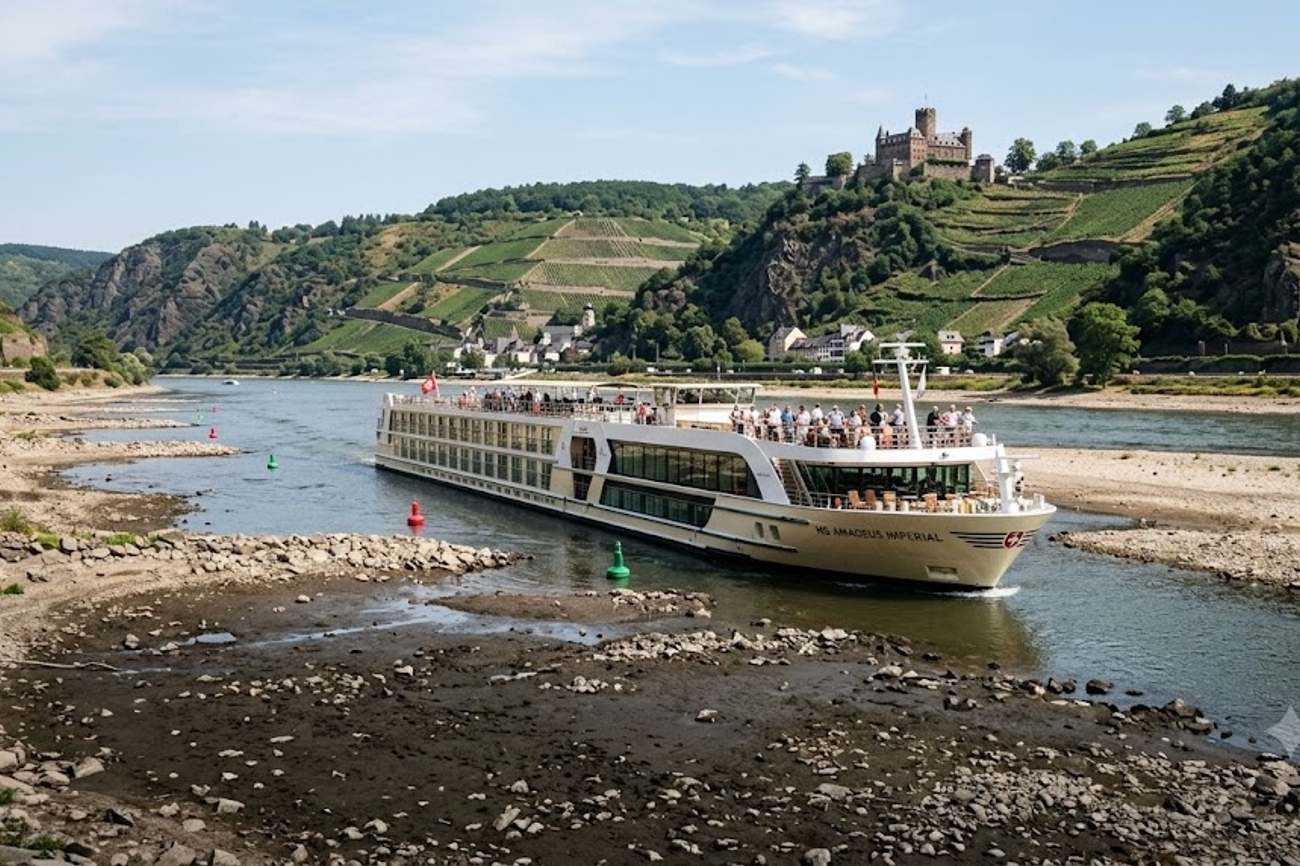
Image generated by AI
[Berlin, September 25, 2026] — Germany’s primary river-cruise networks are facing severe operational disruptions as water levels on the Rhine and Danube plummet to critical lows, forcing widespread itinerary changes and vessel cancellations.
The crisis follows a brief period of recovery in late August, but rapid declines in water depth have now triggered emergency measures for autumn travelers. The situation is most acute at Kaub on the Rhine, where the gauge level dropped to a staggering 2 centimeters on September 25, surpassing the low-water records set earlier this August. Monitoring stations across the Federal Waterways and Shipping Administration (WSV) network indicate that the disruption is not limited to a single stretch of river but is affecting multiple key hubs including Cologne, Duisburg-Ruhrort, and Düsseldorf.
Low Water Triggers Navigational Crisis
The current disruption is driven by a lack of available depth in the navigable channels. While a "negative" gauge reading does not mean a river has dried up—as readings are measured against a specific reference point—it indicates that the water is too shallow for the draught of large passenger vessels. When clearance between the ship's hull and the riverbed vanishes, ships risk grounding or becoming trapped in locks.
The scale of the crisis is evidenced by the percentage of monitoring stations reporting "extremely low" water levels as of September 25, 2026:
| River | % Monitoring Points Extremely Low | Current Travel Impact |
|---|---|---|
| Danube | 73.8% | Significant cruise disruption |
| Rhine | 40.5% | Frequent route and port changes |
| Weser | 35.6% | Potential navigation restrictions |
| Elbe | 12.0% | Conditions comparatively improved |
| Oder | 10.0% | Conditions comparatively improved |
| Mosel | Normal Range | Indirectly affected by Rhine access |
The data highlights a critical reality for travelers: a cruise may be scheduled on a river that appears navigable, but if the connecting waterways or the specific ports of embarkation are blocked by low water, the entire itinerary becomes unviable.
Who Is Affected
The disruption impacts thousands of passengers booked on autumn voyages across Central Europe. The following operators and routes are currently reporting significant instability:
- The Danube Market: This is the hardest-hit region, with nearly 74% of monitoring points reporting extreme lows. This has led to a higher volume of outright cancellations compared to other rivers.
- The Rhine Corridor: Vessels operating between the Netherlands, Belgium, and Germany are facing restricted access. Many ships are being diverted away from German landmarks and toward the Benelux region.
- Specific Operators:
- Nicko Cruises: Reporting multiple cancellations and itinerary shifts, specifically on the Danube.
- Phoenix Reisen: Redirecting planned Rhine and Mosel journeys toward Belgium and the Netherlands.
- Viva Cruises: Implementing amended itineraries for voyages scheduled through late September and October.
- Thurgau Travel: Issuing a combination of cancellations and modified routes.
- A-Rosa: Conducting daily assessments of individual river sections to determine viability.
What This Means for Travelers
For the average passenger, "low water" translates to a fragmented travel experience. You should not expect your itinerary to remain static. In plain language, here is how your trip may change:
1. The "Bus-Bridge" Experience: If a ship cannot pass a shallow section, operators often employ "ship transfers." You may be required to disembark, travel by coach over a shallow stretch of the river, and board a second vessel on the other side.
2. Port Skipping: High-profile stops in German cities may be bypassed entirely. If a port's entrance is too shallow, the ship will skip the city, and the operator may attempt to provide a replacement overland excursion.
3. Total Rerouting: Your "German Highlights" cruise could suddenly become a "Belgium and Netherlands" tour. While the cruise continues, the cultural and geographic focus of the trip changes completely.
4. Sudden Cancellations: In extreme cases, particularly on the Danube, the voyage may be cancelled entirely shortly before departure.
Navigation Risks and Safety Protocols
The danger of operating in these conditions is not theoretical. This summer saw a river cruise vessel become stranded on a sandbank near Bonn on the Rhine, requiring emergency assistance for crew and passengers. An even more severe incident occurred on the Danube near Vidin, Bulgaria, where a grounding forced a full evacuation of the ship.
Because of these risks, the decision to sail is not based on a single "magic number" or threshold. Instead, it is a complex calculation involving:
- The specific draught (depth) of the vessel.
- Real-time data from the European Union Aviation Safety Agency (EASA) equivalents in maritime monitoring.
- The professional judgment of the ship's Master, who has the final authority to refuse a route if safety is compromised.
Unlike high-water events, which often have strict regulatory bans on navigation, low-water decisions are largely left to the cruise operators and their nautical teams.
Passenger Rights and Recourse
Travelers facing disruptions must understand the legal distinction between a "minor adjustment" and a "substantial change."
Under standard package-travel regulations, if an organizer cancels a complete package holiday, the traveler is generally not obligated to accept an alternative and may be entitled to a full refund. However, the situation is more nuanced when the cruise continues but the itinerary changes. Missing a single port of call on a ten-stop journey is rarely considered a "substantial change" that would trigger a full refund.
Passengers are encouraged to review their contracts regarding "force majeure" or "natural events," as low water is often categorized as an act of nature beyond the operator's control. Those affected by Nicko Cruises or Thurgau Travel should specifically inquire about rebooking options or partial compensation for altered journeys.
FAQ: Germany River Cruises 2026
Can I still book a river cruise for October 2026? Yes, but with high risk. Most operators are monitoring water levels daily. If you book now, ensure you have comprehensive travel insurance that covers "itinerary changes" and "operator cancellations" due to natural causes.
What happens if my ship gets stuck or grounded? Safety protocols require the ship's Master to coordinate with local river authorities for towing or evacuation. As seen in the Vidin and Bonn incidents, passengers are evacuated via tender or land transport if the vessel cannot be freed quickly.
Am I entitled to a refund if my cruise is rerouted to Belgium? Generally, no. If the operator provides a comparable cruise experience (same ship, same duration, similar luxury level), it is considered a substitution. You may be entitled to partial compensation if the value of the trip is significantly diminished.
How do I know if my specific cruise is affected? Check your email for "itinerary updates" from your operator. You can also monitor the official water levels provided by the German government's waterway authorities to see if your embarkation port is currently reporting "extremely low" levels.
The Rhine and Danube remain the arteries of European tourism, but nature is currently dictating the schedule.
#RhineRiver2026 #DanubeCruiseDisruption #GermanyTravelAlert #RiverCruiseLowWater #WSV #EuropeanWaterways2026
Related Travel Guides
Disclaimer
This article is for informational and educational purposes only. It does not constitute legal, financial, or professional advice. While we strive to provide accurate and up-to-date information, travel policies, regulations, and conditions change rapidly. Always verify information with official sources before making travel decisions. Nomad Lawyer makes no representations about the accuracy, reliability, completeness, or suitability of the information provided. Readers should consult qualified professionals for advice specific to their circumstances. The views expressed in this article are those of the author and do not necessarily reflect the views of Nomad Lawyer.
Raushan Kumar
Founder & Lead Developer
Full-stack developer with 11+ years of experience and a passionate traveller. Raushan built Nomad Lawyer from the ground up with a vision to create the best travel and law experience on the web.
Learn more about our team →