
Frontier Airlines Flight 4765 Denver to Phoenix Grounded After Ammunition Magazine Discovered Onboard, FBI Launches Federal Investigation into Alarming Aviation Security Breach
An ammunition magazine discovered onboard Frontier Airlines Flight 4765 before a Denver-to-Phoenix departure triggers FBI investigation, full passenger deplane, overnight delays, and urgent aviation security questions.

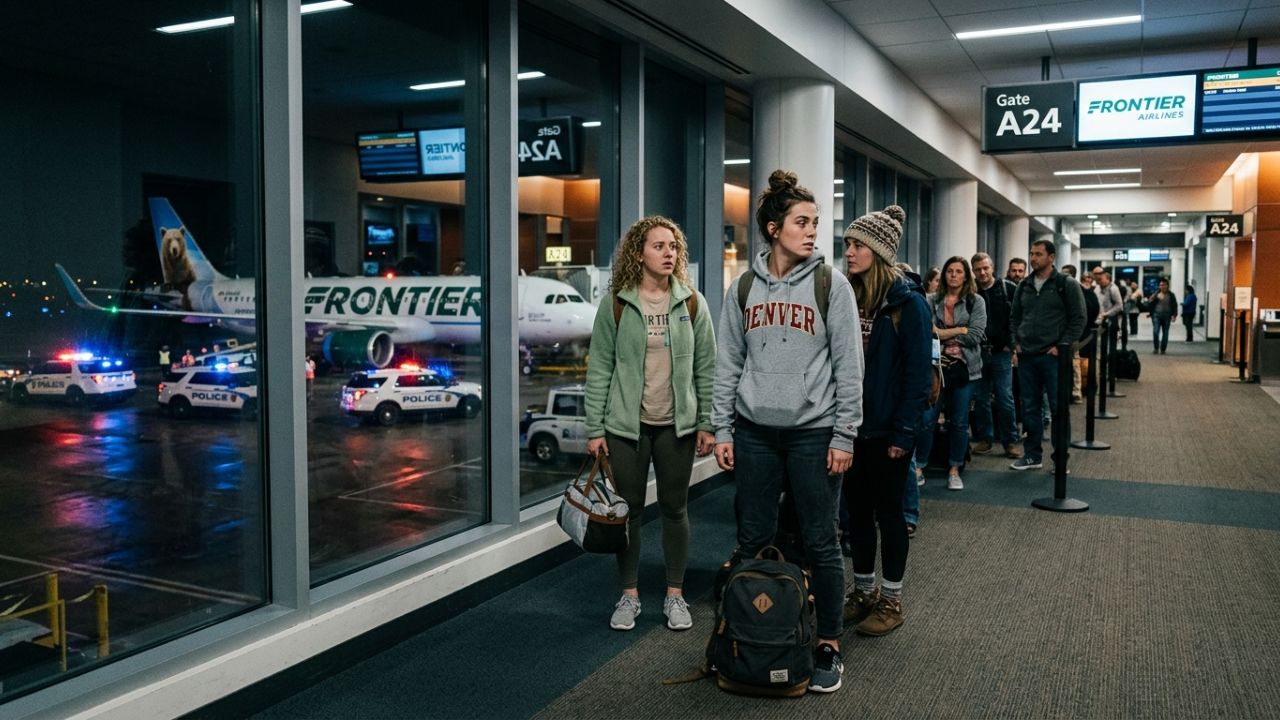
Image generated by AI
Frontier Airlines Flight 4765 Denver to Phoenix Grounded After Ammunition Magazine Discovered Onboard, Triggering FBI Investigation and Emergency Passenger Removal at Denver International Airport
Published on May 13, 2026
What should have been a routine Frontier Airlines departure from Denver to Phoenix on May 10, 2026, became one of the most alarming aviation security incidents at Denver International Airport in recent memory. An ammunition magazine — a firearm component capable of holding multiple rounds of live ammunition — was discovered inside the cabin of Frontier Airlines Flight 4765 before the aircraft left the gate. The discovery triggered an immediate security response: all passengers were removed from the aircraft, subjected to additional screening, and forced to spend the night in Denver before boarding a replacement flight the following morning. The FBI Denver Field Office has since launched a federal investigation to determine whether criminal violations of US aviation and firearms laws occurred. Frontier Airlines confirmed the magazine is believed to belong to a law enforcement officer — but critically, the airline and federal authorities have declined to identify the individual or explain precisely how a firearm accessory bypassed TSA screening procedures and entered a commercial aircraft cabin. This is the full story every traveler needs to understand.
Quick Summary:
- Frontier Airlines Flight 4765 (Denver to Phoenix) was grounded on May 10, 2026 after a gun ammunition magazine was discovered onboard the aircraft cabin before departure.
- All passengers were deplaned and subjected to additional security screening. No firearm was found during the subsequent security sweep of the aircraft.
- The FBI Denver Field Office launched an investigation to determine whether federal aviation security laws were violated — including laws governing firearm accessories aboard commercial flights.
- Frontier Airlines confirmed the magazine is believed to belong to a law enforcement officer, though the individual has not been publicly identified.
- Affected passengers were rebooked onto a replacement flight departing the following morning, May 11, extending their delays overnight.
- No injuries or threats were reported during the incident, but the discovery triggered significant anxiety among passengers and fresh aviation security debate.
- Federal aviation law requires even authorized law enforcement personnel to comply with strict protocols when carrying service weapons or related equipment aboard commercial aircraft.
What Actually Happened Aboard Frontier Flight 4765: A Timeline
The incident unfolded in the tense, time-compressed environment of a pre-departure aircraft cabin at Denver International Airport — one of the United States' largest and busiest aviation hubs, serving over 70 million passengers annually.
Shortly before Frontier Airlines Flight 4765 was scheduled to push back from its gate for the Denver–Phoenix departure, a passenger discovered an ammunition magazine — a detachable feeding device for a firearm — inside the aircraft's cabin. The passenger immediately alerted crew members, triggering the security response that would keep hundreds of travelers grounded overnight.
Frontier Airlines confirmed the discovery and immediately coordinated with airport security, the Transportation Security Administration (TSA), and federal law enforcement authorities. Every passenger was removed from the aircraft as the carrier implemented precautionary security protocols. A full inspection of the aircraft was subsequently conducted by security officials.
Critically, no firearm was located during the sweep. The magazine was the only firearm-related item found aboard the plane. While this is an important distinction — a magazine without a weapon represents a different threat profile than an armed individual — the presence of any firearm accessory inside a commercial aircraft cabin without proper declaration constitutes a serious potential violation of US federal aviation security law.
The airline subsequently rebooked all affected passengers onto a replacement flight that departed on May 11 — meaning every traveler aboard Flight 4765 spent an unplanned night in Denver while federal investigators worked to understand exactly how the magazine came to be on the aircraft.
The FBI Investigation: What Federal Law Says About Firearms on Planes
The FBI Denver Field Office's decision to open a federal investigation is not a procedural formality — it reflects the genuine seriousness with which US federal law treats any discovery of firearm-related items aboard commercial aircraft.
Under Federal Aviation Regulations and Transportation Security Administration rules, the transportation of firearms, ammunition, and firearm accessories aboard commercial passenger aircraft is strictly regulated. The core framework:
- Checked baggage only: Firearms must be transported unloaded in a locked hard-sided container in checked baggage. Passengers must declare the firearm to the airline at check-in.
- Ammunition rules: Ammunition must also be transported in checked baggage, in its original packaging or a securely boxed equivalent, with strict limits on quantity.
- Magazines: A loaded ammunition magazine — or a magazine that has been attached to a firearm — may be subject to the same regulations as ammunition itself, depending on its contents and configuration.
- Law enforcement exemptions: Active law enforcement officers who meet specific criteria may be authorized to carry loaded firearms in aircraft cabins under the Law Enforcement Officers Flying Armed program — but this program requires airline notification, specific credentialing, and compliance with strict protocols.
The central question the FBI's investigation must answer: did the law enforcement officer whose magazine is believed to have been left onboard comply with all applicable protocols? If the officer was authorized to carry a weapon under the Law Enforcement Officers Flying Armed framework, were all required notification and verification procedures followed? And if not — how did a firearm accessory enter the aircraft cabin without triggering TSA's screening process?
Denver International: America's Fifth-Largest Airport Under Security Spotlight
Denver International Airport (DIA) — the fifth-busiest airport in the United States and the largest by total land area of any American airport — is now at the center of a federal investigation that will scrutinize its security procedures in considerable detail.
DIA processed over 77 million passengers in 2023 and serves as a primary hub for United Airlines alongside Frontier Airlines' core operational base. Its security infrastructure — including multiple TSA checkpoints, explosive detection systems, and behavioral detection programs — is among the most extensively resourced in the country.
The discovery of an ammunition magazine aboard a departing Frontier flight raises uncomfortable questions that the TSA and DIA security leadership will need to address publicly: how does a firearm accessory pass through screening without detection or declaration? Were existing exemption protocols for law enforcement officers adequately communicated and enforced? What systemic changes, if any, are required to prevent recurrence?
These questions are not merely procedural. They speak to the fundamental compact of trust between air travelers and the security systems designed to keep them safe — a compact that incidents like this test in deeply unsettling ways.
How Frontier Airlines Handled the Crisis — and What It Reveals About Airline Security Protocols
Frontier Airlines' response to the ammunition magazine discovery was, by all accounts, immediate and procedurally correct. The carrier moved quickly to deplane all passengers, coordinate with federal authorities, and arrange rebooking for affected travelers.
The speed of that response reflects an important reality: airlines operating within the US aviation system have well-rehearsed protocols for exactly this kind of security discovery. The moment a suspicious or prohibited item is reported aboard an aircraft, a sequence of mandatory actions — passenger removal, security sweep, notification of TSA and FBI, documentation — is triggered with minimal discretion left to airline personnel.
What Frontier Airlines could not control — and what the FBI investigation must now determine — is whether the incident reflects a procedural failure by the law enforcement officer involved, a gap in the TSA's detection capabilities, or a failure of the notification protocols that should have flagged the officer's status and equipment before boarding.
For passengers, the experience of Frontier Flight 4765 was a reminder that aviation security, despite its extraordinary sophistication, remains dependent on individual compliance with rules that even authorized officials can fail to follow correctly.
The Broader Debate: Screening Exemptions, Law Enforcement, and the Gaps in Aviation Security
The Frontier Airlines Denver incident has reignited a long-standing debate within US aviation security circles: the extent to which law enforcement exemptions create vulnerability gaps in commercial aviation's security architecture.
The Law Enforcement Officers Flying Armed (LEOFA) program — administered by TSA — allows credentialed officers to carry loaded service weapons in aircraft cabins on commercial flights. The program was designed to provide an additional layer of in-flight security and facilitate officers traveling for official duty. But it requires rigorous pre-flight protocol compliance that, if not followed, can result in exactly the kind of alarming discovery that occurred aboard Flight 4765.
Critics of the program argue that any gap in officer notification and verification — including situations where a magazine is left aboard an aircraft without disclosure — represents an unacceptable risk that undermines the security baseline every commercial passenger depends on.
Defenders argue that the program, when correctly implemented, adds a genuine security benefit and that individual non-compliance should be addressed through enforcement rather than program elimination.
The FBI's investigation of the Frontier Airlines Flight 4765 incident will likely become a case study in how these competing considerations are balanced within the federal aviation security framework.
Guide for Travelers:
- What this means for your Frontier Airlines flight: This was an isolated incident affecting a single Frontier service on May 10. Frontier Airlines continues operating its full network from Denver International Airport and other hubs.
- Know your rights if your flight is delayed for security reasons: Airlines are generally not obligated to provide financial compensation for security-related delays, but most carriers will rebook affected passengers at no additional charge on the next available service.
- If you discover a suspicious item on any flight: Report it immediately to a flight attendant or crew member. Do not touch, move, or attempt to remove the item yourself.
- Traveling with firearms (checked baggage): Declare your firearm to the airline at check-in. Ensure it is unloaded, stored in a locked hard-sided case, and packed in checked baggage — not carry-on. Ammunition must be separately packed and declared.
- Law enforcement travelers: Compliance with TSA's Law Enforcement Officers Flying Armed protocols is mandatory. All required airline notifications must be made before boarding — failure to comply exposes officers to federal investigation.
- Denver International Airport tips: Denver's airport is one of America's largest. Plan for additional walking time between concourses and security checkpoints. Security lanes at DIA can be lengthy during peak travel windows.
- Flight monitoring: FlightAware and the Frontier Airlines app both provide real-time Denver departure updates for travelers monitoring DIA operational status.
Related Travel Guides
- US Flight Chaos: United, Delta, Southwest, and Alaska Cancel 44 Flights and Delay 1,400 More Across America
- ICE Airlines Cancels Keflavik to Seattle and Copenhagen Flights in Sudden Transatlantic Disruption
- Southwest, Delta, and Hawaiian Airlines Hit Las Vegas Harry Reid with 55 Delays
The discovery of an ammunition magazine aboard Frontier Airlines Flight 4765 in Denver is a story that transcends the operational inconvenience suffered by affected passengers — though that inconvenience was genuinely significant for everyone who spent an unplanned night in Colorado waiting for a replacement Phoenix flight. It is a story about the fragility of aviation security's most fundamental assumptions: that screening works, that compliance is universal, and that no item capable of causing concern should ever reach the inside of a commercial aircraft cabin without proper authorization and disclosure. The FBI's investigation will determine whether laws were broken and whether enforcement action is warranted. The TSA's review will assess whether procedural changes are needed. And Frontier Airlines, Denver International, and the broader US aviation community will absorb the lessons of this incident into the ongoing, never-complete project of making commercial air travel as safe as human systems can make it. For the millions of Americans who fly every day — and trust that the person in the next seat is as thoroughly screened as they are — that project has never mattered more.
Disclaimer
This article is for informational and educational purposes only. It does not constitute legal, financial, or professional advice. While we strive to provide accurate and up-to-date information, travel policies, regulations, and conditions change rapidly. Always verify information with official sources before making travel decisions. Nomad Lawyer makes no representations about the accuracy, reliability, completeness, or suitability of the information provided. Readers should consult qualified professionals for advice specific to their circumstances. The views expressed in this article are those of the author and do not necessarily reflect the views of Nomad Lawyer.
Kunal K Choudhary
Co-Founder & Contributor
A passionate traveller and tech enthusiast. Kunal contributes to the vision and growth of Nomad Lawyer, bringing fresh perspectives and driving the community forward.
Learn more about our team →