
Flight Delays Expose $34 Billion Crisis Straining Global Aviation
Flight delays expose a $34 billion annual strain on global aviation in 2026, with disruptions rising three times faster than passenger demand. Airlines, airports, and air traffic control systems struggle to manage record volumes amid staffing shortages and technology vulnerabilities.

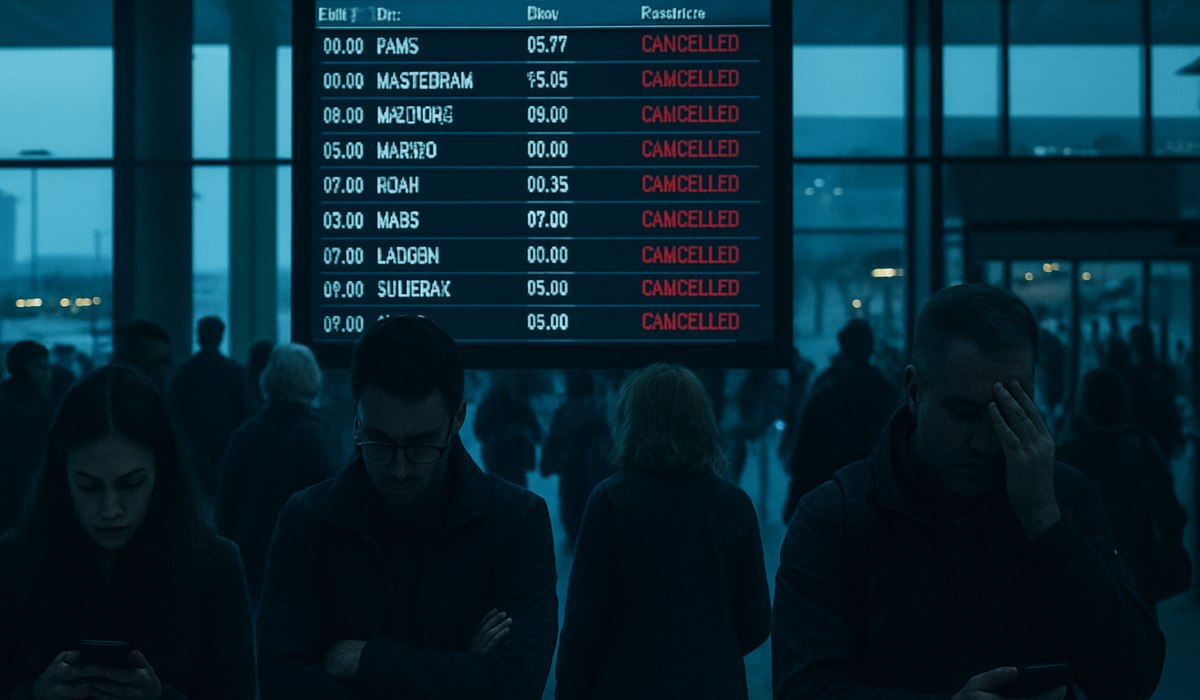
Image generated by AI
The Global Aviation Disruption Crisis
Flight delays expose a systemic breakdown in global aviation, with carriers bleeding an estimated $34 billion annually from cancellations, compensation claims, crew repositioning, and lost revenue. This structural crisis emerges as major airports worldwide—including New York, London, Frankfurt, and Los Angeles—struggle under unprecedented operational strain. Industry data reveals a troubling imbalance: passenger volumes grew 6–7% year-over-year through early 2025, yet disruptions climbed nearly three times faster, eroding already razor-thin margins across the sector and fundamentally reshaping how airlines forecast costs and manage operations.
The $34 Billion Price Tag: Breaking Down Aviation's Structural Crisis
The $34 billion annual cost of flight delays expose encompasses far more than visible passenger inconvenience. Airlines face direct outlays for customer compensation mandated by regulations like EU261 and DOT rules, averaging hundreds of dollars per disrupted traveler. Operational expenses spike through crew overtime, aircraft repositioning, fuel burn during ground delays, and extended gate fees. Indirect costs ripple across partner ecosystems: hotels for stranded passengers, ground transportation, meal vouchers, and lost revenue from unused seats multiply the damage.
Europe's air traffic management bottleneck alone accounts for over €16 billion in annual losses through October 2025, according to regional aviation authorities. This figure excludes cascading effects like missed connections, business disruptions, and relationship damage from customer churn. When combined with North American and Asia-Pacific disruption figures, the global figure approaches the $34 billion threshold, making flight delays expose a foundational challenge threatening industry viability.
Disruption Outpacing Growth: Why Airlines Can't Keep Up
The mathematics of aviation disruption reveal a crisis in real time. While global airline traffic grew 6–7% annually, delays and cancellations accelerated at nearly 18–21% per year—a three-fold disparity that no operational efficiency gain can absorb. This imbalance stems from infrastructure constraints that take decades to upgrade, staffing shortages that compound annually, and weather volatility amplified by climate patterns.
Major U.S. hubs operate nearly two-thirds below target air traffic control staffing levels, forcing chronic ground delay programs. In March 2026 alone, New York-area facilities imposed extended ground delays averaging 45–120 minutes throughout the month. Similar patterns plague Atlanta, Chicago, and Los Angeles. Airlines attempt schedule padding—artificially inflating flight times—but this merely shifts delays rather than eliminating them, destroying schedule reliability and passenger trust.
The lag between hiring new air traffic controllers and full certification spans 3–4 years, meaning current shortages will persist well into 2028–2029. Flight crew rest regulations, recently tightened across North America and Europe, further compress scheduling flexibility. Labor disputes—including the major North American flight attendant strike in early 2026—periodically remove capacity, exacerbating the supply-demand mismatch.
Europe's Air Traffic Management Bottleneck: A €16 Billion Warning Sign
European aviation illustrates how infrastructure fragmentation compounds flight delays expose costs. The continent's fragmented air traffic management system, split across 63 separate centers and thousands of waypoints, creates inefficiencies unparalleled globally. Controllers must coordinate across national boundaries, regulatory jurisdictions, and legacy technology platforms—a process that generates approximately €16 billion in annual disruption costs through October 2025.
The European Union's Single European Sky initiative aims to modernize this fractured system, but implementation lags behind timeline targets. Meanwhile, airports in Frankfurt, London, Amsterdam, and Paris operate at or above design capacity, leaving zero buffer for weather, technical issues, or staffing gaps. Airlines serving these hubs face systematic delays; recovery is nearly impossible when the entire network runs at saturation.
Additionally, severe weather increasingly disrupts European operations. Spring 2026 has witnessed multiple storm systems affecting the Atlantic corridor, compounding delays for transatlantic flights and their domestic connections. Visit the FAA's official disruption tracking to monitor real-time operational status across U.S. and coordinated international routes.
Technology Failures and Cybersecurity Threats Amplify Vulnerability
Flight delays expose extends beyond human and infrastructure limitations into digital fragility. A major IT security vendor's faulty software update in 2024–2025 cascaded through global airline and airport reservation, check-in, and ground operations systems, triggering thousands of cancellations at leading carriers and leaving passengers stranded across continents.
More recently, a data center hardware failure at a major North American airline forced a temporary operational ground stop, cascading disruptions into subsequent days. These technology-driven incidents illustrate a critical vulnerability: aviation systems depend on interconnected digital infrastructure managed by external vendors, creating single-point-of-failure risks.
Cybersecurity threats compound the challenge. Critical infrastructure targeting incidents against airports and airlines have increased 340% since 2023, according to industry security assessments. Unlike weather or staffing issues, cyberattacks can paralyze operations across entire networks in hours. Investment in resilience infrastructure—redundant systems, air-gapped backups, and vendor diversification—remains insufficient across the industry.
Consumer Impact: What Travelers Should Expect in 2026
For 2026 air travelers, flight delays expose significant ripple effects. Roughly one in four U.S. flights experienced delays or cancellations between mid-2024 and mid-2025; that ratio persists into 2026. Average compensation claims exceeded $300 per disrupted passenger, with recovery times stretching weeks as airlines dispute liability.
Passengers face compounded stress during peak travel seasons (April–May, July–August, December). Connecting flights through congested hubs carry 35–40% higher cancellation risk. International routes, particularly transatlantic services, experience delays averaging 30–60 minutes as oceanic routing competes for airspace capacity.
Travelers should expect longer connection times, increased schedule padding, and higher ticket prices as airlines factor disruption costs into revenue management systems. Premium cabin passengers receive better re-accommodation options, widening service disparity. Budget carriers, with thinner margins, offer minimal compensation beyond regulatory minimums.
Use FlightAware for real-time delay tracking and historical pattern analysis before booking. Review airline-specific delay records and opt for flights during off-peak windows (early morning, mid-week, shoulder seasons) when possible.
Traveler Action Checklist
-
Check historical delay data for your chosen route, airport, and airline using FlightAware's statistics; prioritize carriers with sub-15% cancellation rates.
-
Build extra connection time into itineraries, especially through major hubs like New York, London, or Chicago; allow minimum 2 hours for domestic connections, 3 hours for international.
-
Purchase comprehensive travel insurance covering flight delays, cancellations, and missed connections; verify coverage includes compensation gaps beyond airline liability.
-
Monitor real-time flight status using FlightAware and your airline's app; most delays announce 12–24 hours ahead, allowing rebooking before peak congestion.
-
Document all disruptions with boarding passes, receipts, delay confirmations, and communications; maintain records for DOT complaint filings and insurance claims.
-
File DOT complaints for significant delays or inadequate compensation at the U.S. Department of Transportation to escalate systemic issues.
-
Choose travel dates strategically to avoid peak disruption windows (spring storms, summer peaks, holiday surges) when possible.
Key Disruption Data (2024–2026)
| Metric | Figure | Impact |
|---|---|---|
| Annual global disruption cost | $34 billion | Airlines, passengers, supply chain losses |
| European air traffic delays cost | €16 billion+ | Single |
Disclaimer
This article is for informational and educational purposes only. It does not constitute legal, financial, or professional advice. While we strive to provide accurate and up-to-date information, travel policies, regulations, and conditions change rapidly. Always verify information with official sources before making travel decisions. Nomad Lawyer makes no representations about the accuracy, reliability, completeness, or suitability of the information provided. Readers should consult qualified professionals for advice specific to their circumstances. The views expressed in this article are those of the author and do not necessarily reflect the views of Nomad Lawyer.
Raushan Kumar
Founder & Lead Developer
Full-stack developer with 11+ years of experience and a passionate traveller. Raushan built Nomad Lawyer from the ground up with a vision to create the best travel and law experience on the web.
Learn more about our team →