
F-35 Lightning II Wild Weasels Deploy to Misawa Air Base Japan 2026: What It Means for Pacific Security
The US Air Force's 13th Fighter Squadron trades F-16s for fifth-generation F-35A stealth fighters at Japan's Misawa Air Base, reshaping Indo-Pacific deterrence and modern air combat doctrine.

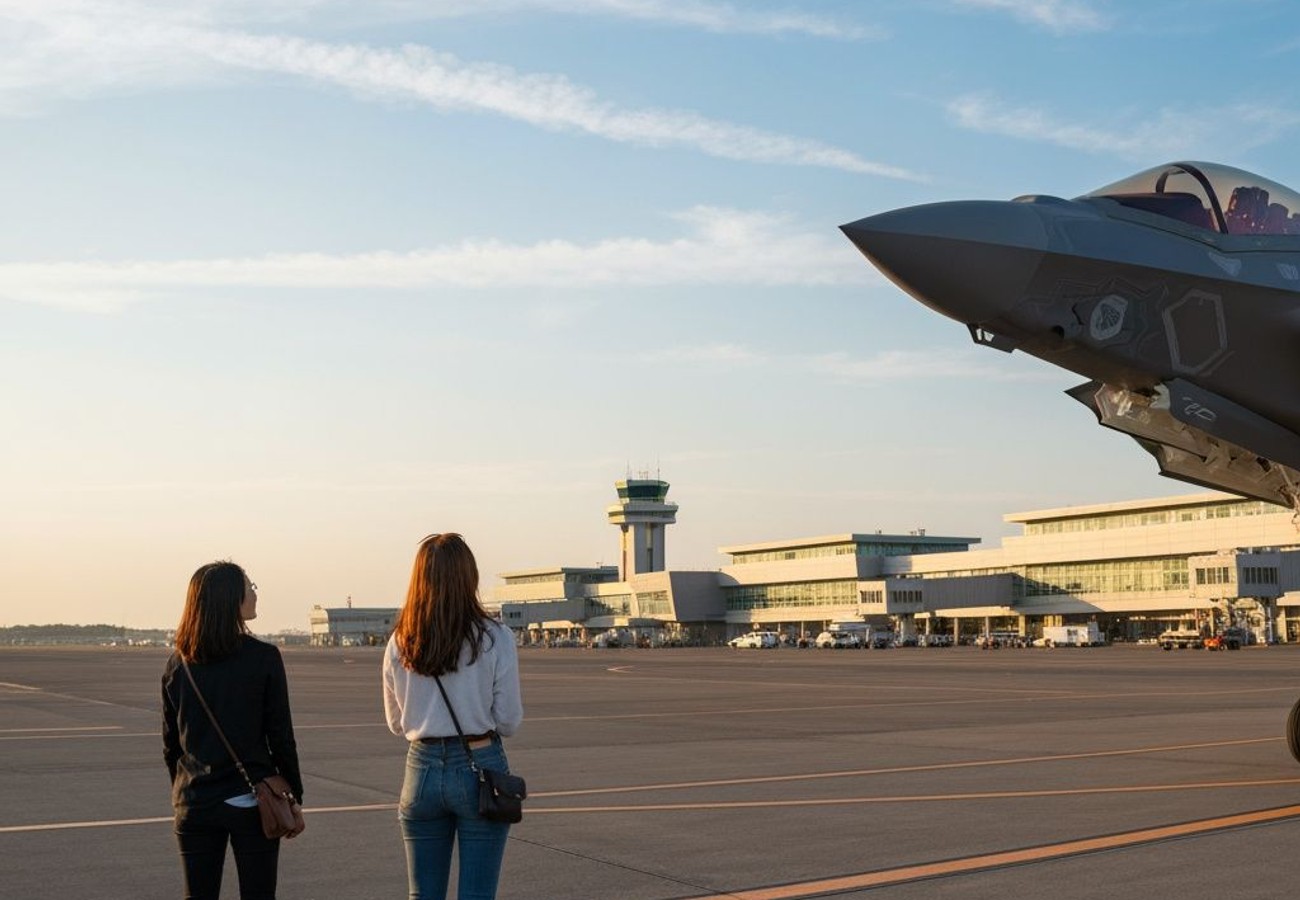
Image generated by AI
The Fifth-Generation Shift That Changes Everything in the Pacific
MISAWA AIR BASE, JAPAN — On March 28, 2026, four F-35A Lightning II fighters touched down on the tarmac at one of America's most strategically vital bases in the Pacific. What arrived that day wasn't just a new jet. It was a fundamental recalibration of airpower in a region where every technological edge matters.
The 13th Fighter Squadron, nicknamed the "Panther Pack," officially became the first unit to permanently base fifth-generation stealth fighters in Japan. Three aircraft transferred from Hill Air Force Base in Utah. The fourth came from RAF Lakenheath in the United Kingdom. All routed through Hickam Air Force Base in Hawaii before completing their journey west.
This wasn't a quiet transition. On April 24, 2026, the 35th Fighter Wing held a formal ribbon-cutting ceremony. The message was unmistakable: American air superiority in the Indo-Pacific just got a major upgrade.
Why This Deployment Matters Far Beyond Japan's Borders
The 35th Fighter Wing has been flying F-16 Fighting Falcons since 1994. That's 32 years of proven capability. But the F-16, while legendary, was never built from the ground up as a sensor-fusion platform. The F-35 was.
Col. Paul Davidson, the wing commander, framed it plainly: this move reflects America's long-standing commitment to Japan and allies across the region. More critically, it improves response time alongside Japanese partners during crisis scenarios.
The Air Force's modernization plan is ambitious. Over time, the base's 36 F-16C/D fighters will be replaced by 48 F-35As. The 14th Fighter Squadron will transition alongside the 13th. That's not just incremental improvement—that's 33% more airframes carrying decisively better technology.
Reddit: "The F-35 arriving in Japan is basically the US saying: we're not leaving, we're upgrading." — r/geopolitics
The Wild Weasel Mission: Why the F-35 Is Built for Danger
Not every fighter pilot volunteers for Wild Weasel duty. The mission sends pilots first over enemy territory to locate, identify, and destroy radar systems and surface-to-air missile batteries. It's the most dangerous role in modern air combat. You go in first. You suppress the enemy's eyes and teeth. Then you get out.
Lt. Col. John Widmer, commander of the 13th Fighter Squadron, broke down the difference in stark terms: legacy platforms like the F-16 carried sensors and weapons added onto existing frames. The F-35 was designed from inception as a sensor platform with fusion and command capability built into its DNA.
Advanced sensor fusion gives F-35 pilots a single, integrated battlespace picture. Every radar, every missile system, every threat—it appears on one display. The software updates continuously, adapting to evolving enemy tactics in real time. That's not just better. In the Wild Weasel mission, that's life-or-death superior.
Proof in Combat: Operation Midnight Hammer and Beyond
The Wild Weasel concept emerged in the 1960s during Vietnam. Decades later, it remains central to military air operations. In June 2025, F-35s suppressed Iran's air defenses during Operation Midnight Hammer, clearing the path for other combat aircraft.
Lt. Col. Aaron Osborne, commander of the 34th Fighter Squadron, revealed something sobering: Operation Rough Rider marked the first time in two decades that Wild Weasel crews faced live fire while executing the mission. The operation introduced new weapons on the F-35, including strikes into fortified tunnels and repeated hits using deep-penetration munitions.
These weren't theoretical exercises. These were real combat conditions testing real equipment. The F-35 didn't just survive—it dominated.
The transfer of the 13th Fighter Squadron's older F-16s to Osan Air Base in South Korea in June 2025 cleared the runway for this transition at Misawa. That timing wasn't accidental.
What This Signals to Beijing, Moscow, and Beyond
Fifth Air Force leadership didn't mince words about the strategic message. Stationing these jets at Misawa and deepening cooperation with Japanese forces sends an unmistakable signal: alliance strength. Potential adversaries should interpret it as resolve.
The base, served by Misawa Airport (MSJ), occupies one of the Pacific's most sensitive geographic positions. Japan's northern frontier. Russian air activity. Chinese military expansion. Taiwanese strait tensions. All of these pressures converge in this airspace.
Deploying the world's most advanced fifth-generation fighter to this exact location isn't coincidence. It's strategy expressed through steel and avionics.
The 35th Fighter Wing still flies the "WW" tail flash—the Wild Weasel heritage stretching back to the Vietnam War. But now that heritage carries 21st-century sensor fusion, stealth technology, and a software ecosystem that updates faster than adversaries can adapt.
For anyone monitoring Pacific airpower, March 28, 2026, marks the day the conversation changed. Misawa didn't just get new jets. The balance of power in the Indo-Pacific just shifted.
The future of aerial deterrence looks different now—and adversaries are watching.
Related Travel Guides
Disclaimer
This article is for informational and educational purposes only. It does not constitute legal, financial, or professional advice. While we strive to provide accurate and up-to-date information, travel policies, regulations, and conditions change rapidly. Always verify information with official sources before making travel decisions. Nomad Lawyer makes no representations about the accuracy, reliability, completeness, or suitability of the information provided. Readers should consult qualified professionals for advice specific to their circumstances. The views expressed in this article are those of the author and do not necessarily reflect the views of Nomad Lawyer.
Kunal K Choudhary
Co-Founder & Contributor
A passionate traveller and tech enthusiast. Kunal contributes to the vision and growth of Nomad Lawyer, bringing fresh perspectives and driving the community forward.
Learn more about our team →