
Exploring 6 US National Parks With Otherworldly Landscapes: California, Washington, Utah, and Alaska 2026
An authoritative guide to six US National Parks featuring extreme geological formations, from California's volcanic vents to Alaska's Arctic peaks, including essential visitor advisories.

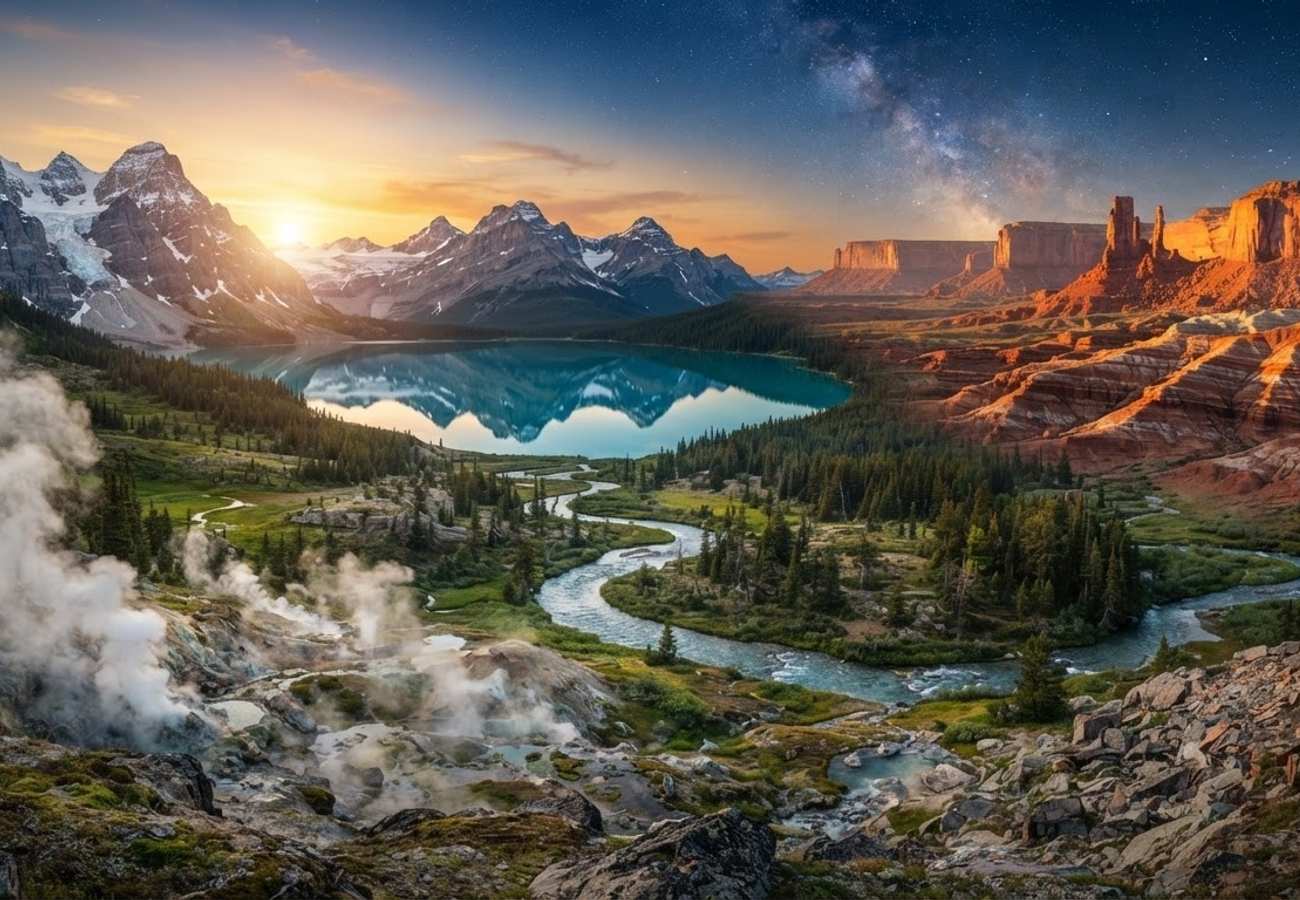
Image generated by AI
The United States hosts several protected wilderness areas featuring volcanic terrain, glacial lakes, and desert monoliths that mirror extraterrestrial environments. These six specific parks offer high-impact geological experiences far removed from traditional tourist corridors.
Analysis of America's Most Extreme Geological Sites
Geological metamorphosis—driven by millions of years of erosion, volcanic activity, and glacial movement—has created specific zones in the US that deviate from standard terrestrial aesthetics. Our analysis identifies six parks where the interaction of fire and ice has produced "otherworldly" conditions.
Volcanic and Alpine Extremes: California and Washington
Lassen Volcanic National Park (California) This site is defined by active geothermal energy. Unlike more crowded geothermal hubs, Lassen features a concentration of steaming fumaroles and bubbling mud pools.
- Key Feature: Bumpass Hell, characterized by sulphur vents and mineral deposits.
- Geological Note: The park is home to Lassen Peak, one of the world's largest plug dome volcanoes.
North Cascades National Park (Washington) Known as the "American Alps," this region is defined by sharp ridges and high-contrast coloration.
- Key Feature: Diablo Lake and Ross Lake, noted for an intense turquoise hue caused by glacial flour.
- Environmental Profile: High-altitude glaciers and deep valleys with significantly lower visitor density than other Western parks.
Kings Canyon National Park (California) A High Sierra destination that blends massive biological structures with alpine geology.
- Key Feature: The Rae Lakes Basin, featuring a chain of blue alpine lakes set against granite cliffs.
- Environmental Profile: Giant sequoia forests integrated with rugged mountain peaks.
Desert and Arctic Frontiers: Utah and Alaska
Capitol Reef National Park (Utah) A critical component of Utah's "Mighty Five," this park focuses on sedimentary layers and erosion.
- Key Feature: The Waterpocket Fold, a massive geological wrinkle that creates a sequence of domes and cliffs.
- Visual Profile: Sandstone formations in red, orange, and gold.
Canyonlands National Park (Utah) The largest of Utah's national parks, offering extreme solitude and vast scale.
- Key Feature: The Needles District, featuring sandstone towers and narrow rock corridors.
- Night Sky Analysis: Due to minimal light pollution, this is a premier site for observing the Milky Way.
Denali National Park (Alaska) An Arctic wilderness dominated by the highest peak in North America.
- Key Feature: Denali (the mountain), often obscured by weather systems.
- Environmental Profile: A mix of ancient ice fields, tundra, and coastal regions populated by bald eagles, seals, and sea otters.
Passenger Rights & Visitor Advisory
For the traveler planning a visit to these remote regions, the logistical risks differ from urban travel. Our analysis of national park policies and travel regulations suggests the following:
Transportation and Access Many of these parks, particularly Denali and North Cascades, have restricted vehicle access to protect the ecosystem. For the visitor, this means:
- Permit Requirements: Certain backcountry areas require advance permits. Failure to secure these can lead to immediate denial of entry.
- Transit Dependency: In Denali, visitors must rely on authorized park buses for deep-park access.
Health and Safety Frameworks Given the "otherworldly" nature of these sites (volcanic vents, Arctic cold, desert heat), standard travel insurance may not cover "extreme" hiking or mountaineering.
- Advisory: Review your policy for "Search and Rescue" (SAR) clauses. In remote areas like the High Sierra or the Alaskan interior, SAR operations can be prohibitively expensive if not covered by insurance.
Environmental Compliance Under the "Leave No Trace" framework adopted by the National Park Service, visitors are legally obligated to maintain the landscape. Our analysis indicates that fines for altering geological formations or disturbing wildlife in these protected zones are strictly enforced.
Industry Analyst View
The shift toward "low-density tourism" is evident in the rising interest in parks like North Cascades and Capitol Reef. While the "Big Five" (such as Yosemite or Zion) face severe over-tourism and traffic congestion, these six parks represent a strategic alternative for high-value travelers seeking solitude.
The integration of "astrotourism" in Canyonlands further indicates a trend where the environment is marketed not just for its terrestrial features, but for its lack of human interference (dark skies). We expect these "off-the-beaten-path" destinations to see a 15-20% increase in international interest as travelers pivot away from overcrowded landmarks.
Nature's most violent transformations have created the world's most serene escapes.
Related Travel Guides
Disclaimer
This article is for informational and educational purposes only. It does not constitute legal, financial, or professional advice. While we strive to provide accurate and up-to-date information, travel policies, regulations, and conditions change rapidly. Always verify information with official sources before making travel decisions. Nomad Lawyer makes no representations about the accuracy, reliability, completeness, or suitability of the information provided. Readers should consult qualified professionals for advice specific to their circumstances. The views expressed in this article are those of the author and do not necessarily reflect the views of Nomad Lawyer.
Raushan Kumar
Founder & Lead Developer
Full-stack developer with 11+ years of experience and a passionate traveller. Raushan built Nomad Lawyer from the ground up with a vision to create the best travel and law experience on the web.
Learn more about our team →