
European River Cruise Disruptions 2026: How Record Danube and Rhine Droughts Affect Travelers
Record-low water levels across the Danube, Rhine, and Po rivers are forcing European cruise lines to rewrite itineraries and cancel sailings amid a severe 2026 hydrological crisis.

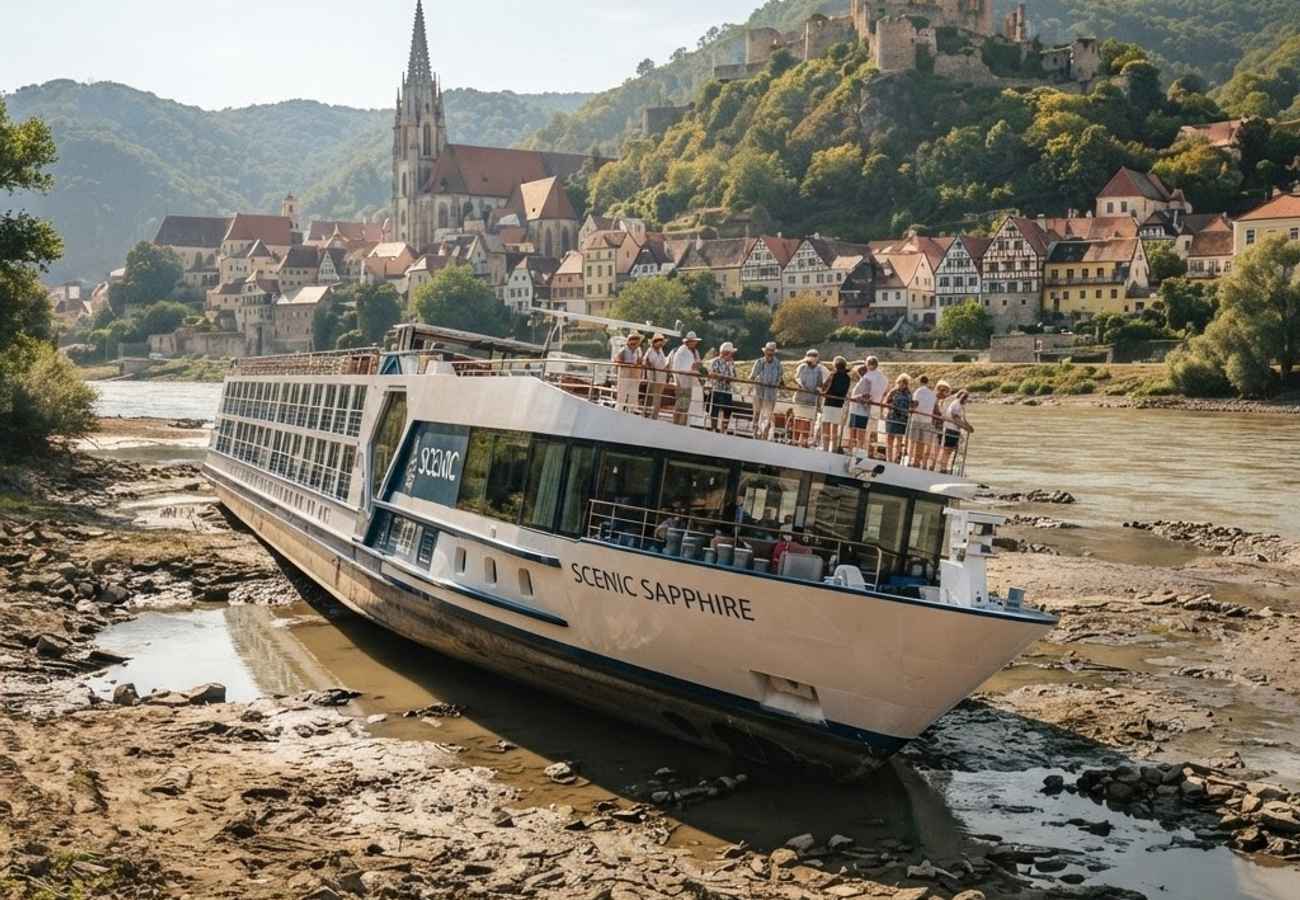
Image generated by AI
Europe is facing a catastrophic hydrological failure in 2026, with the Danube, Rhine, and Po rivers hitting record lows that have left ships stranded and thousands of itineraries in flux. This systemic water shortage is no longer a seasonal anomaly but a structural crisis affecting everything from luxury tourism to nuclear energy cooling.
The scale of the crisis is visible from orbit, with satellite imagery confirming the dramatic shrinkage of the continent's primary waterways. For travelers who have booked river cruises through the heart of Europe, the dream of a leisurely voyage through medieval towns is being replaced by the reality of exposed sandbars, emergency bus transfers, and outright cancellations.
While the industry maintains that river cruising remains physically safe, the operational predictability of these trips has vanished. Current data suggests that the risk is not uniform across all routes, but the instability is widespread enough to force a total rethink of how these voyages are planned and insured.
EU Data Confirms Severe 2026 Hydrological Crisis
The current situation is far more severe than typical dry spells. According to the European Drought Observatory (EDO), managed by Copernicus, approximately 50% of the European Union and the United Kingdom were under some form of drought status—ranging from "watch" to "alert"—by late July 2026. Most alarmingly, 9% of this territory has been classified at the highest "alert" level.
The EDO’s Combined Drought Indicator, which analyzes soil moisture, precipitation, and vegetation stress, indicates that these critical alert-level conditions span from the Alps and southern Germany across the entire Danube river basin. This includes significant portions of Austria, Slovakia, Hungary, Serbia, and Romania.
Further evidence of the crisis is found in the European Flood Awareness System (EFAS). Data tracking river discharge since 1992 reveals that July 2026 saw record-low average flow rates across 95% of the monitored stretches of the Thames and 85% of the Rhine. Roughly two-thirds of the Danube also hit historic lows, surpassing the previous drought benchmarks set in 2018 and 2022.
Nuclear Power Plants Struggle as Water Levels Plummet
The drought's impact extends beyond tourism, threatening critical infrastructure. On July 27, 2026, the state-run Paks Nuclear Power Plant in Hungary reported that the Danube's water level had dropped roughly 42 inches below the normal threshold, breaking all previous records for that specific gauge station.
The situation in Romania has been even more desperate. To prevent the Cernavodă nuclear reactor—the country's only operating plant—from losing its cooling water supply, the state water management agency utilized explosives to blast a channel through rock to redirect Danube water. Additionally, officials sank barges filled with rock to create emergency diversion dikes.
These government-level interventions highlight a systemic failure caused by the near-total absence of Alpine snowpack runoff, which traditionally feeds these river systems.
Operational Failures and Cruise Line Responses
The practical fallout for the cruise industry has been immediate and varied. Several high-profile incidents have occurred this summer:
- Viking: A vessel ran aground on a sandbank in northwest Bulgaria; passengers were safely evacuated via ferry.
- Rhine Groundings: In Bonn, a river ship became stranded and required a freighter to tow it back into deeper channels.
- Uniworld: The operator was forced to change pickup points for a Belgrade-to-Nuremberg sailing because the ship could no longer physically reach Belgrade.
- Riviera Travel: This operator has canceled ten European river departures entirely and modified six others. They are currently offering passengers full refunds, rebooking for 2026 or 2027, or transfers to less-affected rivers like the Seine, Rhône, or the Douro in Portugal.
Not all companies have canceled trips. AmaWaterways reported that it avoided canceling any 2026 Danube, Rhine, or Main departures by implementing aggressive mitigation strategies. These include reversing itineraries, utilizing shallower-draft ships, extending stays in port cities, and substituting river segments with motorcoach transport. Similarly, Tauck and Scenic have pivoted to hybrid "cruise-and-coach" models to bypass blocked river stretches.
Assessing the Physical and Logistical Risks
From a safety perspective, the risk of physical harm to passengers remains low. Modern river vessels are equipped with electronic depth sensors, and captains are trained to halt or reroute well before a vessel is in danger. The Bulgarian grounding is viewed by industry experts as a rare outlier rather than a systemic safety failure.
The primary risk is logistical. Travelers face the possibility of:
- Last-minute itinerary changes: Promised ports of call may be skipped without warning.
- Mode shifts: A luxury cruise may suddenly become a bus tour for several days.
- Insurance gaps: Many travelers are discovering that standard travel insurance does not cover "low water" disruptions, as these are often categorized as foreseeable seasonal risks rather than unforeseen emergencies.
Industry experts note that the window of highest risk is typically between July and October, when rivers hit their seasonal nadir. While April cruises historically face fewer low-water issues, the lack of predictive data for 2027 means travelers cannot rely solely on historical trends.
The Future of European River Cruising
Environmental researchers warn that the 2026 crisis may not be a one-off event. As global temperatures rise, these extreme hydrological conditions could become the "new normal." This suggests a permanent shift in the river cruise business model.
For the traveler, this means that flexibility is no longer an optional preference but a requirement. Larger operators with diverse fleets are better positioned to handle these crises through ship swaps and rerouting. Smaller lines with limited tonnage offer less security when water levels drop.
| River | July 2026 Flow Rate Status (EFAS Data) | Primary Impact Area |
|---|---|---|
| Rhine | 85% of stretches at record lows | Germany (Bonn/Bavaria) |
| Danube | ~66% of stretches at record lows | Hungary, Romania, Bulgaria |
| Thames | 95% of stretches at record lows | United Kingdom |
The era of the guaranteed river itinerary has ended; adaptability is now the most important part of the packing list.
Related Travel Guides
Disclaimer
This article is for informational and educational purposes only. It does not constitute legal, financial, or professional advice. While we strive to provide accurate and up-to-date information, travel policies, regulations, and conditions change rapidly. Always verify information with official sources before making travel decisions. Nomad Lawyer makes no representations about the accuracy, reliability, completeness, or suitability of the information provided. Readers should consult qualified professionals for advice specific to their circumstances. The views expressed in this article are those of the author and do not necessarily reflect the views of Nomad Lawyer.
Preeti Gunjan
Contributor & Community Manager
A passionate traveller and community builder. Preeti helps grow the Nomad Lawyer community, fostering engagement and bringing the reader experience to life.
Learn more about our team →