
European Aviation Crisis 2026: 2,141 Flight Delays and 113 Cancellations Hit 12 Major Airports
Widespread operational failures across Europe result in over 2,000 flight delays and 113 cancellations, with Berlin-Brandenburg and Rome Fiumicino recording the highest disruption rates.

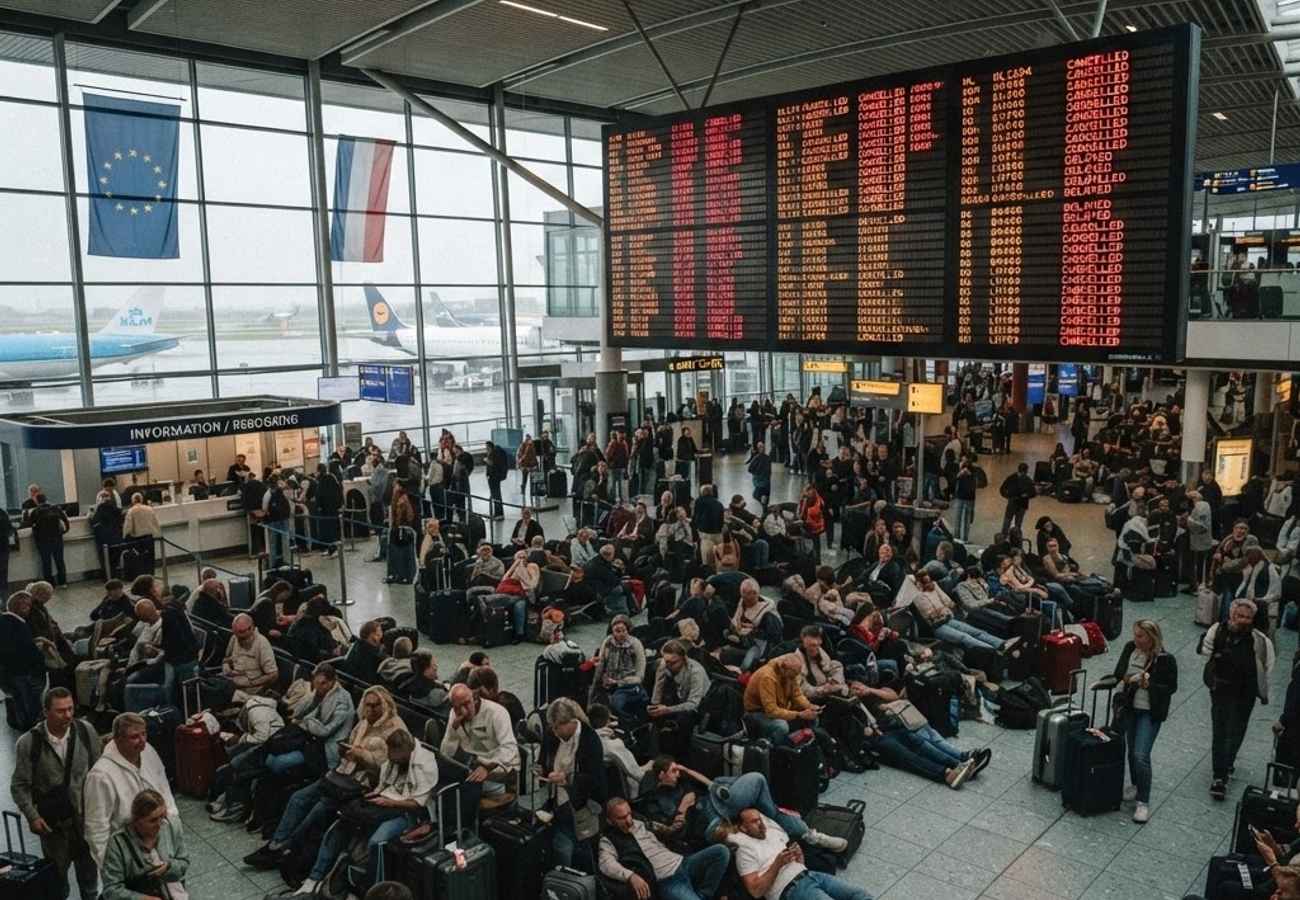
Image generated by AI
Widespread operational failures have triggered 2,141 flight delays and 113 cancellations across nine European nations, with Berlin-Brandenburg recording the highest cancellation rate and Rome Fiumicino seeing the most delays.
European Airspace Operational Breakdown
A significant systemic disruption has impacted aviation markets across Austria, Spain, Denmark, Italy, Germany, the UK, Norway, Sweden, and the Netherlands. Real-time data indicates a concentrated failure in hub efficiency, primarily affecting major carriers including easyJet, KLM, ITA Airways, British Airways, SAS, and Lufthansa.
The volatility is most acute at primary gateways. Rome Fiumicino has emerged as the epicenter of delays, while Berlin-Brandenburg has suffered the most severe rate of total flight cancellations. These disruptions are attributed to a combination of aircraft availability, crew scheduling conflicts, technical requirements, and air-traffic management constraints.
Airport Disruption Metrics
The following table details the specific impact on Europe's busiest hubs, based on recorded data from September 3, 2026.
| Airport | Total Delays | Total Cancellations | Primary Affected Carrier |
|---|---|---|---|
| Rome Fiumicino | 308 | 6 | ITA Airways (127 delays) |
| Amsterdam Schiphol | 297 | 18 | KLM (135 delays, 17 cancellations) |
| London Gatwick | 239 | 3 | easyJet (122 delays) |
| Frankfurt | 255 | 10 | Lufthansa (87 delays, 5 cancellations) |
| Madrid-Barajas | 194 | 6 | Iberia (42 delays) |
| London Heathrow | 198 | 21 | British Airways (101 delays, 15 cancellations) |
| Copenhagen | 175 | 6 | SAS (45 delays) |
| Berlin-Brandenburg | 127 | 28 | easyJet (14 cancellations) |
Airline Performance Analysis
The disruption has not been distributed evenly across carriers. Low-cost and legacy carriers have both faced significant operational hurdles.
- easyJet: Recorded the highest overall disruption with 191 delays and 21 cancellations. The bulk of these occurred at London Gatwick (122 delays) and Berlin-Brandenburg (20 delays, 14 cancellations).
- KLM: Logged 158 delays and 20 cancellations, with the vast majority concentrated at Amsterdam Schiphol (135 delays, 17 cancellations).
- ITA Airways: Reported 132 delays and 2 cancellations, almost exclusively at Rome Fiumicino.
- British Airways: Faced 102 delays and 18 cancellations, with London Heathrow accounting for 101 of those delays.
- SAS: Recorded 96 delays distributed across Copenhagen (45), Stockholm-Arlanda (26), and Oslo (25).
- Lufthansa: Reported 89 delays and 8 cancellations, primarily at Frankfurt (87 delays, 5 cancellations).
Traveler Logistics Guide: Navigating European Disruptions
From a ground-level perspective, the best way to navigate this current instability is to move away from reliance on airport departure boards and shift toward digital, real-time monitoring.
Connection Strategy & Layovers If you are booking a connection through Amsterdam Schiphol or Frankfurt during this period, increase your minimum connection time (MCT) to at least 3-4 hours. Given the current delay volume (297 at Schiphol and 255 at Frankfurt), standard 90-minute windows are currently insufficient to guarantee a successful transfer.
Digital Transit Policies Ensure your digital travel credentials are up to date. For those transiting through the EU, ensure your ETIAS or visa documentation is accessible offline. When a flight is cancelled, do not wait in physical queues at the airport service desk; use the airline's mobile app to request rebooking immediately, as digital slots are often processed faster than in-person requests.
Customs and Ground Transit If you are forced to overnight in a city due to a cancellation, verify if your airline provides hotel vouchers. Under EU Regulation 261/2004, passengers may be entitled to compensation and care (meals and accommodation) depending on the cause of the disruption. Keep all receipts for "duty of care" expenses.
Infrastructure Impact Assessment
This level of disruption across 12 airports suggests a fragility in the regional "hub-and-spoke" model. When primary hubs like London Heathrow or Frankfurt experience high delay volumes, the knock-on effect creates a ripple across secondary airports.
The concentration of cancellations in Berlin-Brandenburg (28) indicates a specific localized capacity or staffing failure that exceeds the general regional trend. For regional tourism, these disruptions create significant bottlenecks, particularly for short-haul transit between the UK and the Schengen Area, potentially leading to a temporary decrease in short-term business travel efficiency.
Operational stability remains volatile; travelers are advised to verify flight status via official carrier channels prior to airport departure.
Related Travel Guides
Disclaimer
This article is for informational and educational purposes only. It does not constitute legal, financial, or professional advice. While we strive to provide accurate and up-to-date information, travel policies, regulations, and conditions change rapidly. Always verify information with official sources before making travel decisions. Nomad Lawyer makes no representations about the accuracy, reliability, completeness, or suitability of the information provided. Readers should consult qualified professionals for advice specific to their circumstances. The views expressed in this article are those of the author and do not necessarily reflect the views of Nomad Lawyer.
Preeti Gunjan
Contributor & Community Manager
A passionate traveller and community builder. Preeti helps grow the Nomad Lawyer community, fostering engagement and bringing the reader experience to life.
Learn more about our team →