
No More Passport Stamps in Europe: What American Travelers Must Know About Biometric EES Across 29 Countries
The EU's biometric Entry/Exit System (EES) is fully operational across 29 Schengen destinations, replacing ink passport stamps with facial scans and fingerprint kiosks.

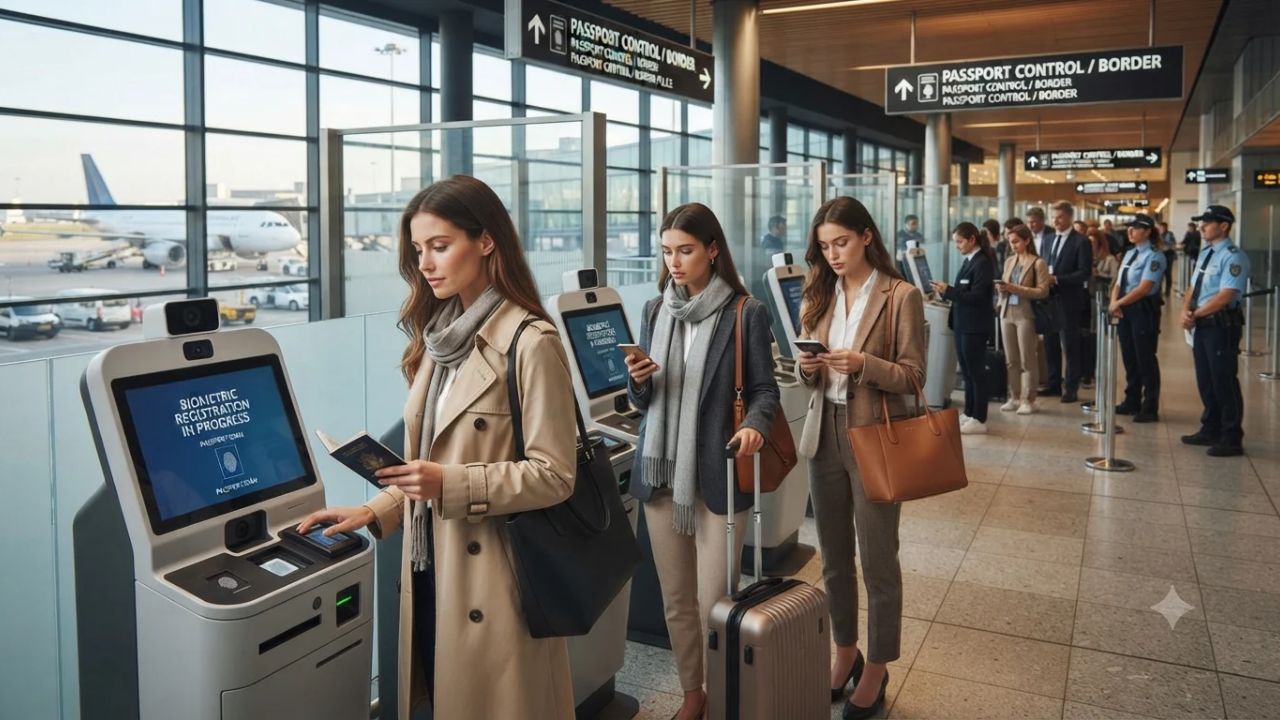
The classic ink stamp on physical passport pages has officially vanished across 29 European nations, replaced by digital biometric profiling under the European Union's fully operational Entry/Exit System (EES). Following an initial phased deployment that began on 12 October 2025, the system reached mandatory full-scale enforcement on 10 April 2026, capturing digital facial portraits, four fingerprint scans, and exact entry and exit timestamps for all non-EU short-stay visitors staying up to 90 days within any 180-day window.
While the European Commission notes that individual kiosk registration takes slightly more than sixty seconds under optimal conditions, the simultaneous arrival of multiple transatlantic widebody aircraft has produced substantial queue spikes at primary gateways including Madrid-Barajas, Brussels, Lisbon, and Eurostar rail checkpoints in London. For American vacationers and business travelers, crossing the European external border now demands a new understanding of connection buffers and biometric protocols.
Deconstructing the Biometric Border: EES vs. ETIAS
Much of the initial confusion among transatlantic travelers stems from conflating the border-level Entry/Exit System with the upcoming European Travel Information and Authorisation System (ETIAS). These represent two distinct layers of European border management operating at completely different points in the journey.
The table below clarifies the key operational differences, requirements, and compliance timelines:
| System Feature | Entry/Exit System (EES) | European Travel Information & Authorisation System (ETIAS) |
|---|---|---|
| Operational Status | Fully Operational (Since 10 April 2026) | Scheduled Launch in Q4 2026 |
| Primary Location | Physical external Schengen airport/port kiosks | Online digital pre-clearance before boarding |
| Required Data | Four fingerprints, facial biometric image, passport scan | Personal background data, travel document info, security questions |
| Target Audience | Non-EU short-stay visitors (up to 90 days / 180 days) | Visa-exempt non-EU citizens traveling to 30 countries |
| Duration of Validity | Digital profile stored for 3 years | Valid for 3 consecutive years or until passport expires |
| Physical Manifestation | Replaces manual passport ink stamps entirely | Electronic boarding authorization checked by airlines |
| Fee Structure | Free at border checkpoint | Standard electronic application fee |
Where Gateway Bottlenecks Are Forming: Airport-by-Airport Analysis
The transition to automated biometric capture has produced varying levels of efficiency across European international airports, depending on physical terminal floor space, hardware installation schedules, and border police staffing.
Madrid-Barajas (MAD) and Lisbon Humberto Delgado (LIS)
Spain's airport operator Aena and Portuguese immigration authorities have faced heavy morning surges when banks of overnight flights from New York, Miami, and São Paulo land simultaneously at Terminal 4 and Terminal 1. Because first-time visitors must record biometrics at dedicated self-service kiosks before presenting themselves to national police officers, transit queues have occasionally backed up into arrival concourses, causing near-misses for passengers connecting onward to domestic Spanish or Portuguese flights.
Brussels Airport (BRU) and Northern Transit Hubs
At Brussels Airport, initial hardware retrofits resulted in selective kiosk shortages during early deployment, temporarily forcing federal police to process non-EU arrivals through manual stations. Similar peak-hour friction points have emerged at Milan Linate (LIN), Milan Bergamo (BGY), Frankfurt (FRA), Paris Charles de Gaulle (CDG), and the St Pancras Eurostar terminal in London where juxtaposed French border controls operate.
Visitor Insider Tips: Passing European Immigration Without Friction
- Enforce a Three-Hour First-Port Layover: When booking flights from North America with a European connection (such as Atlanta to Madrid to Seville, or Boston to Brussels to Berlin), your first port of entry into the Schengen zone is where you clear EES immigration. Do not book tight 60-minute connections; budget a minimum of 150 to 180 minutes between flights.
- Understand the First-Time vs. Subsequent Entry Rule: During your initial trip under EES, you must submit full fingerprints and a facial portrait. On subsequent visits within the three-year validity window, you simply scan your passport and verify your facial image at automated e-gates, cutting processing time to seconds.
- Maintain Clear Visibility at Biometric Kiosks: When stepping up to EES capture units, remove eyeglasses, hats, and scarves completely. Ensure your four right-hand fingers (excluding the thumb) are placed flat and dry on the optical scanner glass to avoid repeated capture errors.
- Download the Official European Union Verification Portal: Access the Official EU Travel Portal to check real-time system advisories and verify the exact status of your remaining 90-day allowance under the rolling 180-day short-stay calculation.
- Retain Digital Proof of Travel Dates: Because physical ink stamps are no longer stamped into your passport booklet, keep digital copies of your airline boarding passes and e-tickets on your smartphone to resolve any potential dispute regarding your entry date.
Digital Sovereignty, Data Privacy, and Schengen Security
The transition from physical rubber stamps to centralized digital biometric records represents the most significant structural overhaul of European border infrastructure since the signing of the Schengen Agreement in 1985. Under the regulatory architecture of EU-LISA (the European Union Agency for the Operational Management of Large-Scale IT Systems), traveler biometric data is encrypted and stored in strict compliance with European General Data Protection Regulation (GDPR) standards.
By automatically calculating authorized lengths of stay and flagging overstays, the system eliminates human calculation errors while closing security vulnerabilities linked to stolen physical identity documents. For travelers, the initial operational friction represents the entry price into an automated system designed to eventually allow rapid e-gate crossings across all 29 member nations.
FAQ: European Biometric Border Controls in 2026
Do Americans need to pay a fee or register online for EES before flying?
No. EES is completely free and completed in person at European airport kiosks upon arrival. You do not need an advance online registration until ETIAS launches in late 2026.
Does EES change the 90/180-day Schengen limit for tourists?
No. The legal allowance remains strictly 90 days within any rolling 180-day window. EES simply automates the calculation and flags overstays electronically.
Will I still receive a stamp in my passport when visiting France, Spain, or Italy?
No. Physical ink stamps have been entirely discontinued at all external Schengen border crossing points in the 29 participating nations.
What happens if I miss my connecting European flight due to immigration queues?
If your itinerary was booked on a single ticket, your operating airline is responsible for rebooking you on the next available flight to your final destination at no additional charge.
As digital scans replace faded ink on paper pages, smart timing and patient preparation remain the keys to European discovery.
Related Travel Guides
- US Weekend Travel Split: Gulf Storms Threaten Atlanta and the Southeast as New York and Boston Stay Dry
- Jamaica Jumps to 78th in Global Tourism Index: Beyond All-Inclusive Resorts to Kingston and the Blue Mountains
- Global Aviation Rebalances: IATA Data Reveals Diverging Fortunes Across the Americas, Europe, and Middle East
- US Flight Cancellations Surge to Four-Year High: How Megahubs DFW, JFK, and O'Hare Are Handling the Strain
Disclaimer
This article is for informational and educational purposes only. It does not constitute legal, financial, or professional advice. While we strive to provide accurate and up-to-date information, travel policies, regulations, and conditions change rapidly. Always verify information with official sources before making travel decisions. Nomad Lawyer makes no representations about the accuracy, reliability, completeness, or suitability of the information provided. Readers should consult qualified professionals for advice specific to their circumstances. The views expressed in this article are those of the author and do not necessarily reflect the views of Nomad Lawyer.
Naina Thakur
Contributor & Travel Specialist
Travel enthusiast and legal writer covering visa regulations, responsible tourism, and cultural journeys across global destinations.
Learn more about our team →