
Dubai Flight Caps Deepen Global Travel Turmoil in 2026
Dubai International Airport's one-flight-per-day cap on foreign carriers now extends to UK airlines, deepening aviation disruptions across Europe, Asia, and Africa in 2026. Thousands of passengers face cancellations and rerouting.

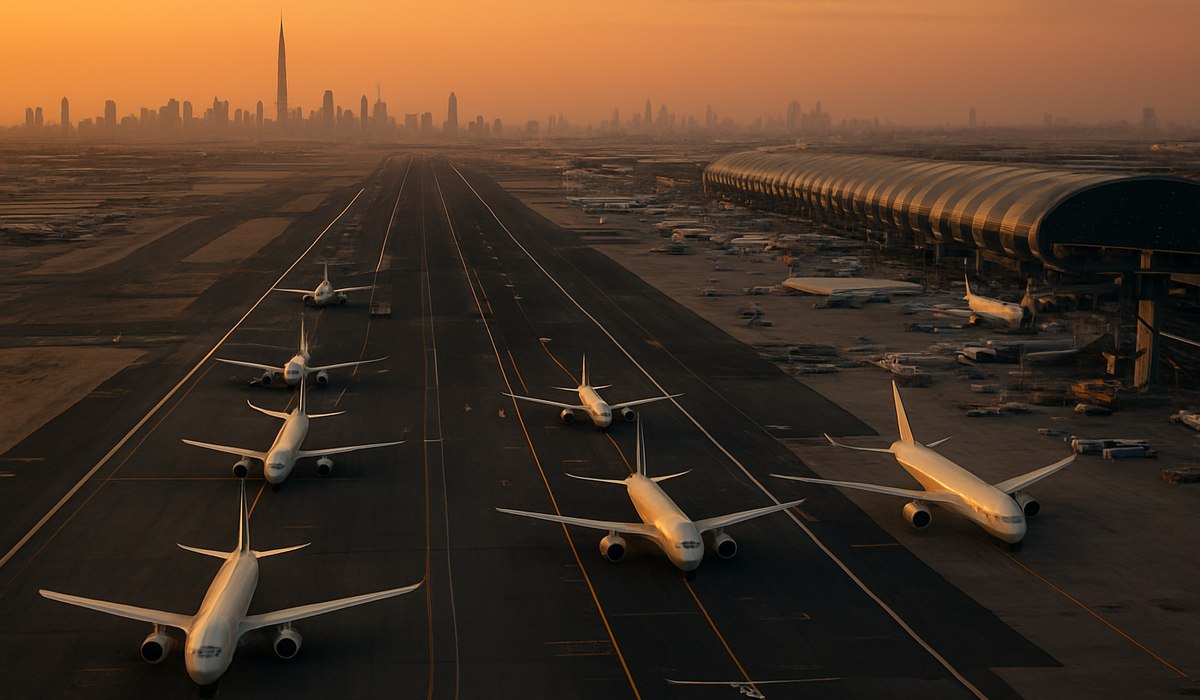
Image generated by AI
Dubai Flight Caps Expand to UK Carriers, Escalating Worldwide Aviation Chaos
Dubai International Airport's new one-flight-per-day foreign airline cap now ensnares United Kingdom carriers, intensifying global aviation disruptions that already impact travelers across Germany, India, Singapore, Hong Kong, and dozens of other major markets. The restriction marks a significant escalation in capacity constraints at the world's busiest international airport hub, affecting millions of connecting passengers and forcing major route redeployments across three continents.
Capacity Crunch at World's Busiest International Hub
Dubai International Airport held the ranking of world's busiest airport by international passenger volume in 2024, but regional security crises have fundamentally reshaped operations. Recent Iranian military strikes and airspace closures throughout late February and early March 2026 damaged critical infrastructure and forced repeated operational shutdowns.
Although runway activity resumed following these incidents, capacity remains significantly depressed compared to historical norms. Airport authorities implemented the temporary dubai flight caps limiting each foreign airline to exactly one daily flight rotation. This measure applies uniformly across all non-UAE carriers, effectively freezing expansion plans on some of Earth's most heavily traveled international routes.
Industry observers characterize this as a temporary measure, with several aviation trade publications projecting potential extension through late May 2026 or beyond. The constraints target foreign operators specifically, while Dubai-based carriers like Emirates maintain substantially denser scheduling privileges—creating competitive imbalances that foreign airlines view as disadvantageous.
Ripple Effects Across Global Aviation Networks
The expansion of dubai flight caps to UK-based carriers demonstrates how localized airport constraints generate worldwide disruption. British and European airlines historically used Dubai as a critical transfer hub connecting passengers to Asian, African, and Australasian destinations. The reduction to single daily departures eliminates same-day connection possibilities for thousands of passengers daily.
This forced redeployment cascades through global route networks. Carriers in Singapore, Hong Kong, and Indian metros previously operated between 12-15 daily flights to Dubai. Compressing this volume into one daily rotation leaves aircraft sitting idle and crews underutilized. Airlines report canceling hundreds of planned services monthly due to these restrictions.
Network planners across Asia are rapidly redrawing route maps, shifting widebody aircraft away from Dubai routes toward intra-Asian services or transpacific markets. This diverts passenger flows toward alternative hub cities including Doha, Istanbul, and European gateways. The broader consequence: global connectivity becomes less efficient, layover times extend dramatically, and passenger choice diminishes significantly.
UK Airlines Join Growing List of Restricted Markets
The inclusion of UK carriers represents a notable escalation because Britain represents Emirates' largest long-haul market. London, Manchester, and Glasgow airports typically generated substantial connecting traffic through Dubai to Asia-Pacific destinations.
Recent schedule updates and booking data confirm that major UK operators now face identical single-flight restrictions. This constraint occurs simultaneously with ongoing European industrial disputes affecting air traffic control and airport staff across Germany and the United Kingdom. These compounding disruptions create what aviation analysts describe as a perfect storm of capacity reductions.
Indian and Asian carriers appear most severely impacted by the dubai flight caps. Trade association statements reveal that carriers like IndiGo, Air India, and regional operators previously deployed substantial fleets on Dubai routes. The compression to one daily flight makes these formerly profitable routes economically unviable under current fuel and labor cost structures.
What Travelers Need to Know Now
The expansion of dubai flight caps directly affects anyone with existing or planned bookings through Dubai International Airport. Current restrictions eliminate same-day connections for international transfers, potentially adding 12-24 hours to journey times for passengers traveling between Europe and Asia-Pacific regions.
Several immediate travel impacts warrant attention: booking flexibility becomes essential, as alternative routings may involve different carriers, airports, or airlines. Loyalty program redemptions and seat availability increasingly concentrate on morning or early evening flights, creating bottlenecks for premium cabin travelers.
Airlines implementing capacity reductions across affected routes are issuing schedule change notices. Monitor email for communications from your carrier regarding any itinerary modifications. Passengers holding tickets for affected flights should proactively contact their airline to discuss alternatives rather than waiting for involuntary rebooking.
Check real-time flight status using FlightAware before traveling to Dubai. This free tool provides current delay information, runway assignments, and operational patterns that help passengers identify which flight times experience fewer disruptions.
Traveler Action Checklist
-
Verify your booking immediately – Contact your airline directly to confirm whether your reservation involves Dubai International Airport and confirm current flight status.
-
Activate flight tracking – Use FlightAware to monitor your specific flights daily for 7 days before departure, noting any changes in scheduling or equipment.
-
Document your itinerary – Screenshot or print all reservation confirmations, connection times, and airline contact numbers before traveling.
-
Request rebooking proactively – If your flight appears on cancellation lists, contact your airline's customer service immediately rather than waiting for involuntary rescheduling.
-
Review passenger rights – Visit the U.S. Department of Transportation website to understand compensation eligibility if you experience significant delays or cancellations.
-
Add travel insurance – Purchase a comprehensive travel insurance policy that covers airline disruptions and rebooking expenses if you haven't already done so.
-
Plan extended layover time – Allow minimum 3-4 hour connections rather than your standard 2-hour baseline when rebooking through Dubai.
-
Identify alternative gateways – Research connecting flights through Istanbul, Doha, or European hubs as backup routing options.
Key Data Table: Dubai Flight Caps Impact Summary
| Metric | Pre-Crisis Baseline | Current Status | Change |
|---|---|---|---|
| Foreign Airlines' Daily Dubai Flights | 8-15 per operator | 1 per operator | -87% to -93% reduction |
| Airport Operating Capacity | 100% | 60-70% | 30-40% constrained |
| Affected Markets | None | UK, Germany, India, Singapore, Hong Kong, Australia | 6+ countries |
| Estimated Monthly Cancellations | 0 | 400-600 flights | Acute disruption |
| Average Connection Layover Time | 2-3 hours | 12-24+ hours | 4-10x longer |
| UK-Asia Route Frequency | 8+ daily connections | 1 daily option | 87% reduction |
| Alternative Hub Displacement | Stable | Doha, Istanbul increasing | Capacity redistributing |
Frequently Asked Questions About Dubai Flight Caps
Q: Will the dubai flight caps persist indefinitely?
Aviation industry sources suggest the restrictions remain temporary through at least late May 2026. However, no official end date has been confirmed by Dubai authorities. Carriers should plan for at least 6-8 weeks of continued limitations while regional security conditions stabilize and airport infrastructure repairs complete.
Q: Which airlines are most affected by these restrictions?
Foreign carriers including British Airways, Lufthansa, Air India, Singapore Airlines, and Cathay Pacific each face the one-flight-per-day limit. UAE-based carriers like Emirates and Etihad maintain higher frequency privileges, creating competitive disparities that industry observers view as temporary market protection measures.
Q: Can I rebook to avoid Dubai connections entirely?
Yes—contact your airline to explore alternative routing through Istanbul, Doha, or European hubs. However, rebooking typically incurs fees unless your original flight was cancelled. Airlines may waive change fees during disruption periods, so explicitly request fee waivers when rebooking.
**Q: What compensation am I entitled to
Disclaimer
This article is for informational and educational purposes only. It does not constitute legal, financial, or professional advice. While we strive to provide accurate and up-to-date information, travel policies, regulations, and conditions change rapidly. Always verify information with official sources before making travel decisions. Nomad Lawyer makes no representations about the accuracy, reliability, completeness, or suitability of the information provided. Readers should consult qualified professionals for advice specific to their circumstances. The views expressed in this article are those of the author and do not necessarily reflect the views of Nomad Lawyer.
Preeti Gunjan
Contributor & Community Manager
A passionate traveller and community builder. Preeti helps grow the Nomad Lawyer community, fostering engagement and bringing the reader experience to life.
Learn more about our team →