
The Driftless Area: Exploring Wisconsin and Iowa's Unglaciated Valleys, Spring Creeks, and Gravel Trails in 2026

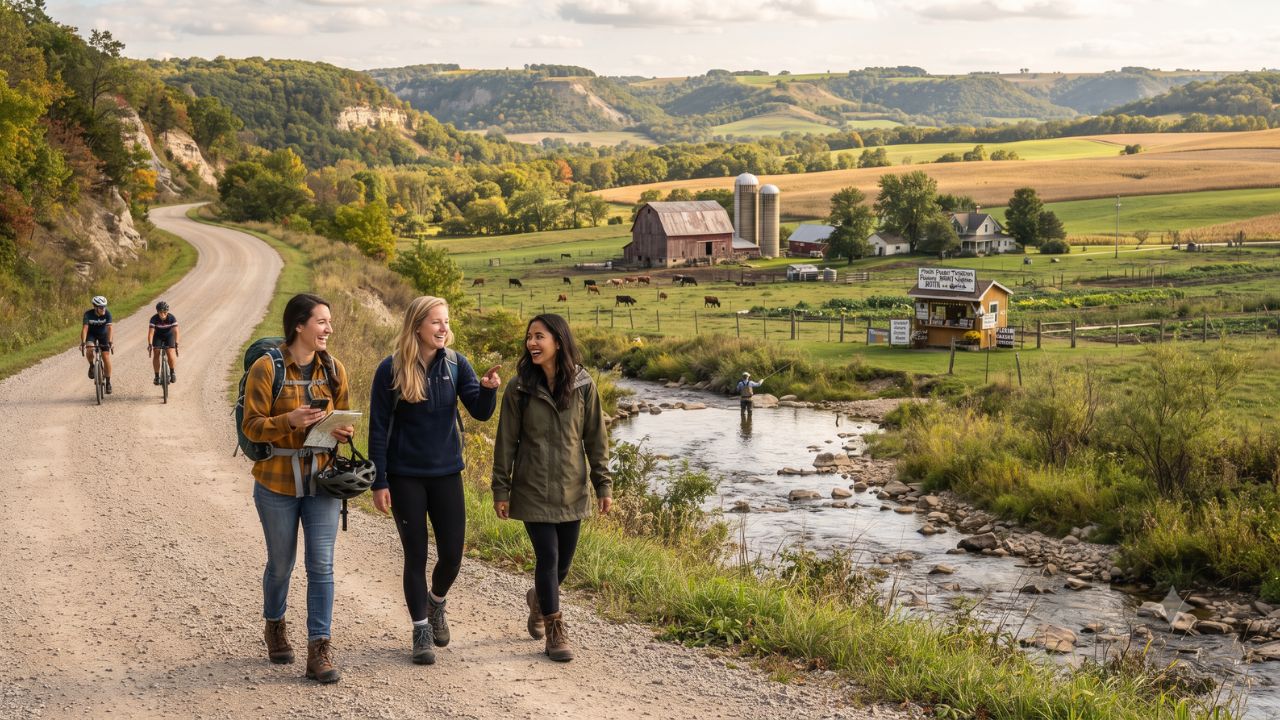
While massive continental glaciers flattened nearly the entire Upper Midwest during the last Ice Age, an unexpected geological anomaly completely bypassed a 24,000-square-mile region spanning southwestern Wisconsin, northeastern Iowa, southeastern Minnesota, and northwestern Illinois. Known as the Driftless Area, this unglaciated sanctuary preserved a labyrinth of deeply carved limestone coulees, soaring sandstone bluffs, and more than 6,000 miles of spring-fed cold-water trout streams.
Today, the Driftless Area is gaining widespread acclaim among outdoor purists as an antidote to commercialized mega-resorts. Rather than mega-hotel developments, the region’s visitor economy thrives on regenerative organic farmsteads, world-class spring creek fly-fishing, challenging gravel cycling ascents, and family-owned artisan cheese creameries. Travelers exploring this distinct topographical haven encounter a slower, self-reliant rural rhythm rooted in ecological stewardship and agricultural heritage.
The Organic Agritourism and Gravel Cycling Frontier
The expansion of outdoor recreation across the Driftless region represents a harmonious convergence of conservation and agro-tourism. Across rolling ridgelines and hidden valley bottoms, multi-generational family farms have diversified into direct-to-consumer farm-to-table dining, cider orchards, sheep dairy creameries, and boutique timber cabins.
At the same time, the region’s extensive network of unpaved country backroads has turned southwest Wisconsin and northeast Iowa into a premier gravel cycling territory. The topography is famously deceptive: flat map projections obscure punishing 15% to 20% elevation gradients as routes climb out of damp stream hollows onto windswept limestone ridges. Cycling events and self-guided bikepacking expeditions connect historic agricultural communities, encouraging travelers to spend nights in converted barns and historic schoolhouses rather than corporate chain hotels.
Promoted through sustainable tourism programs by Travel Wisconsin, the regional travel model relies on decentralized local commerce. By keeping hospitality small-scale, visitor dollars directly support local outfitters, organic growers, country bakeries, and community conservation trusts.
What Makes the Driftless Terrain and Spring Creeks Distinct
The ecological distinctiveness of the Driftless Area stems directly from its untouched Paleozoic geology:
Because continental ice sheets never smoothed the terrain or deposited glacial debris (known geologically as "drift"), underground karst aquifers remained intact. Subterranean limestone fissures filter rainwater, discharging millions of gallons of crystal-clear, mineral-rich groundwater through thousands of natural springs at a constant temperature of around 9°C to 10°C (48°F to 50°F) year-round.
These steady thermal conditions create premier cold-water habitats managed by the Wisconsin Department of Natural Resources and the Iowa Department of Natural Resources. Streams throughout Vernon, Crawford, and Winneshiek counties support dense populations of wild brown trout, native brook trout, and rainbow trout. Unlike silted lowland rivers, Driftless spring creeks produce prolific aquatic insect hatches—including blue-winged olives, caddisflies, and hexagenia mayflies—that sustain an authentic, four-season fly-fishing heritage.
Cultural base camps across the region reflect this independent spirit:
- Viroqua, Wisconsin: A national hub for organic farming, biodynamic agriculture, and independent artisan markets anchored by the Driftless Café.
- Decorah, Iowa: Famed for its limestone river palisades, the cold waters of Trout Run Creek, Nordic cultural museums, and independent craft brewing.
- Mineral Point and Prairie du Chien: Historic lead-mining and fur-trading settlements featuring 19th-century Cornish stone cottages and Mississippi River confluence vistas.
Visitor Insider Tips
Navigating the winding coulees, gravel corridors, and trout streams of the Driftless Area requires local etiquette and practical preparation:
- Understand Streambank Access Rights: In Wisconsin, anglers can wade any navigable stream as long as they keep their feet wet within the water line, but crossing private dry banks requires permission or established DNR angler easements. In Iowa, always verify dedicated state-owned public fishing easements before stepping off public road right-of-ways.
- Pack Dedicated Offline Navigation: Cellular coverage drops significantly in deep limestone coulees and forested hollows. Download offline topographic GPS maps (such as Gaia GPS or Ride with GPS) before venturing onto unpaved gravel cycling routes.
- Tire Width for Gravel Riding: If cycling the ridge roads, equip your bicycle with at least 40mm to 45mm tubeless gravel tires to handle chunky crushed limestone and steep loose ascents.
- Sample World-Class Artisan Dairy: Visit local farmstead creameries to taste award-winning clothbound cheddars, aged gouda, and fresh cheese curds produced from pasture-fed Jersey and Guernsey herds.
- Basecamp Selection: Choose basecamps with direct access to multiple river valleys—such as Viroqua or Richland Center in Wisconsin, or Decorah in Iowa—to minimize driving and maximize trail time.
Cultural and Environmental Context
The fragile karst hydrology of the Driftless Area makes its cold-water streams highly vulnerable to agricultural runoff, topsoil erosion, and flash flood events caused by intense storms. Because thin topsoils sit directly atop porous limestone bedrock, surface contaminants can migrate rapidly into the underlying drinking water table and spring creeks.
In response, local farmers and conservation alliances—including Trout Unlimited chapters and the Driftless Area Restoration Initiative—actively practice regenerative agriculture. Farmers plant native prairie contour strips, manage rotational grazing herds, and restore natural stream meanders with sloped, rip-rapped banks. These community-led conservation practices protect wild trout spawning redds while ensuring that outdoor recreation enriches rural communities without degrading the pristine waters that define the region.
FAQ: Visiting the Driftless Area 2026
What states are part of the Driftless Area?
The Driftless Area covers southwestern Wisconsin, northeastern Iowa, southeastern Minnesota, and northwestern Illinois, centered along the Upper Mississippi River basin.
When is the best time for fly fishing in the Driftless?
Spring (April to June) offers prime insect hatches and active trout feeding, while autumn (September to October) features vibrant fall foliage and aggressive brown trout spawning behavior.
Do I need a special fishing license for Driftless trout streams?
Yes, anglers must purchase an official state fishing license along with an inland trout stamp from either the Wisconsin DNR or Iowa DNR, depending on which side of the state border you fish.
What is the currency and standard payment method in rural Driftless towns?
All transactions are in US Dollars (USD). While credit cards are widely accepted in towns, carry cash for rural roadside honesty-box farm stands and local produce markets.
Carved by ancient springs and shielded from the glaciers of time, the Driftless Area proves that the wildest corners of the American heartland are found where nature was left untouched.
Related Travel Guides
Disclaimer
This article is for informational and educational purposes only. It does not constitute legal, financial, or professional advice. While we strive to provide accurate and up-to-date information, travel policies, regulations, and conditions change rapidly. Always verify information with official sources before making travel decisions. Nomad Lawyer makes no representations about the accuracy, reliability, completeness, or suitability of the information provided. Readers should consult qualified professionals for advice specific to their circumstances. The views expressed in this article are those of the author and do not necessarily reflect the views of Nomad Lawyer.
Kunal K Choudhary
Co-Founder & Contributor
A passionate traveller and tech enthusiast. Kunal contributes to the vision and growth of Nomad Lawyer, bringing fresh perspectives and driving the community forward.
Learn more about our team →