
Delta Air Lines Flight From Barcelona to Boston Diverts to Porto After Cabin Smoke Incident Involving 296 Passengers Onboard
A Delta Air Lines transatlantic flight from Barcelona to Boston carrying 296 passengers diverted to Porto Airport in Portugal following smoke detection inside the cabin.

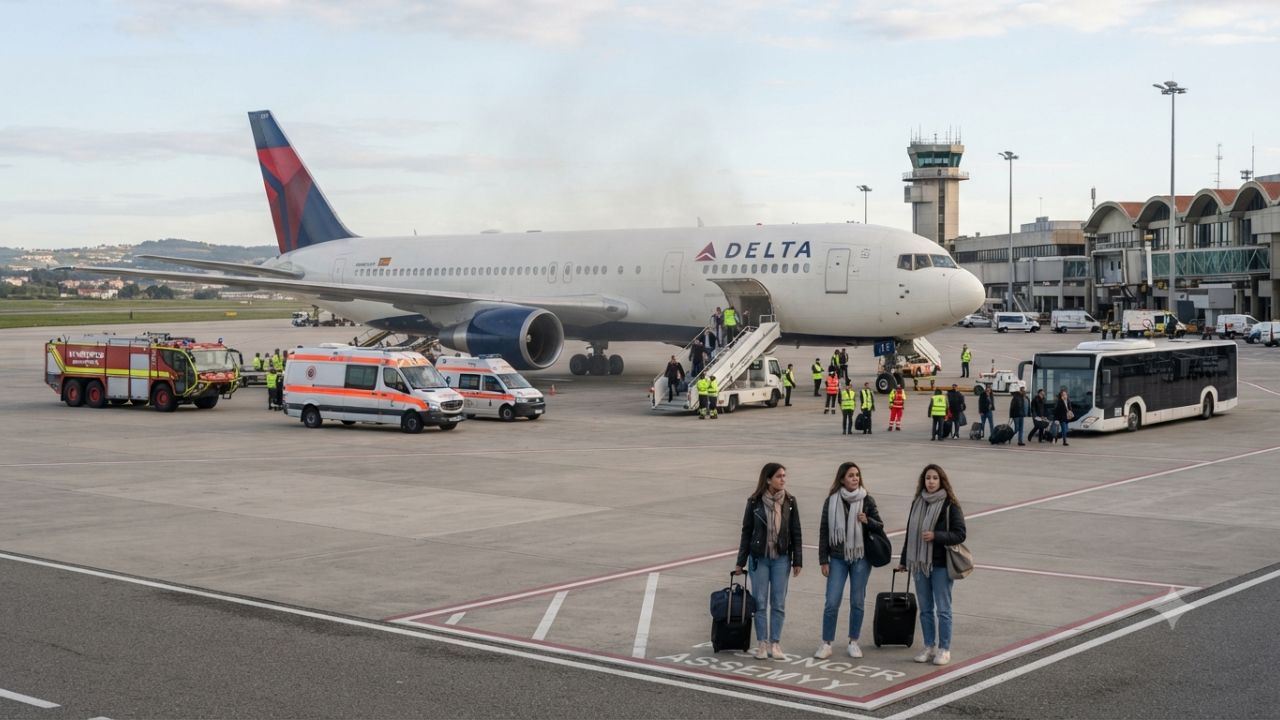
Image generated by AI
A Delta Air Lines transatlantic flight operating from Barcelona El Prat Airport to Boston Logan International Airport was forced to execute an unscheduled emergency landing at Porto Airport in northern Portugal after smoke was detected inside the passenger cabin. Emergency responders met the aircraft upon landing on Sunday, evaluating 14 passengers on-site and transferring four individuals to a regional medical facility for smoke inhalation assessment.
The widebody aircraft was carrying 296 passengers along with flight and cabin crew when an air quality alert was declared mid-journey over the Atlantic approach corridor. Flight crew followed emergency protocols, descending and diverting to Francisco de Sá Carneiro Airport (OPO) in Porto, where emergency fire and medical services were positioned along the runway.
Transatlantic Flight Diversion and Emergency Landing Details
The mid-flight diversion occurred during the oceanic transit phase of the Barcelona-to-Boston route. Upon detecting smoke originating from an onboard aircraft system, pilots requested immediate diversion clearance from regional air traffic control authorities and directed the aircraft toward Porto Airport.
Porto Airport emergency teams responded instantly, executing standard aircraft emergency procedures. The flight touched down safely, and emergency services cleared the aircraft on the taxiway before passengers were disembarked into the terminal handling area.
| Incident Parameter | Flight Specification & Event Benchmark |
|---|---|
| Airline Operator | Delta Air Lines |
| Origin Gateway | Barcelona El Prat Airport (BCN), Spain |
| Scheduled Destination | Boston Logan International Airport (BOS), United States |
| Diversion Airport | Francisco de Sá Carneiro Airport (OPO), Porto, Portugal |
| Total Passengers Onboard | 296 passengers |
| On-Site Medical Evaluations | 14 passengers assessed by emergency responders |
| Hospitalizations | 4 passengers evaluated for precautionary smoke inhalation |
| Primary Incident Cause | System-related smoke detected inside the passenger cabin |
Medical Response, Cabin Air Quality, and Onboard Safety
Following disembarkation at Porto Airport, medical personnel conducted health screenings for all 296 passengers. A total of 14 travelers received immediate on-site medical attention for mild discomfort related to air quality.
Four passengers were subsequently transported to a local hospital in Porto for detailed evaluation for suspected smoke inhalation. Port emergency officials confirmed that all evaluated individuals exhibited mild symptoms, with no life-threatening injuries reported.
Preliminary operational updates indicate that the cabin smoke stemmed from an internal aircraft system component. Technical maintenance engineers and aviation safety inspectors have initiated a detailed mechanical inspection to determine the exact origin of the smoke and verify system integrity before clearing the airframe for return to service.
| Passenger Category | Count / Volume | Medical Outcome & Handling Status |
|---|---|---|
| Total Passengers Onboard | 296 | Safely disembarked at Porto Airport terminal |
| Passengers Screened On-Site | 14 | Evaluated for mild smoke inhalation symptoms |
| Hospitalized for Precaution | 4 | Transported to Porto hospital; mild symptoms reported |
| Remaining Passengers | 278 | Accommodated at Porto terminal pending replacement flight |
Traveler Logistics Guide: Flight Diversions, Passenger Rights, and EU261 Claims
For international passengers experiencing unexpected flight diversions and emergency landings during transatlantic journeys, understanding airline obligations and consumer rights is essential.
Airline Care and Duty of Support During Unscheduled Diversions
When an international flight diverts to a third-country airport due to a safety incident:
- Duty of Care Obligations: Under international aviation standards and EU Regulation EC 261/2004 (which applies to flights departing from EU airports such as Barcelona), the operating carrier is required to provide passengers with complimentary meals, refreshments, hotel accommodation, and ground transfers if an overnight delay occurs.
- Replacement Aircraft & Rebooking: Operating carriers typically dispatch a replacement aircraft or rebook passengers onto partner airline flights to complete transit to the final destination (Boston Logan).
- Baggage and Immigration Protocols: Passengers landing at non-scheduled transit airports remain in designated transit lounges or proceed through temporary border control if overnight hotel stays are required.
Passenger Claims and Legal Protections
- EU261 Rights for EU Departures: Flights departing from an EU airport (Barcelona) are covered under EU261 regulations. While extraordinary safety circumstances (such as unexpected technical emergencies) may exempt carriers from fixed compensation, passengers remain fully entitled to duty-of-care expenses and full rebooking or refund options.
- Retaining Travel Documentation: Travelers affected by diversions should retain all boarding passes, delay notices, and out-of-pocket expense receipts for ground transport, meals, and communications.
| Protection Category | Regulatory Scope (EU261 / International Rules) | Traveler Entitlement & Operational Action |
|---|---|---|
| Duty of Care | Mandatory for all EU departures | Free meals, hotel accommodation, transfers, & communications |
| Rerouting / Refund | Mandatory upon major delay | Choice between free rebooking to BOS or full ticket refund |
| Expense Reimbursements | Receipts required | Claim back reasonable out-of-pocket costs for food & hotel |
| Baggage Claims | Covered under Montreal Convention | Track misrouted or delayed bags through airline ground desk |
Aviation Safety Standards and Technical System Investigation
Smoke or fumes in an aircraft cabin trigger the highest level of emergency response under civil aviation safety frameworks. Flight crews undergo rigorous simulator training to isolate electrical circuits, re-route environmental control systems (ECS), and execute rapid descents to the nearest safe diversion airfield.
The diversion to Porto Airport permitted airport authorities to manage the incident without causing broader disruptions to regional European air traffic control networks. Porto Airport maintained normal operations across all other scheduled flights throughout the emergency response.
Aviation safety inspectors from national transport authorities, alongside Delta Air Lines technical teams, are conducting a thorough diagnostic investigation of the aircraft systems. The investigation findings will clarify whether mechanical, electrical, or air conditioning components caused the incident and determine if corrective service bulletins are required.
FAQ: Delta Flight Barcelona-Boston Diversion to Porto 2026
Why did the Delta flight from Barcelona to Boston make an emergency landing in Porto?
The flight diverted to Porto Airport after smoke was detected inside the passenger cabin coming from an onboard aircraft system component.
How many passengers were on board the diverted Delta flight?
There were 296 passengers on board the aircraft.
Were any passengers injured during the cabin smoke incident?
No severe injuries were reported. Emergency teams evaluated 14 passengers on-site, and four travelers were taken to a local hospital in Porto as a precaution for mild smoke inhalation symptoms.
What rights do passengers have when a flight departing Europe is diverted?
Under EU261 regulations, passengers departing from an EU airport are entitled to hotel accommodation, meals, ground transfers, and rebooking to their final destination at the airline's expense.
Related Travel Guides
Disclaimer
This article is for informational and educational purposes only. It does not constitute legal, financial, or professional advice. While we strive to provide accurate and up-to-date information, travel policies, regulations, and conditions change rapidly. Always verify information with official sources before making travel decisions. Nomad Lawyer makes no representations about the accuracy, reliability, completeness, or suitability of the information provided. Readers should consult qualified professionals for advice specific to their circumstances. The views expressed in this article are those of the author and do not necessarily reflect the views of Nomad Lawyer.
Kunal K Choudhary
Co-Founder & Contributor
A passionate traveller and tech enthusiast. Kunal contributes to the vision and growth of Nomad Lawyer, bringing fresh perspectives and driving the community forward.
Learn more about our team →