
Delta Consolidates West Coast Dominance at LAX as Multi-Hub Architecture Counters Legacy Airline Competition
Delta Air Lines expands its premium footprint across LAX Terminal 2 and 3, balancing high-yield West Coast luxury against Atlanta's high-volume global transit hub.

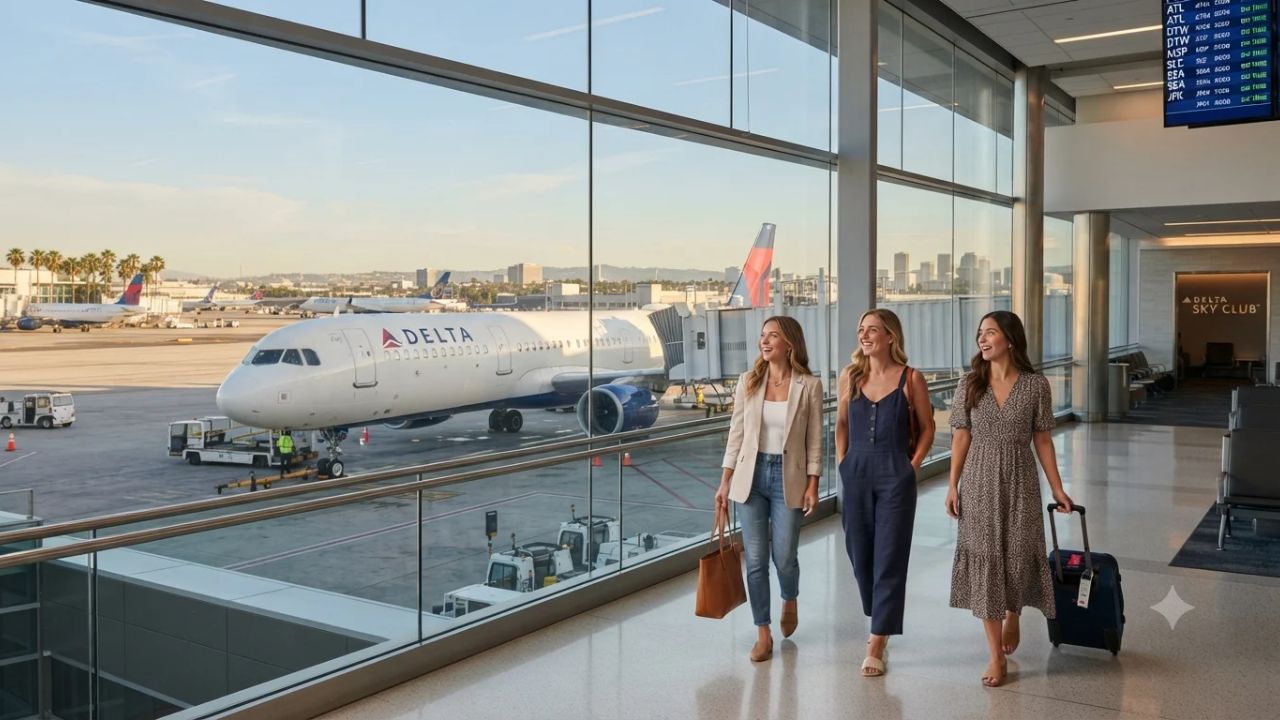
Image generated by AI
Anchoring an operational network spanning seven core domestic hubs and deploying multi-million-dollar airside lounge investments across Terminal 2 and Terminal 3 at Los Angeles International Airport (LAX), Delta Air Lines is executing a bifurcated global connectivity model that balances high-yield West Coast premium travelers against high-volume intercontinental transit through Atlanta. While Hartsfield-Jackson Atlanta International Airport (ATL) retains its supremacy as the world's highest-volume commercial passenger megahub, Delta's capital concentration at LAX highlights an accelerating industry battle for corporate revenue. According to air traffic performance metrics tracked by the Federal Aviation Administration (FAA), legacy carriers are increasingly differentiating their networks by pairing dense regional connecting banks with ultra-premium coastal gateway infrastructure.
The strategic emphasis on Southern California reflects an airline industry reality: volume alone does not guarantee operating margins. At LAX, where market share has historically been fragmented among American Airlines, United Airlines, and foreign flag carriers, Delta Air Lines has established an integrated operational footprint designed to capture entertainment executives, corporate travelers, and transpacific flyers. By deploying dedicated Delta One Lounges featuring full-service restaurant dining, private showers, and personalized service, the carrier is closing the product gap with premier Asian and European competitors.
The Coastal Yield Engine: Why LAX Represents Delta's High-Margin Frontier
Los Angeles has emerged as Delta's most aggressively defended point-to-point battleground. Under a capital modernization program executed alongside Los Angeles World Airports (LAWA), the airline consolidated its operations across a modernized Terminal 2 and Terminal 3 complex. The centerpiece of this commercial push is the expansion of premium ground infrastructure, highlighted by the dedicated Delta One Lounge in Terminal 2, which complements existing premium facilities in Terminal 3.
Unlike standard airport lounges that cater broadly to frequent-flyer credit card holders, the Delta One facility enforces strict cabin-class gating. Eligible international and transcontinental business-class travelers encounter sit-down dining menus, curated beverage pairings, relaxation zones, and luxury shower suites with regional design cues inspired by Southern California architecture.
This ground experience functions as the anchor for Delta's transcontinental and long-haul international flights. On flagship routes connecting Los Angeles with New York (JFK), London (LHR), Tokyo (HND), and Sydney (SYD), premium corporate travelers increasingly select carriers based on the seamlessness of their departure journey. Providing dedicated curb-to-lounge check-in lanes, accelerated security screening, and private lounge environments allows Delta to protect double-digit fare premiums over low-cost and hybrid competitors.
| Hub Airport Location | IATA Code | Primary Network Function | Connecting Market Scope | Infrastructure & Strategic Focus |
|---|---|---|---|---|
| Atlanta, Georgia | ATL | Primary Global Megahub | World's busiest transit fortress; Europe, LatAm, Africa | Headquarters base; maximum domestic bank efficiency |
| Los Angeles, California | LAX | West Coast & Transpacific Gateway | High-yield corporate point-to-point and Pacific routes | Delta One Lounges, Terminal 2/3 consolidation |
| Detroit, Michigan | DTW | Midwest International Gateway | Midwest manufacturing feeder to Europe and East Asia | High-efficiency single-terminal design, automated tram |
| Minneapolis–Saint Paul | MSP | Northern Tier Connecting Hub | Upper Midwest domestic feed and seasonal Europe routes | Centralized regional operations, strong domestic loyalty |
| Salt Lake City, Utah | SLC | Mountain West Connection Center | Western regional transfer hub; intermountain flow | Modernized single-concourse terminal, fortress yields |
| Seattle, Washington | SEA | Pacific Northwest International Gateway | Tech corporate traffic, transpacific Asian corridors | Competing against Alaska Airlines hub presence |
| New York (JFK) | JFK | Global Financial Gateway | Premier transoceanic business and transcontinental routes | Terminal 4 international operations, Sky Club expansion |
Network Geometry: How Seven Hubs Distribute Global Flow
While LAX captures the media spotlight through luxury investments, the operational engine powering Delta's financial profitability remains its domestic multi-hub network. Rather than forcing all traffic through a single mega-facility, Delta distributes passengers across seven geographically distinct transfer centers:
Atlanta (ATL) serves as the world's most efficient passenger transfer machine, routing millions of travelers from regional secondary airports across the American South into transoceanic departures for Europe, Latin America, and Africa. In the industrial heartland, Detroit (DTW) functions as a specialized international springboard, linking industrial suppliers and Midwest business travelers directly to automotive and technology centers in Tokyo, Seoul, Amsterdam, and Paris without requiring a coastal layover.
Further west, Minneapolis–Saint Paul (MSP) and Salt Lake City (SLC) provide high-yield fortress protection. Salt Lake City acts as an airside valve for Western ski and mountain destinations, while Minneapolis captures transcontinental and upper-Midwest corporate flows. In the Pacific Northwest, Seattle-Tacoma (SEA) positions the airline against local rival Alaska Airlines, serving corporate contracts generated by regional technology giants. Together with New York (JFK), which anchors transatlantic financial travel, this multi-hub structure creates a redundant network that minimizes nationwide system delays during severe weather events.
Product Segmentation and the Commercialization of Comfort
Delta's hub expansion mirrors a broader philosophical shift across the global aviation sector: the disaggregation of the passenger cabin. As leisure flyers face tightening household budgets, commercial airlines are driving profitability by segmenting the cabin into four distinct monetization tiers:
At the apex sits Delta One, offering lie-flat seating, luxury bedding, and exclusive lounge access for intercontinental and premium transcontinental travelers. Directly below, Delta Premium Select targets international leisure travelers willing to pay a 50% to 70% premium over economy for wider recliner seats, footrests, and elevated dining. In the domestic network, First Class captures corporate business bookings, while Delta Comfort+ monetizes extra legroom and dedicated overhead bin storage within the forward main cabin.
This multi-tiered strategy enables Delta to extract incremental revenue across every passenger demographic. However, it also introduces operational tension. As airlines dedicate greater square footage and ground resources to top-tier travelers, standard economy passengers encounter tighter seat pitch, unbundled luggage fees, and crowded gate boarding areas, generating ongoing consumer debate over whether legacy carriers are sacrificing core passenger service to subsidize luxury suites.
Expert Analysis: Pricing Discipline and Network Defensibility
From an airline economics viewpoint, Delta's multi-hub design represents a masterclass in risk diversification and revenue defense. When compared to the mega-connecting models of Gulf carriers like Emirates in Dubai or Qatar Airways in Doha—which rely on massive wide-body fleets transferring sixth-freedom international passengers through a single geographic point—Delta's domestic network generates robust local originating traffic that shields the company from international geopolitical volatility.
For travelers booking this route, the direct consequence is superior schedule frequency and operational backup. If a Midwest severe winter storm paralyses operations at Detroit or Minneapolis, Delta's dispatch centers can reroute coast-to-coast passengers through Atlanta or Salt Lake City with minimal disruption, preserving passenger connections that point-to-point budget carriers would simply cancel.
The pricing pressure this creates means business travelers in Delta fortress hubs like Atlanta, Salt Lake City, and Detroit face elevated average airfares, as the carrier's capacity dominance limits low-cost competition on non-stop business corridors. Conversely, in contested markets like LAX, the airline must continuously out-invest rivals in tangible ground amenities to prevent corporate accounts from migrating to American or United. By securing premier airport real estate at LAX and linking it to an unassailable domestic transfer network, Delta ensures that its revenue model remains insulated against broader macroeconomic fluctuations.
Key Takeaways
- Bifurcated Hub Strategy: Delta balances high-yield premium point-to-point corporate travel at LAX against high-volume intercontinental connecting traffic through its Atlanta headquarters.
- Dedicated Ground Luxury: The opening of the Delta One Lounge in LAX Terminal 2 introduces full-service dining, private showers, and curated amenities aimed at matching premier Asian and European carriers.
- Seven-Hub Architecture: Delta distributes domestic and international passengers across seven distinct hubs (ATL, LAX, DTW, MSP, SLC, SEA, JFK), providing operational redundancy during weather disruptions.
- Cabin Monetization Tiers: The airline's profitability is driven by structured cabin segmentation spanning Delta One, Premium Select, First Class, and Delta Comfort+.
- Competitive Pressure in Fortress Markets: While intense competition at LAX forces heavy investment in customer experience, Delta's schedule dominance in hubs like Atlanta and Salt Lake City supports premium fare yields.
FAQ: Delta Air Lines Hub Strategy and Premium Services 2026
What makes the Delta One Lounge at LAX different from a standard Sky Club?
The Delta One Lounge requires a business-class Delta One ticket for entry and features full-service restaurant dining, complimentary premium beverages, private shower suites, and quiet relaxation areas.
Which airport is Delta Air Lines' largest global connecting hub?
Hartsfield-Jackson Atlanta International Airport (ATL) remains Delta's primary global hub, linking hundreds of domestic secondary cities with non-stop flights to Europe, Latin America, and Africa.
Why does Delta maintain major international hubs in Detroit and Minneapolis?
Detroit and Minneapolis provide direct transatlantic and transpacific links for the Midwest and northern tier states, enabling travelers to reach Europe and Asia without connecting through congested coastal airports.
What are the four main cabin classes offered by Delta Air Lines?
Delta segments its cabins into Delta One (long-haul lie-flat business), Delta Premium Select (international premium economy), First Class (domestic premium), and Delta Comfort+ (extra-legroom economy).
From the marble showers of Los Angeles to the high-volume runways of Atlanta, Delta's hub network demonstrates that winning global aviation requires mastering both ends of the sky.
Related Travel Guides
- American Airlines and United Drive Managua Connectivity as US$55.3M Runway Expansion Reshapes Nicaragua Aviation
- Air Traffic Resilience and Airport Passenger Cost Pressures in North America
- Las Vegas Rebounds With 2.7% Visitor Growth and 77.2% Hotel Occupancy Despite Escalating Resort Fees and Travel Costs
Disclaimer
This article is for informational and educational purposes only. It does not constitute legal, financial, or professional advice. While we strive to provide accurate and up-to-date information, travel policies, regulations, and conditions change rapidly. Always verify information with official sources before making travel decisions. Nomad Lawyer makes no representations about the accuracy, reliability, completeness, or suitability of the information provided. Readers should consult qualified professionals for advice specific to their circumstances. The views expressed in this article are those of the author and do not necessarily reflect the views of Nomad Lawyer.
Raushan Kumar
Founder & Lead Developer
Full-stack developer with 11+ years of experience and a passionate traveller. Raushan built Nomad Lawyer from the ground up with a vision to create the best travel and law experience on the web.
Learn more about our team →