
China Travel Chaos: Thousands Stranded as Severe Weather and Airspace Restrictions Trigger 166 Flight Cancellations and 2,183 Massive Airport Delays
As severe weather systems and brutal airspace restrictions paralyze China's major aviation hubs, desperate passengers face terrifying travel chaos, rolling flight cancellations, and massive terminal gridlock.

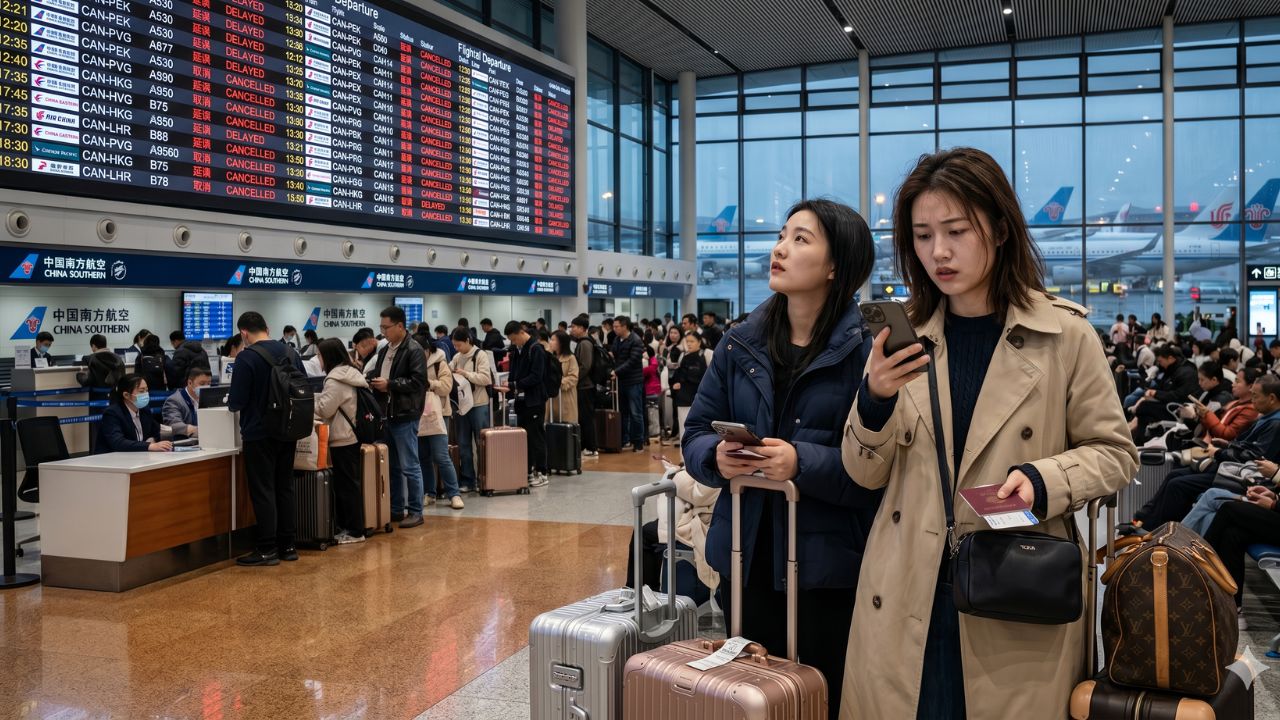
Image generated by AI
A Massive Operational Meltdown Plunges China into Gridlock
While massive sectors of the global passenger network frequently battle highly unpredictable weather events, synchronized nationwide airspace restrictions remain the absolute most terrifying catalyst for sudden, unmanageable terminal congestion. Delivering highly urgent, breaking airline news, verified Asian aviation trackers confirm that a catastrophic operational meltdown is actively generating severe, cascading travel chaos across China. Today, a horrifying total of 166 complete flight cancellations and an absolutely staggering 2,183 severe new flight delays have been officially recorded, violently paralyzing major hubs and regional airports alike, resulting in a total of 2,349 disrupted flights.
While desperate travelers already attempt to navigate sudden, terrifying airport disruptions caused by massive domestic volumes, these exclusive aviation updates reveal that legacy carriers like Air China, China Southern, China Eastern, Cathay Pacific, and Shenzhen Airlines are battling a total network collapse. Tens of thousands of passengers passing through major routes serving Guangzhou, Shanghai, Beijing, Shenzhen, and Hong Kong have been brutally stranded. The widespread issues highlight exactly how quickly operational congestion can ripple through the incredibly complex Chinese aviation network, forcing airlines to violently ground aircraft and completely destroying the itineraries of both domestic and international passengers.
Expanded Overview: The Scale of the Aviation Crisis
The sudden, highly publicized execution of this operational meltdown serves as an undeniable example of how rapidly the incredibly fragile Chinese aviation network can completely disintegrate. As airlines fiercely grapple with these operational challenges, the sheer scale of the disruption is completely overwhelming airport infrastructure. Passengers arriving at airport terminals across China on Monday were horrifyingly greeted by crushed departure halls, rapidly changing information boards, and completely paralyzed travel schedules.
Delayed aircraft, massive schedule adjustments, and severe passenger backlogs are placing terrifying additional pressure on ground operations. Consequently, many travelers are encountering severely extended waiting times, horrifying missed onward connections, and highly expensive, unexpected itinerary changes. While airline operational teams frantically tackle the terminal congestion, passengers are violently urged to prepare for massive schedule adjustments, as the situation continues to severely impact travel plans across the country's absolute busiest aviation corridors.
Section-Wise Breakdown of the Connectivity Crisis
Guangzhou Baiyun: The Epicenter of Disruption
Among all airports reporting severe operational challenges, Guangzhou Baiyun International Airport shockingly experienced the absolute highest number of delays. The facility registered a terrifying 659 delayed flights and 14 cancellations. The massive scale of disruption at Guangzhou explicitly highlights the mounting pressure facing China’s aviation network as airlines frantically attempt to maintain schedules. Because Guangzhou serves as one of China’s absolute most important aviation gateways—connecting domestic routes with major international destinations throughout Asia, Europe, and the Middle East—this localized failure instantly severed global itineraries.
Shanghai Hubs Face Extreme Strain
Shanghai’s two major mega-hubs also horrifyingly reported substantial disruptions. Shanghai Pudong International Airport recorded 173 severe delays and 11 cancellations, while Shanghai Hongqiao International Airport logged 144 delays and 3 cancellations. Together, Shanghai’s airports accounted for more than 300 delayed flights, violently underscoring the operational strain facing one of Asia’s absolute busiest financial and aviation markets.
Beijing and Shenzhen Operational Collapse
The Chinese capital fiercely faced considerable disruptions that paralyzed domestic commuter traffic. Beijing Daxing International Airport reported 109 delays and 9 cancellations, while Beijing Capital International Airport registered 67 delays and 9 cancellations. Authorities in Beijing have previously activated emergency response measures during severe weather events, warning that heavy rainfall permanently cripples airport operations.
Southern China’s aviation network also remained under intense pressure. Shenzhen Bao’an International Airport recorded 223 delays and 7 cancellations, making it one of the most heavily affected airports in the nation. Meanwhile, Hong Kong International Airport horrifyingly reported 169 delays and 8 cancellations, completely stranding both regional and long-haul international passengers.
Verified Chinese Aviation Disruption Data Table
To fully comprehend the massive operational scale and strategic fallout dictating this highly volatile travel meltdown, the following table explicitly details the exact cancellation and delay metrics recorded across China's major and regional hubs:
| Airport Facility | Cancelled Flights (#) | Delayed Flights (#) |
|---|---|---|
| Guangzhou Baiyun Int'l | 14 | 659 |
| Shanghai Pudong Int'l | 11 | 173 |
| Shanghai Hongqiao Int'l | 3 | 144 |
| Shenzhen Bao’an Int'l | 7 | 223 |
| Hong Kong Int'l | 8 | 169 |
| Hangzhou Xiaoshan Int'l | 3 | 110 |
| Beijing Daxing Int'l | 9 | 109 |
| Nanjing Lukou Int'l | 6 | 97 |
| Kunming Changshui Int'l | 3 | 76 |
| Chengdu Tianfu Int'l | 8 | 69 |
| Beijing Capital Int'l | 9 | 67 |
| Harbin Taiping Int'l | 13 | 63 |
| Xi’an Xianyang Int'l | 3 | 58 |
| Tianjin Binhai Int'l | 6 | 27 |
| Changsha Huanghua Int'l | 5 | 26 |
Note: Smaller regional airports including Ulanhot, Xilinhot, Hailar Dongshan, and Lijiang also experienced severe operational interruptions.
Passenger Impact: Stranded Itineraries and Severe Anxiety
For the modern domestic and international commuter attempting to navigate this highly volatile Asian corridor, the passenger impact of this massive operational meltdown is completely exhausting. For travelers, the statistics tell only part of the terrifying story. Behind the 2,183 delays and 166 cancellations are completely stranded families desperately trying to reunite, high-level business travelers racing against collapsing corporate deadlines, and thousands of international tourists watching carefully planned, highly expensive itineraries disintegrate in real time.
As airlines frantically focus on recovery efforts—repositioning aircraft, adjusting exhausted crew schedules, and attempting to accommodate impacted passengers through emergency rebooking programs—travelers are heavily urged to remain at their gates. Passengers across China will be desperately hoping that the next update on the departure board finally displays the highly coveted "On Time" status.
Industry Analysis: The Fragility of Chinese Airspace
From a macroeconomic and industry operations perspective, the localized cancellations highlight a massive, terrifying truth: weather and airspace restrictions can instantly cripple the entire Chinese aviation network. Aviation analysts point to severe weather systems—including massive thunderstorms, low visibility, heavy rainfall, and strong winds—as the absolute primary catalyst severely reducing airport capacity.
Furthermore, temporary airspace management measures and brutal operational restrictions strictly enforced by the Civil Aviation Administration of China (CAAC) have heavily influenced airline scheduling. When the CAAC issues air traffic management directives to ensure safety during adverse conditions, the resulting ground stops create a massive ripple effect that permanently paralyzes the interconnected airline grid.
Conclusion: A Highly Volatile Domestic Crisis
The massive, highly publicized operational failure of the Chinese aviation network represents a severe, terrifying crisis for the Asian travel sector. By actively forcing thousands of passengers to endure 166 flight cancellations and 2,183 severe delays, the airline industry guarantees an incredibly stressful, highly exhausting journey. As the operational teams frantically battle this massive terminal gridlock, passengers are heavily urged to aggressively monitor their bookings via official airline channels, strictly prepare for severe delays, and fully expect massive, cascading flight cancellations amidst unprecedented nationwide travel chaos.
Key Takeaways
- Massive National Meltdown: Severe operational congestion triggered a staggering 2,349 total disrupted flights across China (166 cancellations, 2,183 delays).
- Guangzhou Gridlock: Guangzhou Baiyun International Airport violently led the disruption board with 659 massive delays and 14 cancellations.
- Legacy Carrier Failures: Air China, China Southern, China Eastern, and Cathay Pacific completely failed to maintain their scheduled itineraries.
- Weather & CAAC Directives: Massive thunderstorms and severe temporary airspace restrictions issued by the CAAC completely paralyzed the domestic grid.
- Regional Ripple Effects: Major regional airports including Shenzhen, Hangzhou, and Nanjing faced severe gridlock as mega-hub delays violently cascaded across the connecting network.
Disclaimer: The specific cancellation metrics, delayed flight volumes, and airline operational failures presented in this report are based on verified flight tracking data regarding the Chinese aviation disruption on June 1, 2026. Official airline routing, terminal congestion levels, and final ticket rebooking options are highly volatile and subject to continuous, real-time update based on active Civil Aviation Administration of China (CAAC) operational directives. Prospective passengers are urgently advised to fiercely monitor their specific booking status and verify active flight schedules directly via the airline's official portal prior to airport arrival.
Disclaimer
This article is for informational and educational purposes only. It does not constitute legal, financial, or professional advice. While we strive to provide accurate and up-to-date information, travel policies, regulations, and conditions change rapidly. Always verify information with official sources before making travel decisions. Nomad Lawyer makes no representations about the accuracy, reliability, completeness, or suitability of the information provided. Readers should consult qualified professionals for advice specific to their circumstances. The views expressed in this article are those of the author and do not necessarily reflect the views of Nomad Lawyer.
Kunal K Choudhary
Co-Founder & Contributor
A passionate traveller and tech enthusiast. Kunal contributes to the vision and growth of Nomad Lawyer, bringing fresh perspectives and driving the community forward.
Learn more about our team →