
China Aviation Crisis 2026: 5,313 Flights Delayed and 148 Cancelled Across Major Hubs
Massive operational disruptions hit China's aviation sector on July 6, 2026, with over 5,000 delays and 148 cancellations affecting Air China and China Eastern.

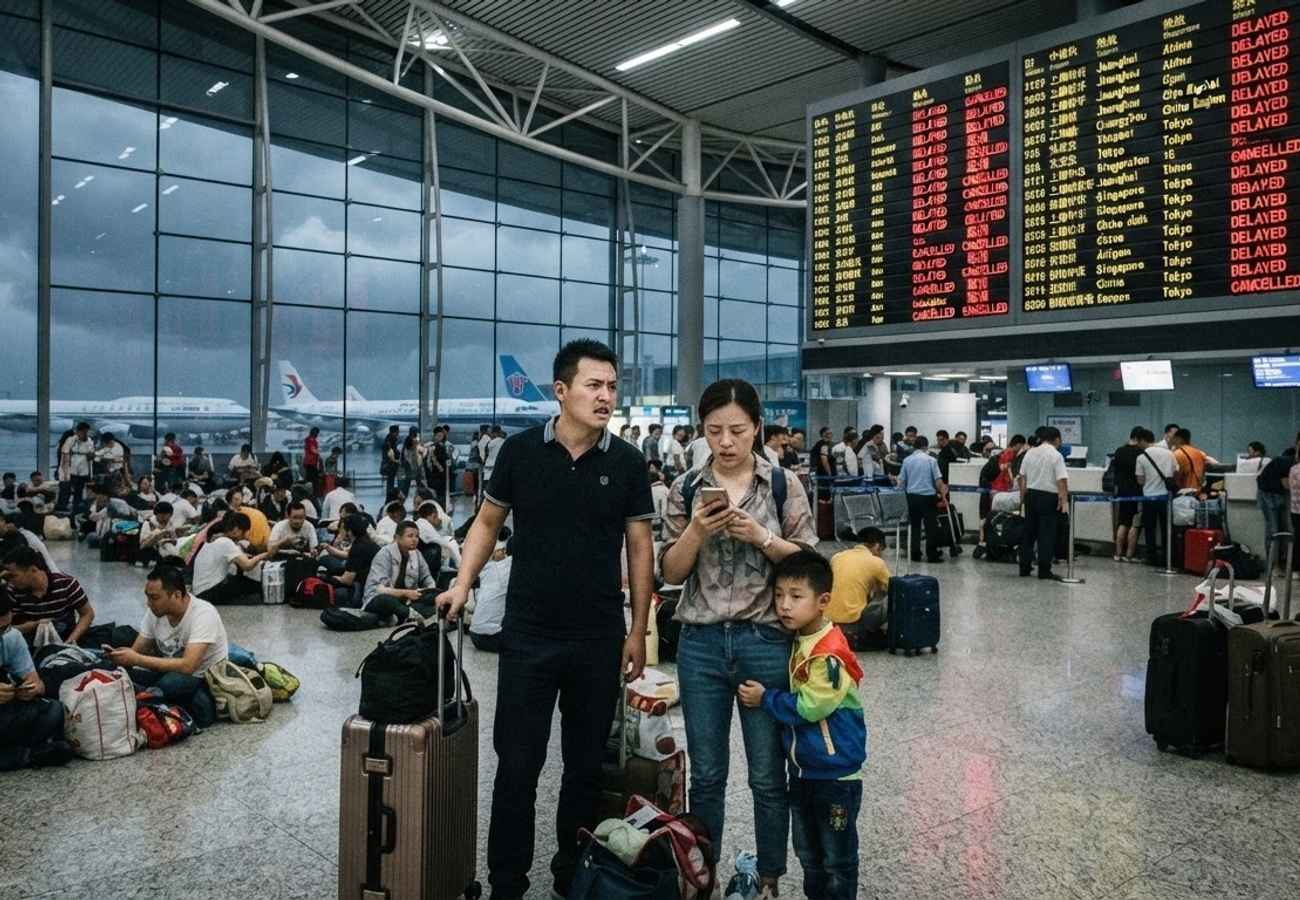
Image generated by AI
Severe weather and operational bottlenecks have paralyzed air travel across China, leaving thousands of passengers stranded on July 6, 2026.
The disruption saw 5,313 flights delayed and 148 cancelled across a network of primary hubs. The crisis was driven by a combination of peak season air traffic, aircraft rotation failures, and the lingering atmospheric instability following Tropical Storm Maysak in southern regions.
Network-Wide Operational Collapse
The scale of the disruption affected nearly every major aviation artery in the country. Hubs in Beijing, Shanghai, Shenzhen, and Chongqing reported significant congestion, with operational constraints compounding the effects of localized thunderstorms and poor visibility.
Industry observers note that the recovery process has been slowed by crew scheduling conflicts and air traffic management restrictions. China Eastern and Air China emerged as the hardest-hit carriers, struggling to maintain schedules amidst the systemic volatility.
Airport Disruption Metrics
The following data outlines the specific impact on China's most critical aviation gateways:
| Airport | Delayed Flights | Cancelled Flights |
|---|---|---|
| Guangzhou Baiyun | 879 | 13 |
| Shenzhen Bao’an | 690 | 8 |
| Shanghai Pudong | 571 | 16 |
| Beijing Capital | 563 | 10 |
| Hangzhou Xiaoshan | 457 | 8 |
| Beijing Daxing | 406 | 12 |
| Chongqing Jiangbei | 312 | 6 |
| Xi’an Xianyang | 310 | 8 |
| Jinan Yaoqiang | 165 | 10 |
| Dalian Zhoushuizi | 138 | 12 |
| Shenyang Taoxian | 132 | 6 |
| Qingdao Jiaodong | 132 | 6 |
| Lanzhou Zhongchuan | 128 | 8 |
| Shijiazhuang Zhengding | 117 | 6 |
| Nanchang Changbei | 95 | 8 |
| Zhuhai | 145 | 6 |
Carrier Impact Analysis
Market data reveals that while many airlines faced challenges, a few carriers suffered disproportionate losses in reliability.
- China Eastern: Recorded the highest volume of disruptions with 912 delays and 39 cancellations. Approximately 35% of its total schedule was impacted.
- Hainan Airlines: Reported the highest percentage of instability, with nearly 47% of its flights delayed.
- Air China: Experienced 666 delays and 16 cancellations, affecting 33% of its domestic operations.
- Spring Airlines: Saw 144 delays and 19 cancellations, with a 23% delay rate.
- China Express Airlines: Recorded 111 delays and 10 cancellations (24% delay rate).
- Chengdu Airlines: Logged 83 delays and 2 cancellations (23% delay rate).
Why This Matters: Industry Implications
Our analysis of the flight data indicates a precarious fragility in China's aviation infrastructure during the 2026 peak travel season. The fact that a single weather event—Tropical Storm Maysak—could trigger a ripple effect resulting in over 5,000 delays suggests a lack of "buffer capacity" in current air traffic management.
The high delay percentages for Hainan Airlines (47%) and China Eastern (35%) highlight a critical vulnerability in aircraft rotation. When a hub like Guangzhou Baiyun (which saw 879 delays) stalls, it creates a "domino effect" where crews and aircraft are out of position for subsequent legs, effectively paralyzing the network long after the storm has passed. This indicates that the industry is currently unable to absorb sudden shocks without systemic failure.
Forward Outlook
Expect continued volatility in the southern corridors as airlines attempt to reset crew rotations. Passengers are advised to prioritize digital notifications and review refund policies, as the backlog of delayed aircraft may lead to further "tactical cancellations" to stabilize schedules.
Travelers should remain flexible and consider alternative regional hubs to avoid the current congestion in the Beijing and Shanghai sectors.
Related Travel Guides
Disclaimer
This article is for informational and educational purposes only. It does not constitute legal, financial, or professional advice. While we strive to provide accurate and up-to-date information, travel policies, regulations, and conditions change rapidly. Always verify information with official sources before making travel decisions. Nomad Lawyer makes no representations about the accuracy, reliability, completeness, or suitability of the information provided. Readers should consult qualified professionals for advice specific to their circumstances. The views expressed in this article are those of the author and do not necessarily reflect the views of Nomad Lawyer.
Preeti Gunjan
Contributor & Community Manager
A passionate traveller and community builder. Preeti helps grow the Nomad Lawyer community, fostering engagement and bringing the reader experience to life.
Learn more about our team →