
Massive Travel Chaos Hits China as Severe Weather Forces 60 Flight Cancellations Across Beijing, Shanghai, and Chengdu Hubs
A severe wave of aviation disruption has paralyzed China's busiest travel corridors, with China Eastern, Air China, and XiamenAir cancelling 60 flights due to extreme weather and airspace congestion.

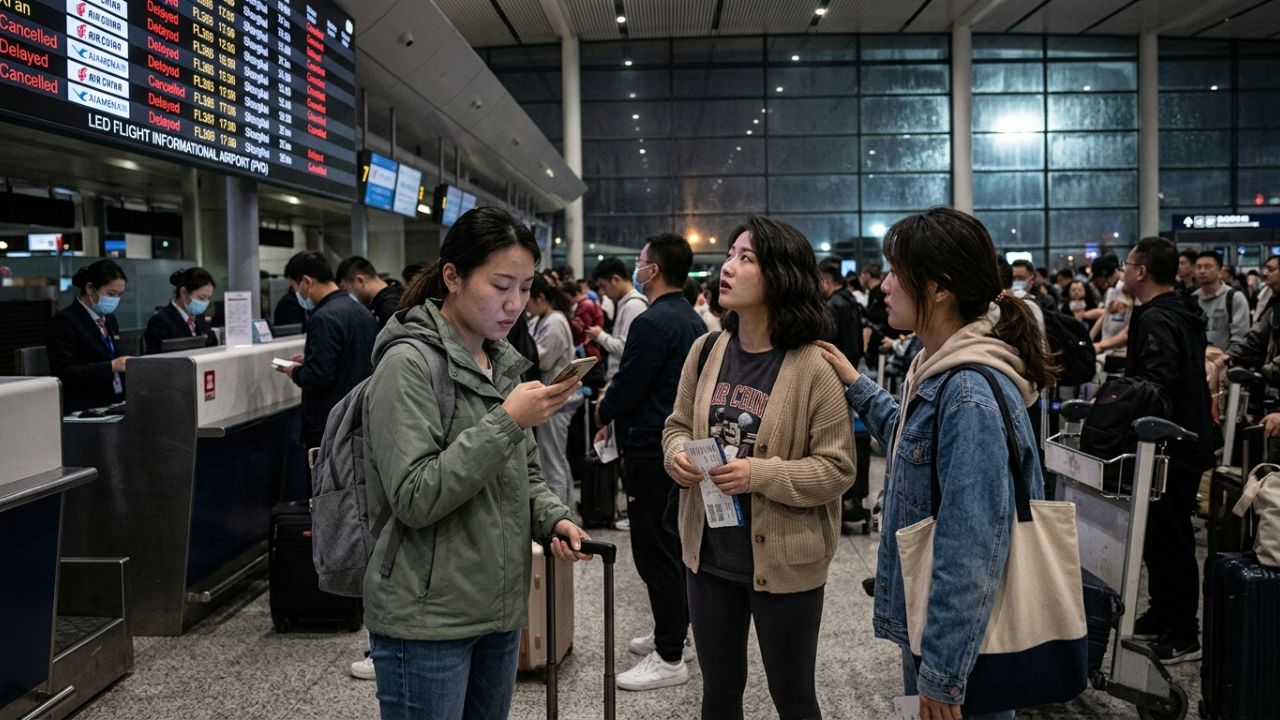
Image generated by AI
Massive Travel Chaos Hits China as Severe Weather Forces 60 Flight Cancellations Across Beijing, Shanghai, and Chengdu Hubs
Published on May 13, 2026
A severe wave of aviation chaos has abruptly engulfed China’s busiest travel corridors today, leaving thousands of international and domestic passengers stranded in overcrowded airport terminals. On May 13, 2026, violent thunderstorm activity, dense low visibility, and intense air traffic control restrictions forced three of China’s largest carriers—China Eastern Airlines, Air China, and XiamenAir—to drastically slash their schedules, resulting in 60 sudden flight cancellations. The operational meltdown has severely disrupted the nation’s primary economic and tourism hubs, with massive ripple effects paralyzing operations at Shanghai Pudong, Beijing Capital, and Chengdu Tianfu airports. For travelers navigating the peak spring and early summer tourism season, this sudden airspace constriction has triggered widespread panic, as families, corporate executives, and tour groups face agonizingly long queues for rebooking, severe accommodation shortages, and completely shattered itineraries. As the aviation industry frantically struggles to reposition aircraft and restore network stability across eastern, central, and southwestern China, passengers are urgently advised to rethink their immediate travel plans and brace for prolonged, exhausting delays.
Quick Summary:
- Severe weather and congested airspace have triggered a massive wave of aviation disruption across China on May 13, 2026, paralyzing the nation's busiest air corridors.
- A staggering total of 60 domestic flights were cancelled across major carriers, comprising 20 from China Eastern Airlines, 20 from Air China, and 20 from XiamenAir.
- The operational chaos heavily affected primary aviation mega-hubs, notably Shanghai Pudong, Beijing Capital, Chengdu Tianfu, and Hangzhou Xiaoshan.
- The disruption was primarily caused by aggressive thunderstorm activity across eastern and central China, leading to severe air traffic flow restrictions and low visibility.
- Thousands of passengers, including high-yield business commuters and holidaymakers, have been left stranded, facing extensive rebooking delays and regional hotel shortages.
- Travel experts strongly advise impacted passengers to utilize China's highly efficient high-speed rail network as an immediate emergency backup for short-to-medium distance routes.
The Perfect Storm: Why China's Skies Suddenly Gridlocked
The sheer scale of today's aviation breakdown highlights the fragile interconnectivity of China's massive domestic airspace. Real-time aviation monitoring platforms, including FlightAware, indicated that the primary culprit was a massive front of severe thunderstorms violently sweeping across eastern and central China.
In modern aviation, thunderstorms do more than just make flights bumpy; they force entire fleets to deviate from established flight paths. When major hubs like Shanghai and Beijing suffer from low visibility and lightning risks, Air Traffic Control (ATC) immediately implements severe flow restrictions, drastically reducing the number of aircraft allowed to land or take off per hour.
Because modern airlines operate on razor-thin turnaround times, a single delayed flight in Shanghai quickly triggers a domino effect, stranding the aircraft and crew meant to fly the next leg out of Chengdu or Wuhan. To prevent total network gridlock and maintain critical safety margins, carriers were forced to execute proactive, bulk cancellations rather than allowing rolling delays to consume the entire system.
China Eastern and Air China Bear the Brunt in Shanghai and Beijing
As the dominant players in China's two largest aviation markets, China Eastern Airlines and Air China bore the absolute brunt of the disruption.
China Eastern was forced to scrap 20 flights, with the epicenter of the chaos located in Shanghai. Critical business and leisure routes, including heavy-traffic corridors from Shanghai to Xi'an, Qingdao, and Chengdu, were completely severed. Passengers looking forward to a luxury escape in Sanya or a cultural tour in Dalian found their plans abruptly halted.
Meanwhile, Air China scrambled to manage the fallout in northern and southwestern China. The flagship carrier cancelled 20 flights, severely paralyzing the vital Beijing-Chengdu corridor—one of the most profitable and heavily trafficked routes in the world. High-level corporate travelers, government officials, and tourists en route to see the pandas in Sichuan were left scrambling as flights connecting Beijing to Guangzhou, Hangzhou, and Ningbo were wiped from the departure boards.
XiamenAir Network Severely Hit Across the Coastal Corridors
While the mega-hubs suffered, the coastal and central networks operated by XiamenAir were equally devastated. The airline cancelled 20 flights, plunging southeastern China into logistical turmoil.
Fujian Province, a massive economic engine and tourism draw, was heavily impacted, with flights grounded at Xiamen Gaoqi and Fuzhou Changle airports. Crucial regional arteries connecting Hangzhou to Chongqing, and Quanzhou to Changsha, were completely disabled. For travelers seeking an immersive cultural experience in China's ancient coastal cities, the sudden lack of regional connectivity proved disastrous, especially for those relying on routes with fewer daily frequencies where rebooking options are incredibly scarce.
Terminal Chaos: Stranded Passengers and Shattered Itineraries
Inside the terminals, the scene was one of sheer frustration and exhaustion. The cancellation wave created overwhelming passenger bottlenecks at customer service counters across the country.
Travelers reported grueling, multi-hour waits to retrieve checked baggage from aborted flights and even longer queues to negotiate rebooking options with stressed airline staff. The sudden influx of thousands of displaced passengers quickly overwhelmed airport transit hotels and nearby accommodations, leaving many families and tour groups stranded in departure halls overnight.
For the booming domestic tourism sector—which relies heavily on precision logistics for multi-city tour packages—these disruptions are catastrophic. Local hotels, transport providers, and tour guides in cities like Kunming and Xi'an faced a sudden wave of no-shows and frantic rescheduling requests, severely straining the hospitality ecosystem.
Bypassing the Aviation Gridlock: The High-Speed Rail Alternative
While the skies remain congested, this crisis highlights the incredible resilience of China's broader transportation infrastructure. The country's world-class, sprawling high-speed rail (HSR) network immediately emerged as the ultimate lifeline for stranded passengers.
Cities connected by the HSR network were able to absorb massive portions of the displaced passenger demand. For travelers whose flights between Beijing and Hangzhou, or Shanghai and Wuhan, were cancelled, the high-speed train offered an incredibly fast, weather-resistant alternative. Tourism operators and travel experts are increasingly integrating rail backups into their itineraries, recognizing that a 300 km/h train is often significantly more reliable than a flight during China's volatile spring and summer storm seasons.
Guide for Travelers:
- Do Not Go to the Airport Unconfirmed: If your travel is scheduled during this weather event, constantly monitor your flight status using apps like Umetrip (航旅纵横) or FlightAware. If your flight is cancelled, do not head to the airport—you will only join massive, unmoving queues.
- Utilize Digital Rebooking: Avoid the customer service desks entirely. Use your airline’s official mobile app or WeChat mini-program to digitally process automated rebooking options or claim your full refund instantly.
- Pivot to High-Speed Rail: If your flight is cancelled on a short-to-medium distance route (e.g., Shanghai to Hangzhou, Beijing to Xi'an), immediately open the 12306 app or Trip.com and book a high-speed train ticket. These sell out rapidly during aviation disruptions.
- Travel Insurance is Essential: Ensure you have comprehensive domestic travel insurance that covers "trip delay" and "trip interruption." Keep all receipts for meals and emergency hotel stays caused by the cancellation to ensure a smooth claims process.
- Best Time to Fly: During the volatile spring and summer storm seasons, always attempt to book the earliest morning flights available (between 6:00 AM and 8:00 AM). Thunderstorms typically develop and disrupt airspace in the late afternoon and evening.
Related Travel Guides
- Vietnam’s Foreign Ownership Cap in Airlines Set to Soar to 49%
- Singapore and Asia-Pacific Face Sharp Airfare Fluctuations in 2026
- Royal Jordanian Airlines Launches Direct Flights from Amman to Dallas
The sudden, severe aviation disruption that has engulfed China’s skies today is a stark reminder of how vulnerable modern air travel remains to the wrath of nature. While airlines like China Eastern, Air China, and XiamenAir utilize some of the most advanced operational technology in the world, the safety imperative of navigating severe thunderstorms must always take precedence over the schedule. For the thousands of families, tourists, and business travelers left stranded in the crowded terminals of Shanghai, Beijing, and Chengdu, the experience is undeniably frustrating. Yet, it also underscores the critical importance of flexibility, rapid digital problem-solving, and utilizing the formidable strength of China’s high-speed rail network as a backup. As the aviation industry works feverishly to clear the backlog and restore safe passage, travelers are reminded that navigating a dream destination occasionally requires weathering the storm—both literally and logistically.
Disclaimer
This article is for informational and educational purposes only. It does not constitute legal, financial, or professional advice. While we strive to provide accurate and up-to-date information, travel policies, regulations, and conditions change rapidly. Always verify information with official sources before making travel decisions. Nomad Lawyer makes no representations about the accuracy, reliability, completeness, or suitability of the information provided. Readers should consult qualified professionals for advice specific to their circumstances. The views expressed in this article are those of the author and do not necessarily reflect the views of Nomad Lawyer.
Kunal K Choudhary
Co-Founder & Contributor
A passionate traveller and tech enthusiast. Kunal contributes to the vision and growth of Nomad Lawyer, bringing fresh perspectives and driving the community forward.
Learn more about our team →