
Breaking Airline News: Severe Thunderstorms Trigger FAA Ground Delay at Chicago O'Hare, Plunging United and American Airlines into Massive Travel Chaos
Breaking airline news: Amidst a terrifying era of severe weather fragility, a massive FAA Ground Delay Program at Chicago O'Hare triggers 635 delays and 267 flight cancellations, plunging North America into extreme travel chaos.

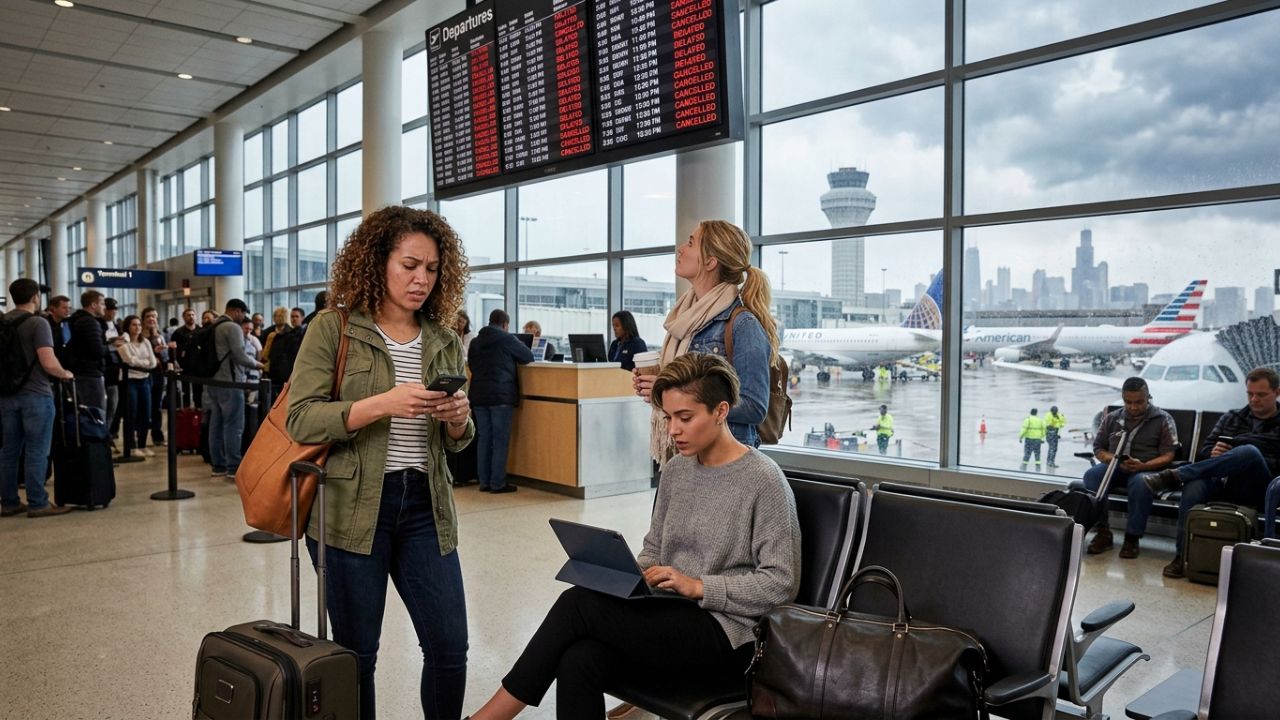
Image representing the intense strategic battle as thousands of stranded passengers desperately navigate severe flight cancellations and massive terminal gridlock at Chicago O'Hare, battling extreme travel chaos caused by severe weather.
Breaking Airline News: Severe Thunderstorms Trigger FAA Ground Delay at Chicago O'Hare, Plunging United and American Airlines into Massive Travel Chaos
As paralyzing terminal bottlenecks, terrifying severe weather cells, and severe operational fragility violently threaten to completely shatter passenger mobility across North America, a massive centralized meltdown has executed a devastating blow to the global aviation network. In a harrowing display of infrastructure vulnerability, hundreds of thousands of travelers are currently isolated and violently stranded at Chicago O’Hare International Airport (ORD). Triggered by severe thunderstorms, the Federal Aviation Administration (FAA) has aggressively imposed a massive Ground Delay Program, instantly generating a staggering 635 delays and 267 flight cancellations. By violently severing the operational integrity of this critical mid-western hub, American Airlines, United Airlines, Delta Air Lines, and a massive network of regional carriers including SkyWest and Envoy have been plunged into absolute, extreme travel chaos, destroying travel plans across the United States and Canada.
In a brutal demonstration of how fragile modern aviation networks truly are when confronted with extreme meteorological events, the sheer logistical nightmare of attempting to navigate through Chicago rapidly degenerated into terrifying transit scenarios. For passengers, securing a confirmed ticket meant absolutely nothing as departure boards lit up with delays averaging an agonizing 437 minutes (more than 7 hours). The terrifying ripple effects of this FAA-mandated lockdown violently spread across the continent, severely disrupting major routes connecting regional centers to highly populated hubs like New York, Atlanta, Los Angeles, Boston, Toronto, and Montreal. As airport operations buckled under the immense pressure of stranded travelers, the incident proved that centralized hub-and-spoke models are violently susceptible to sudden, catastrophic airport disruptions.
Expanded Overview: The Massive Scale of the Weather Contagion
The terrifying crisis of overwhelming passenger stress currently gripping the Chicago terminal brutally exposes the severe limitations of airlines attempting to maintain tight turnaround schedules during severe weather. Recognizing that aggressively running aircraft through intense storm cells is mathematically impossible, the FAA intervention fundamentally rewrote the travel matrix for the day. The sheer scale of this infrastructural collapse is immense. Because Chicago O'Hare serves as a highly critical connective node for both United and American Airlines, the combination of flight cancellations and heavily delayed departures created massive, uncontrollable ripple effects across deeply connected networks, violently impacting both highly vulnerable leisure tourists and time-sensitive corporate business passengers.
Section-Wise Breakdown: The Operational Realignment
Deploying the Ground Delay: FAA Intervention
To survive the terrifying surge of severe thunderstorms without triggering a catastrophic airborne disaster, the FAA violently locked down the airspace. The core reason for these widespread disruptions is the terrifying combination of lightning near runways (forcing immediate, mandatory pauses on all ground operations), severe wind shear (drastically reducing the number of aircraft ATC can safely process), and heavy rainfall (destroying visibility and violently increasing taxi times). These storm cells lingering over the airport act as an impenetrable wall, prolonging the backlog and compounding delays across the entire North American system.
Airline Paralysis: The Corporate Collapse
The most terrifying aspect of this specific travel chaos is its brutal impact on the primary mega-carriers dominating the hub. American Airlines and United Airlines absorbed massive hits, but the devastation was particularly severe for regional operators who simply lack the spare aircraft to recover. SkyWest, Envoy Air, GoJet, JetBlue, Republic, Endeavor Air, and Jazz were all violently affected. These smaller regional airlines showed disproportionately high cancellation percentages, proving that during severe weather, low-frequency operators are completely decimated.
Origin Airport Contagion: The Ripple Effect
The meltdown executed a massive strike against primary commercial corridors sending flights into Chicago. Major origin airports violently contributing to the delays included LaGuardia (LGA), Cleveland-Hopkins (CLE), St Louis Lambert (STL), Minneapolis/St Paul (MSP), and Hartsfield-Jackson (ATL). This proves that a storm in Chicago instantly corrupts operations on the East Coast and in the deep South.
Destination Airport Paralysis
Conversely, the failure to launch flights out of Chicago stranded passengers expecting arrivals across the country. Reagan National (DCA), Charlotte/Douglas (CLT), San Francisco (SFO), and Palm Beach (PBI) experienced terrifying knock-on delays. Furthermore, the operational bleeding spilled across international borders, violently impacting Canadian gateways like Toronto Pearson (YYZ) and Montreal-Trudeau (YUL). Regional airports such as Roanoke, Salina, Manhattan, and Purdue experienced absolute devastation, showing extreme cancellation rates up to 100% for their very low-volume flights.
Chicago O’Hare Disruption & Ground Delay Matrix
To fully comprehend the massive logistical and strategic fallout of this terrifyingly efficient network collapse, corporate travel managers and affected tourists must review the exact operational metrics defining the capacity strain. The following matrices provide a granular breakdown of the specific, officially verified statistical data driving this massive disruption.
Table 1: Carrier Operational Meltdown Data
| Airline Operator | Verified Delays | Verified Cancellations |
|---|---|---|
| American Airlines | 138 delays (30%) | 46 cancellations (10%) |
| United Airlines | 156 delays (21%) | 18 cancellations (2%) |
| SkyWest | 116 delays (22%) | 56 cancellations (10%) |
| Envoy Air | 71 delays (20%) | 76 cancellations (21%) |
| Delta Air Lines | 28 delays (33%) | 7 cancellations (8%) |
Table 2: Origin Airport Contagion Data
| Origin Airport | Verified Delays | Verified Cancellations |
|---|---|---|
| LaGuardia (LGA) | 11 delays (31%) | 5 cancellations (14%) |
| Cleveland-Hopkins (CLE) | 3 delays (23%) | 4 cancellations (30%) |
| St Louis Lambert (STL) | 7 delays (35%) | 4 cancellations (20%) |
| Minneapolis/St Paul (MSP) | 7 delays (29%) | 3 cancellations (12%) |
| Hartsfield-Jackson (ATL) | 7 delays (33%) | 2 cancellations (10%) |
Table 3: Destination Airport Contagion Data
| Destination Airport | Verified Delays | Verified Cancellations |
|---|---|---|
| Reagan National (DCA) | 12 delays (54%) | 1 cancellation |
| Charlotte/Douglas (CLT) | 1 delay (6%) | 1 cancellation |
| San Francisco (SFO) | 7 delays (38%) | 1 cancellation |
| Palm Beach (PBI) | 2 delays (50%) | 1 cancellation |
Data accurately reflects the verified disruption metrics associated with the Chicago O'Hare FAA Ground Delay Program.
Passenger Impact: Surviving the Chicago Lockdown
For the thousands of global executives and regional residents attempting to navigate the rapidly collapsing transit corridors via Chicago, this massive capacity failure represents a highly terrifying reality. The brutal reality of enduring a 437-minute delay inflicts intense psychological stress—leaving the passenger entirely stranded and draining resources. By aggressively executing tactical survival protocols, passengers can drastically reduce their exposure to these terrifying logistical environments.
What to Do if Your Flight is Caught in the Ground Delay
Travelers desperately preparing to navigate the modernized but highly fragile domestic network must immediately execute the following survival protocols:
- Violently Monitor the FAA: You must aggressively monitor the FAA status page alongside your airline’s mobile app. A Ground Delay Program dictates the flow of traffic; knowing when the program lifts is critical to anticipating your actual departure time.
- Execute Regional Hub Checks: If you are flying to or from smaller regional airports (like Salina, Roanoke, Manhattan, or Purdue), you must anticipate total route failure. Because these routes have low volume, airlines will violently cancel them first to save aircraft for more profitable trunk routes. Prepare alternative ground transport immediately.
- Anticipate the 7-Hour Grind: With the average delay exceeding 7 hours, passengers must secure provisions. Arrive at the airport early to clear security before the massive backlog of stranded passengers clogs the checkpoints, and immediately secure a location near power outlets to maintain communication.
Industry Analysis: The Economics of Hub Fragility
From a strategic aviation perspective, the travel turmoil currently threatening legacy networks highlights the terrifying vulnerability of the hub-and-spoke operational model. Industry analysts confirm that the massive disruption at Chicago O'Hare perfectly demonstrates how severe weather can violently infect an entire continental network. When carriers like American and United suffer a synchronized hub shutdown, the lack of operational resilience and the inability to process aircraft through severe wind shear guarantees that hundreds of thousands of passengers will suffer severe travel chaos across the US and Canada.
Conclusion: A Strategic Retreat to Ensure Aviation Survival
As the extremely critical domestic travel network continues to face terrifying strain from natural disasters, the massive disruptions executed across Chicago represent a massive warning to passengers attempting to rely blindly on scheduled itineraries. The aggressive spread of these delays proves that surviving modern aviation requires terrifyingly swift adaptability and a highly aggressive approach to rebooking. Author's Observation: All information regarding the 635 delays and 267 cancellations was obtained from FlightAware and affected airports. In order to maintain absolute passenger safety, the FAA actively modifies airspace capacity without warning. Passengers are heavily advised to prepare for extreme knock-on delays and maintain absolute flexibility when navigating this era of extreme travel chaos.
Key Takeaways
- Massive Tactical Failure: Severe thunderstorms forced the FAA to issue a Ground Delay Program at Chicago O'Hare, resulting in 635 delays (averaging 437 minutes) and 267 cancellations.
- Primary Operators Crippled: The disruptions heavily impacted American Airlines (46 cancellations), United Airlines (18 cancellations), Envoy Air (76 cancellations), and SkyWest (56 cancellations).
- Total Network Contagion: The travel chaos violently spread to major origin hubs (LGA, ATL, MSP) and destination hubs (DCA, SFO), alongside international gateways in Toronto and Montreal.
- Severe Regional Isolation: Regional airports like Roanoke and Purdue suffered up to 100% cancellation rates as airlines sacrificed low-volume routes.
- Traveler Advisory: Stranded passengers must aggressively monitor official FAA updates, anticipate 7-hour delays, and prepare alternative travel routes to immediately escape the massive terminal gridlock.
Related Travel Guides
- How Airline Consolidations Are Sparking Major Travel Chaos Across the Globe
- Navigating Severe Flight Cancellations: A Passenger's Guide to Surviving Airport Disruptions
- The Ultimate Guide to Beating Airport Congestion During the 2026 Summer Surge
Disclaimer: The flight cancellation metrics (267 total), specific airline disruption data (American, United, Envoy, SkyWest), the average delay metric (437 minutes), and the list of affected regional/international destinations presented in this article are based on official intelligence sourced from FlightAware and affected airports as of June 12, 2026. Specific flight availability, terminal conditions, and exact aircraft delays are highly dynamic and subject to immediate, unannounced changes based on severe weather parameters and FAA safety mandates. Passengers are strongly advised to meticulously verify specific route availability and rebooking rights directly with their operating airline before attempting to navigate through Chicago O'Hare International Airport.
Kunal K Choudhary
Co-Founder & Contributor
A passionate traveller and tech enthusiast. Kunal contributes to the vision and growth of Nomad Lawyer, bringing fresh perspectives and driving the community forward.
Learn more about our team →