
Canada Pacific Link and Global Energy-Backed Tourism Economies Guide 2026
Canada targets C$20B+ annual GDP growth through the 1,250 km Pacific Link pipeline, joining Qatar, Saudi Arabia, and the UAE in leveraging energy revenues to fund world-class travel infrastructure.

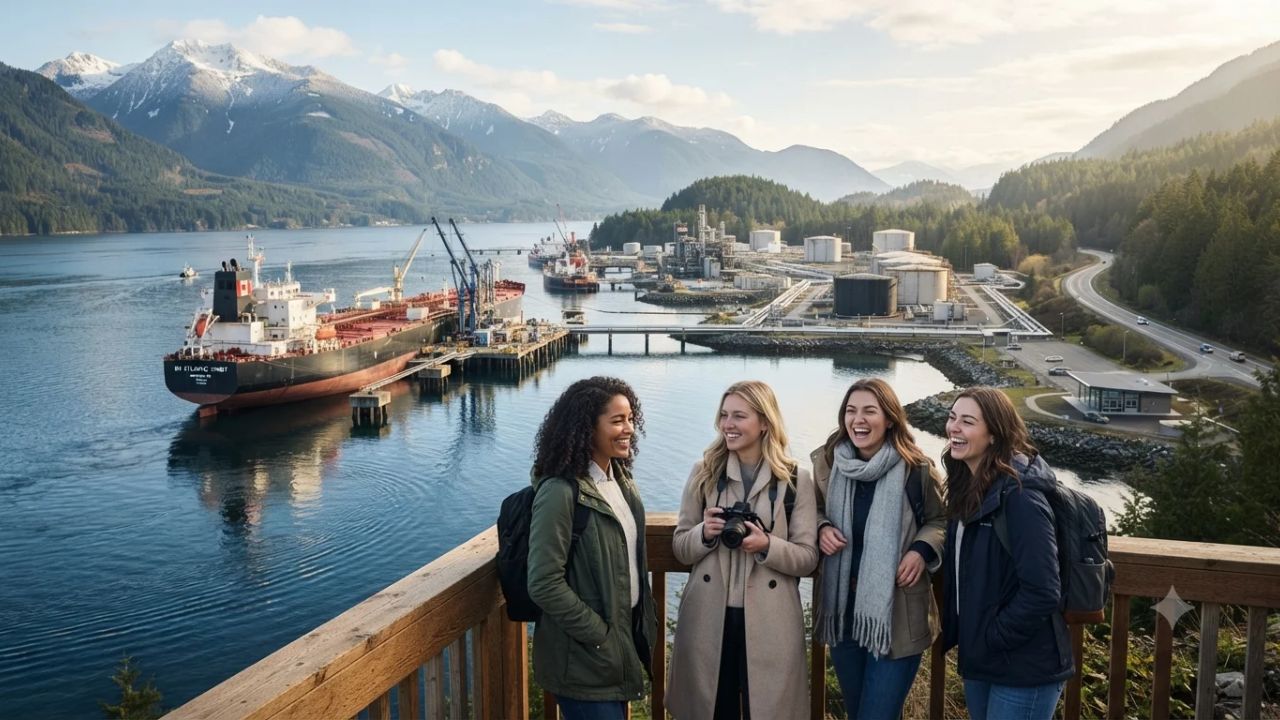
While Canada sent 90.1% of its 4.3 million daily barrels of exported crude oil exclusively to the United States in 2025, the proposed 1,250-kilometer Pacific Link pipeline project is engineered to break this single-buyer bottleneck by channeling one million barrels per day from Bruderheim, Alberta directly to deepwater marine berths near Delta, British Columbia. Projected by federal economic planners to contribute upwards of C$20 billion annually to national GDP—with Alberta estimating annual impacts reaching C$30 billion alongside C$200 billion in potential broader investments—the initiative mirrors a global macroeconomic model adopted by Qatar, Saudi Arabia, the United Arab Emirates, and Guyana. In these powerhouse economies, robust hydrocarbon revenues are channeled directly into modern airport terminals, luxury hospitality corridors, and high-yield cultural tourism infrastructure.
Sovereign Energy Revenues Driving Tourism and Infrastructure Expansion
The convergence of resource export growth and national destination development represents a defined strategy for long-term economic resilience. According to strategic development benchmarks published by Destination Canada, public revenues generated from energy logistics create the underlying fiscal bandwidth required to upgrade international transportation grids, expand regional passenger rail lines, and support national park conservation.
Across the globe, leading tourism giants demonstrate how hydrocarbon strength directly finances leisure and aviation assets:
- Qatar: Expanding liquefied natural gas capacity via the North Field East project from 32 million tonnes to 142 million tonnes annually, Qatar Tourism utilizes energy revenues to raise tourism’s GDP share from 8% toward 12% by 2030 through major hospitality, museum, and aviation investments.
- Saudi Arabia: Developing the massive Jafurah unconventional gas field (targeting two billion standard cubic feet daily by 2030) and the Tanajib plant (processing 2.6 billion standard cubic feet daily in 2026). Concurrently, Visit Saudi welcomed 123 million total travelers in 2025 (generating SAR304 billion in spending, including 29.3 million international arrivals contributing SAR176.6 billion), aiming for tourism to represent 10% of national GDP.
- United Arab Emirates: Advancing the US$6.2 billion Umm Shaif Gas Cap (600 million cubic feet daily) and SARB (200 million cubic feet daily), while tourism generated AED251.3 billion in 2025 (AED209 billion in international visitor spending), targeting AED450 billion in tourism GDP and 40 million hotel guests under its 2031 strategy.
- Guyana: Expanding offshore production past 902,000 barrels per day with its fifth FPSO Errea Wittu aiming beyond one million barrels daily (oil exports reaching US$15.05 billion in H1 2026). The national government directly allocated G$3.2 billion to expand the arrivals terminal at Cheddi Jagan International Airport and G$2.2 billion to the Hospitality and Tourism Institute, supporting a target of over 500,000 annual international visitors.
- Côte d'Ivoire and Senegal: Backing destination master plans with major energy milestones, including Côte d’Ivoire’s US$4 billion Baleine Phase 3 development (building on 6.7 million visitors and CFA1.1 trillion receipts in 2025) and Senegal’s Sangomar offshore project and 85-kilometer domestic gas pipeline.
Energy Projects and Destination Infrastructure Comparison
| Country | Anchor Energy Infrastructure | Daily Output / Scope | Primary GDP Strategy | Tourism Transformation & Funding Allocation |
|---|---|---|---|---|
| Canada | Pacific Link Pipeline (Bruderheim to Delta) | 1,000,000 bpd capacity | C$20B–C$30B annual GDP boost; 140,000 peak jobs | Upgraded Pacific ports, Western Canadian rail & park funding |
| Qatar | North Field LNG Expansion | 142M tonnes/year target | Multi-decade export growth | Target 12% GDP from tourism, airport expansion |
| Saudi Arabia | Jafurah & Tanajib Gas Plants | 4.6B+ standard cu ft/day combined | Vision 2030 industrial growth | 123M tourists in 2025; targeting 10% tourism GDP |
| UAE | Umm Shaif & SARB Gas Developments | 800M standard cu ft/day | Hydrocarbon & trade expansion | AED450B tourism GDP target; 40M hotel guests by 2031 |
| Guyana | Offshore Stabroek Block & Errea Wittu FPSO | 1,000,000+ bpd capacity | Rapid GDP growth (+41.3% in H1 2026) | G$3.2B Cheddi Jagan Airport terminal, tourism institute |
| Côte d’Ivoire | Baleine Field Phase 3 | US$4B final investment decision | National industrialization | Expanding national destination strategy; 6.7M+ arrivals |
| Senegal | Sangomar Oil & GTA Gas Pipeline | 300M cu ft/day (85 km pipeline) | Sovereign hydrocarbon base | Modernizing seaside hotel zones and regional heritage hubs |
Visitor Insider Tips for Exploring Western Canada
Travelers navigating Western Canada between the Pacific Coast of British Columbia and the Rocky Mountains of Alberta can take advantage of world-class transportation corridors connecting these dynamic economic hubs.
- Scenic Rail Between Alberta and the Coast: Instead of driving parallel to heavy freight highways, book the Rocky Mountaineer or VIA Rail passenger services between Calgary/Banff and Vancouver. This route winds through dramatic mountain passes and pristine river canyons inaccessible by standard road networks.
- Pacific Coast Maritime Excursions in Delta and Richmond: The coastal waters around Delta and Roberts Bank offer remarkable wildlife viewing. Base yourself in nearby Steveston Village or South Delta during late summer to witness resident orca pods and migrating pacific salmon runs.
- Edmonton to Jasper Highway Corridor: When traveling from the pipeline's inland terminus region near Bruderheim toward the Canadian Rockies, take Highway 16 (the Yellowhead Route) through Elk Island National Park to view protected bison herds before entering Jasper National Park.
- Shoulder Season Mountain Bookings: Visit Banff, Lake Louise, and Jasper during late September or early October. Autumn brings golden larch foliage, daytime temperatures around 14 degrees Celsius, and significantly lower lodge rates compared to peak July summer rushes.
Cultural and Environmental Context: Coastal Stewardship and Indigenous Partnerships
The modernization of large-scale infrastructure corridors across Western Canada requires rigorous environmental oversight and deep collaboration with First Nations communities. The Pacific coastline around Delta and the Fraser River estuary represents a critical habitat for migratory shorebirds, salmon fisheries, and coastal marine mammals.
Modern infrastructure planning increasingly integrates Indigenous equity ownership, environmental co-management, and stringent marine escort protocols for ocean-going vessels. Concurrently, government royalties and resource revenues support national conservation initiatives, preserving fragile alpine watersheds and coastal rainforests for future generations of eco-travelers.
FAQ: Energy-Backed Tourism Economies 2026
How does Canada's Pacific Link project impact regional travel?
Pacific Link creates direct economic corridors across 1,250 kilometers between Alberta and the British Columbia coast, stimulating regional hotel, transport, and aviation infrastructure development.
Which countries best illustrate using energy wealth to build tourism?
Qatar, Saudi Arabia, and the UAE are the leading global examples, using liquefied natural gas and oil revenues to build mega-airports, luxury resorts, and cultural institutions.
How is Guyana using petroleum revenues for tourism?
Guyana has allocated G$3.2 billion toward expanding Cheddi Jagan International Airport's arrivals terminal and G$2.2 billion to establish a state-of-the-art Hospitality and Tourism Institute.
What is the best season to explore the Alberta-to-BC travel corridor?
Late spring through early autumn (May to October) provides optimal weather for exploring the Canadian Rockies, coastal fjords, and provincial wildlife parks.
From the glaciated peaks of the Canadian Rockies to the gleaming shorelines of the Arabian Gulf, sovereign energy investments continue to build the world's most sophisticated travel gateways.
Related Travel Guides
Disclaimer
This article is for informational and educational purposes only. It does not constitute legal, financial, or professional advice. While we strive to provide accurate and up-to-date information, travel policies, regulations, and conditions change rapidly. Always verify information with official sources before making travel decisions. Nomad Lawyer makes no representations about the accuracy, reliability, completeness, or suitability of the information provided. Readers should consult qualified professionals for advice specific to their circumstances. The views expressed in this article are those of the author and do not necessarily reflect the views of Nomad Lawyer.
Raushan Kumar
Founder & Lead Developer
Full-stack developer with 11+ years of experience and a passionate traveller. Raushan built Nomad Lawyer from the ground up with a vision to create the best travel and law experience on the web.
Learn more about our team →