
Canada's Air Travel Collapses: 79 Flight Cancellations and 299 Delays Strike 8 Major Cities on June 10, 2026
Severe weather and logistical failures trigger massive disruptions across Canadian aviation. Toronto, Vancouver, and Montreal airports report hundreds of delays affecting Jazz, Air Canada, WestJet, and regional carriers.

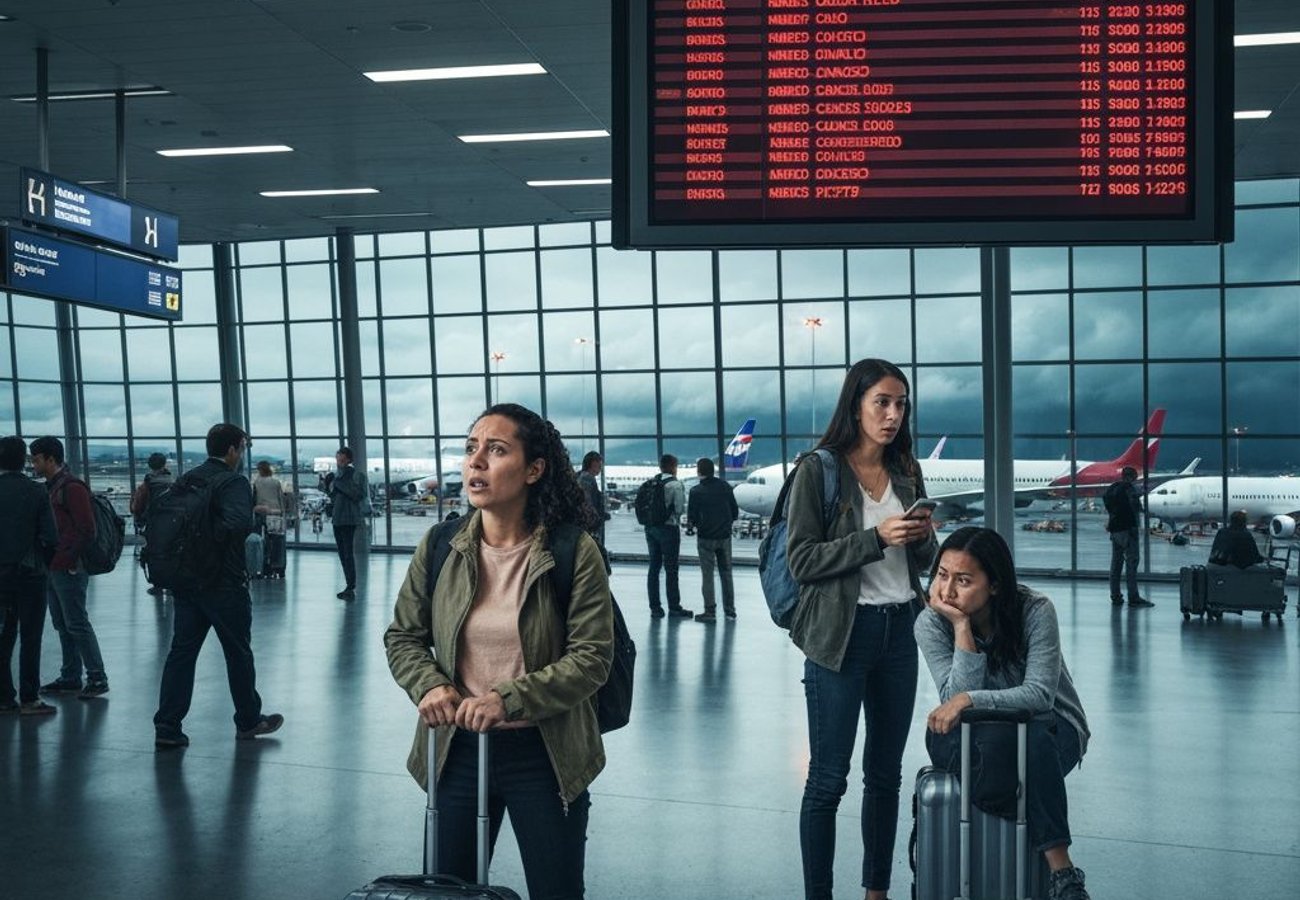
Image generated by AI
The Meltdown: What Happened in Canadian Skies Today
A catastrophic wave of flight disruptions hammered Canadian aviation on June 10, 2026, leaving thousands of travelers stranded across eight major cities. The toll: 79 flight cancellations and 299 delays rippled through the country's busiest hubs, affecting carriers including Jazz, Air Canada, Air Canada Rouge, WestJet, Air Inuit, PAL Airlines, and Pacific Coastal Airlines.
The chaos stems from a lethal combination of severe weather—heavy storms and catastrophic flooding across Manitoba—colliding with logistical gridlock at major airport terminals. Passengers faced missed connections, canceled business meetings, and shattered travel plans with no end in sight.
Reddit: "Just stranded at YYZ for 6 hours. No communication from Air Canada. This is unacceptable." — r/canada
Toronto Pearson Becomes Ground Zero
Toronto Pearson International Airport (YYZ), Canada's busiest aviation hub, became the epicenter of the chaos. The airport recorded 13 cancellations and 103 delays—the highest delay count among all Canadian facilities. As the primary hub for both domestic and transatlantic travel, Pearson's gridlock created a domino effect across the entire network.
Toronto City Centre Airport (YTZ) wasn't spared, reporting 12 cancellations and 24 delays. For business travelers and short-haul passengers relying on this downtown facility, the disruptions meant rescheduled meetings and missed connections to the US.
The scale of disruption at Pearson alone underscores how dependent Canada's air network is on this single gateway. When YYZ stumbles, the entire system feels it.
Vancouver, Montreal, and Secondary Hubs Buckle Under Strain
The West Coast didn't escape unscathed. Vancouver International Airport (YVR) reported 16 cancellations and 64 delays, making it the second-hardest-hit major airport. This matters significantly for passengers traveling between Western Canada and Asia-Pacific destinations—a critical route for business and leisure travelers.
Montreal-Trudeau Airport (YUL) experienced 14 cancellations and 54 delays, crushing passengers with connections to the US Northeast and Europe. For French-speaking travelers and Quebec residents, YUL is the primary gateway, and its collapse meant few viable alternatives.
Secondary airports faced proportionally severe impacts:
- Calgary International (YYC): 4 cancellations, 16 delays
- Edmonton International (YEG): 6 cancellations, 15 delays
- Ottawa Macdonald-Cartier (YOW): 4 cancellations, 11 delays
- Halifax International (YHZ): 2 cancellations, 4 delays
- Kelowna International (YLW): 2 cancellations, 4 delays
- London International (YXU): 4 cancellations, 3 delays
Even military installations like CFB Goose Bay weren't immune, with 2 cancellations and 1 delay recorded.
Which Airlines Got Hit Hardest?
Jazz (operating as Air Canada Regional) bore the brunt with a staggering 31 cancellations and 47 delays. As the regional backbone feeding Canada's major hubs, Jazz's operational collapse meant domestic passengers faced the worst disruptions.
Air Canada, the national carrier, reported 10 cancellations and 50 delays—significant given its fleet size and schedule density. Air Inuit, serving Northern Canada's critical supply routes, saw 12 cancellations and 25 delays.
Smaller carriers experienced proportional damage:
- Air Canada Rouge: 5 cancellations, 13 delays
- PAL Airlines: 6 cancellations, 9 delays
- WestJet: 1 cancellation, 33 delays
- WestJet Encore: 3 cancellations, 10 delays
- Pacific Coastal Airlines: 3 cancellations, 9 delays
- Air Borealis: 1 cancellation, 0 delays
The data reveals a troubling pattern: larger carriers operating densely-scheduled routes absorbed the most cancellations, while delays hit everyone proportionally. Check FlightAware's real-time tracker for current disruption status.
The Domino Effect: Stranded Passengers and Ripple Impacts
For passengers, today's chaos meant far more than simple inconvenience. Business travelers missed critical meetings. Families arrived too late for weddings and funerals. International connections were lost, triggering cascading delays across the North American network.
The flooding in Manitoba, while geographically limited, created a bottleneck effect. Aircraft repositioning routes were disrupted. Ground crews faced operational constraints. Air traffic control had to route flights around weather systems, increasing flight times and fuel consumption—reducing aircraft availability for subsequent flights.
Reddit: "My connection from Calgary to Tokyo just got canceled. Air Canada won't rebook me until Thursday. $500 for a hotel I didn't plan to pay." — r/travel
Smaller airports like Kelowna and London, with limited flight options to begin with, became effectively isolated for many passengers. Those cities lack the competitive service of major hubs, meaning stranded travelers couldn't simply book alternative carriers.
What Affected Travelers Should Do Right Now
If you're caught in this disruption, immediate action is critical:
Monitor Real-Time Information: Check your airline's app, SMS alerts, and email continuously. Notifications update as situations evolve, and rebooking windows open and close rapidly.
Call Airline Customer Service Directly: Don't rely on chat systems alone. Phone lines move slower, but agents have authority to make rebooking decisions on the spot. Have your booking reference ready.
Explore Alternative Routings: If your destination airport is secondary (like Kelowna or London), research whether flying to a nearby major hub—Vancouver, Toronto, or Edmonton—and driving is viable.
Confirm Accommodation Coverage: Check whether your airline will cover hotel costs for overnight disruptions. Review Air Canada's travel delay compensation policy and similar carrier policies for your airline.
Understand Your Legal Rights: Under Canadian Air Passenger Rights regulations, carriers must provide meals, accommodation, and communication for delays exceeding three hours. Compensation may apply for delays over 9 hours—up to $2,400 CAD depending on distance.
File Delay Claims: Keep receipts for all expenses incurred. You may be entitled to reimbursement even if you're eventually rebooked.
The Bigger Picture: Canada's Aviation Fragility
Today's collapse exposed systemic vulnerabilities in Canadian air infrastructure. The country relies heavily on three major hubs—Toronto, Vancouver, and Montreal—creating single-point-of-failure risks. When weather or operational issues strike, there's minimal redundancy.
Regional carriers like Jazz and Air Inuit operate on razor-thin margins, making them especially susceptible to cascading delays. A weather event in one province shouldn't paralyze domestic travel across the nation—yet that's precisely what happened.
The flooding in Manitoba highlights climate change's growing impact on aviation operations. As extreme weather events accelerate, airports and airlines must invest in weather resilience, including improved forecasting integration and operational flexibility.
Bottom Line for Nomad Travelers
If you're traveling through Canada in the coming weeks, expect ongoing friction. Airlines are recalibrating schedules, ground crews are catching up on maintenance backlogs, and aircraft are still repositioning. Delays may persist intermittently through mid-week.
Book flights with longer layover windows than usual. Arrive 3-4 hours early for domestic flights, 4-5 for international departures. Use FlightAware's tracking tools obsessively. And consider travel insurance that covers airline-caused disruptions—today proved that assumption is no longer luxury, it's necessity.
Canada's aviation system will recover. But today serves as a stark reminder that modern air travel remains fragile, and weather events—especially in a nation as geographically vast as Canada—can still halt the entire operation.
When weather and logistics collide, the traveler pays the price—and Canadian passengers just learned that lesson the hardest way.
Related Travel Guides
Disclaimer
This article is for informational and educational purposes only. It does not constitute legal, financial, or professional advice. While we strive to provide accurate and up-to-date information, travel policies, regulations, and conditions change rapidly. Always verify information with official sources before making travel decisions. Nomad Lawyer makes no representations about the accuracy, reliability, completeness, or suitability of the information provided. Readers should consult qualified professionals for advice specific to their circumstances. The views expressed in this article are those of the author and do not necessarily reflect the views of Nomad Lawyer.
Preeti Gunjan
Contributor & Community Manager
A passionate traveller and community builder. Preeti helps grow the Nomad Lawyer community, fostering engagement and bringing the reader experience to life.
Learn more about our team →