
Canada Flight Cancellations and Delays Spark Nationwide Travel Chaos as Air Canada, Jazz, PAL, and Air Inuit Ground 102 Flights and Delay 381 Across Montréal, Toronto, Vancouver, Halifax, and Northern Airports: New Aviation Updates
Canada faces severe travel chaos as Air Canada, Jazz, PAL, and Air Inuit cancel 102 flights and delay 381 across Toronto, Montreal, Vancouver, and northern hubs.

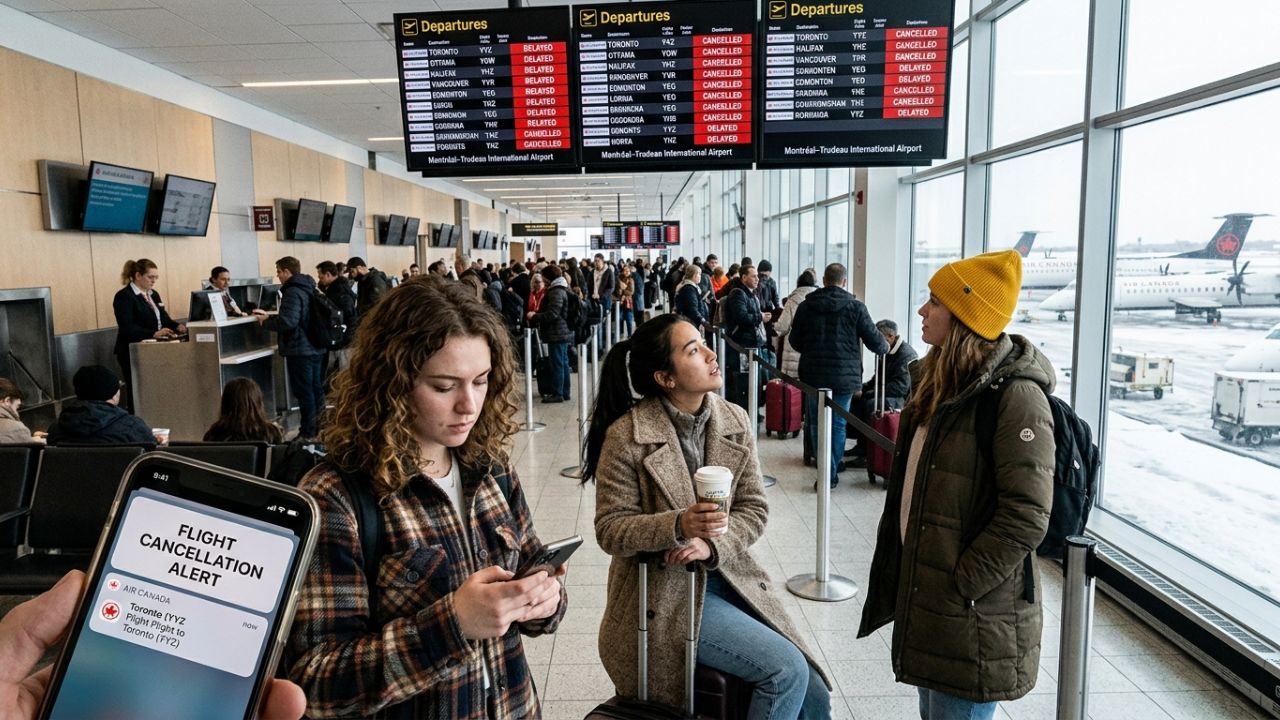
Image generated by AI
In a dramatic wave of operational instability, Canada's air travel network has been plunged into severe travel chaos. On May 18, 2026, a nationwide scheduling crisis forced a cumulative total of 102 flight cancellations and 381 flight delays across the country, according to public aviation records. This latest airline news update highlights the intense pressure on both busy urban gateways and remote northern airstrips. High-frequency legacy and regional carriers—including Air Canada, Jazz Aviation, PAL Airlines, and Air Inuit—are struggling to stabilize schedules, leaving thousands of passengers navigating missed connections, long lines, and high travel anxiety from Montréal to Vancouver.
Context and Background
Aviation data suggests that the widespread operational slowdown was driven by severe weather patterns, high passenger volumes, and airport congestion. In compliance with strict safety directives enforced by Transport Canada, airlines adjusted schedules to manage regional runway constraints and atmospheric volatility. Because Canada's high-density domestic corridors share heavy scheduling connectivity, minor delays at primary transit nodes quickly cascade through regional networks, disrupting flight rotations for smaller communities.
The timing of these disruptions is particularly critical given the high demand of the spring season. Large carriers like Air Canada manage massive passenger volumes, making them vulnerable to crew allocation shortages and gate capacity bottlenecks when traffic staggers. Meanwhile, regional carriers face concentrated operational challenges, directly impacting essential travel links for communities that rely on regional flights for medical, logistics, and government services.
Detailed Section-Wise Breakdown of Canadian Airport Disruptions
The scheduling bottleneck has disproportionately affected Canada's eastern airports in terms of outright groundings, while major western gateways experienced a high volume of delayed flights:
The Eastern Hubs: Montréal (YUL), Ottawa (YOW), and Halifax (YHZ) Groundings
Eastern Canada emerged as the epicenter of today’s cancellations. Montréal–Trudeau International Airport (YUL) recorded a significant 10 flight cancellations alongside 40 delayed flights. Meanwhile, the Atlantic gateway at Halifax Stanfield International Airport logged 8 cancellations and 12 delays, matching Ottawa Macdonald–Cartier International (YOW), which also faced 8 cancellations and 7 delays. These groundings disrupted domestic transfers, leaving regional routes under extreme schedule pressure.
The Mega Hubs: Toronto Pearson (YYZ) and Vancouver International (YVR) Scheduling Crisis
Canada’s busiest hub, Toronto Pearson International Airport, managed to avoid high cancellation volumes but registered a staggering 65 flight delays and 5 cancellations, creating immense gate congestion. On the West Coast, Vancouver International Airport (YVR) mirrored this pattern, logging 2 cancellations and 34 delays, as flight dispatchers worked to recover aircraft rotations amidst air traffic flow constraints.
Northern Vulnerability: Aupaluk (YAE) and Kangirsuk (YKG) Outages
The fragility of remote northern air travel was highlighted by significant cancellations at northern communities. Kangirsuk Airport (YKG) recorded 6 cancellations and 1 delay, while Aupaluk Airport (YAE) suffered 4 cancellations with 0 delays. Because these remote communities have limited alternative transit options, even small-scale groundings can cause severe isolation.
Flight Details and Operational Performance Matrices
The following tables outline the detailed breakdown of the scheduling disruptions across Canadian airports and airlines, highlighting the scope of the operational pressure:
Table 1: Flight Disruptions by Canadian Airport (May 18, 2026)
| Airport Name | Airport Code | Flight Cancellations | Flight Delays | Geographic Region / Profile |
|---|---|---|---|---|
| Montréal–Trudeau International Airport | YUL | 10 | 40 | Major eastern urban hub; highest cancellations |
| Halifax Stanfield International Airport | YHZ | 8 | 12 | Atlantic gateway under operational pressure |
| Ottawa Macdonald–Cartier International | YOW | 8 | 7 | Eastern hub; significant cancellations |
| Toronto Pearson International Airport | YYZ | 5 | 65 | Busiest domestic gateway; highest absolute delays |
| Vancouver International Airport | YVR | 2 | 34 | West Coast gateway under scheduling pressure |
| Kangirsuk Airport | YKG | 6 | 1 | Remote northern community; highly disruptive |
| Aupaluk Airport | YAE | 4 | 0 | Remote northern airstrip; highly isolated |
| Total Monitored Airports | Multiple | 43 | 159 | Combined airport-level impact |
Table 2: Flight Disruptions by Airline Operating in Canada (May 18, 2026)
| Airline Name | Airline Code / Group | Cancellations | Delays | Primary Operational Focus |
|---|---|---|---|---|
| PAL Airlines | Regional | 13 | 10 | Highest cancellations; major regional impact |
| Air Inuit | Regional | 10 | 19 | Critical northern and remote logistics |
| Jazz Aviation | ACA (Air Canada Express) | 6 | 34 | High-frequency regional commuter routes |
| Air Canada | Mainline Carrier | 5 | 32 | Major domestic and international hub-and-spoke routes |
| Air Canada Rouge | Leisure Division | 2 | 16 | Vacation and leisure flight networks |
| Monitored Airlines Total | Listed Carriers | 36 | 111 | Subtotal of key carrier operations |
| Cumulative National Total | All Operators | 102 | 381 | Total Canadian aviation system impact |
What Passengers Get
Passengers stuck at terminals across Canada faced a challenging travel environment:
- Crowded Departures Terminals: Long queues formed at ticket counters and customer service desks as travelers worked to adjust their itineraries.
- Limited Northern Alternatives: For passengers stranded at remote northern airports, alternative flight options were highly limited, requiring flexible wait-and-see approaches.
- Re-accommodation and Refunds: Under Canadian passenger protection regulations, major airlines offered alternate flight options, re-routings, or full refunds for canceled services.
- Tarmac Waiting Times: Many delayed flights faced gate holds and extended taxi times before clearance, keeping travelers on board for prolonged periods.
What This Means for Travelers
Travel specialists urge affected passengers to remain proactive and implement the following survival tips during disruptions:
- Monitor Flight Status Constantly: Keep a close eye on your airline's mobile app or FlightAware updates for real-time schedule changes before departing.
- Review Carrier Rebooking Policies: Check your airline's passenger rights pages, as major carriers are offering flexible rebooking policies for delayed flights.
- Allow Extra Transfer Buffers: If your route involves connecting flights through Toronto Pearson or Montréal–Trudeau, ensure you have adequate buffer time.
- Confirm Luggage Arrangements: Carry essential medications, travel documents, and devices in your carry-on luggage in case your checked bags are delayed.
- Maintain Communication with Gate Staff: Engage directly with airline customer service representatives at the terminal for the latest rebooking options.
FAQ: Canadian Flight Cancellations and Delays 2026
1. What caused the widespread flight cancellations and delays across Canada on May 18, 2026?
The disruptions were triggered by a combination of weather-related regional restrictions, high spring travel volumes, and airport congestion, which forced scheduling adjustments to maintain safety standards.
2. Which Canadian airports and airlines recorded the highest number of flight disruptions?
Montréal–Trudeau (YUL) led cancellations with 10 flights affected, while Toronto Pearson (YYZ) recorded the highest delays at 65. Among airlines, PAL Airlines and Air Inuit logged the highest cancellation counts at 13 and 10, respectively.
3. Are Canadian passengers entitled to compensation or rebookings for these delayed flights?
Yes. Under Canadian passenger protection regulations, carriers are providing rebookings, refunds, or alternative flight options for passengers affected by airline-driven delays and cancellations.
Related Travel Guides
- Washington Dulles Airport Faces Severe Travel Chaos as FAA Reports 44 Flight Delays on Key Routes to London, Frankfurt, Miami, New York, and Chicago: New Aviation Updates
- Boston Logan Airport Gripped by Travel Chaos as Weather and Congested Airspace Force 76 Flight Delays and Cancellations, Disrupting American Airlines, Delta, JetBlue, and United Airlines Flights to London, New York, Chicago, Los Angeles, and Toronto: New Aviation Updates
- The 10 Best Travel Insurance Policies for Geopolitical and Weather Disruptions, According to Reddit
Disclaimer
This article is for informational and educational purposes only. It does not constitute legal, financial, or professional advice. While we strive to provide accurate and up-to-date information, travel policies, regulations, and conditions change rapidly. Always verify information with official sources before making travel decisions. Nomad Lawyer makes no representations about the accuracy, reliability, completeness, or suitability of the information provided. Readers should consult qualified professionals for advice specific to their circumstances. The views expressed in this article are those of the author and do not necessarily reflect the views of Nomad Lawyer.
Kunal K Choudhary
Co-Founder & Contributor
A passionate traveller and tech enthusiast. Kunal contributes to the vision and growth of Nomad Lawyer, bringing fresh perspectives and driving the community forward.
Learn more about our team →