
Etihad Airways Denies Fire Report on Chennai to Abu Dhabi Flight EY343, Confirms Three-Hour Delay After Technical Issue Triggers Emergency Response at Chennai Airport
Etihad Airways swiftly refutes false fire reports on flight EY343 from Chennai to Abu Dhabi, confirming a precautionary technical issue caused a three-hour delay with zero safety threat to passengers.

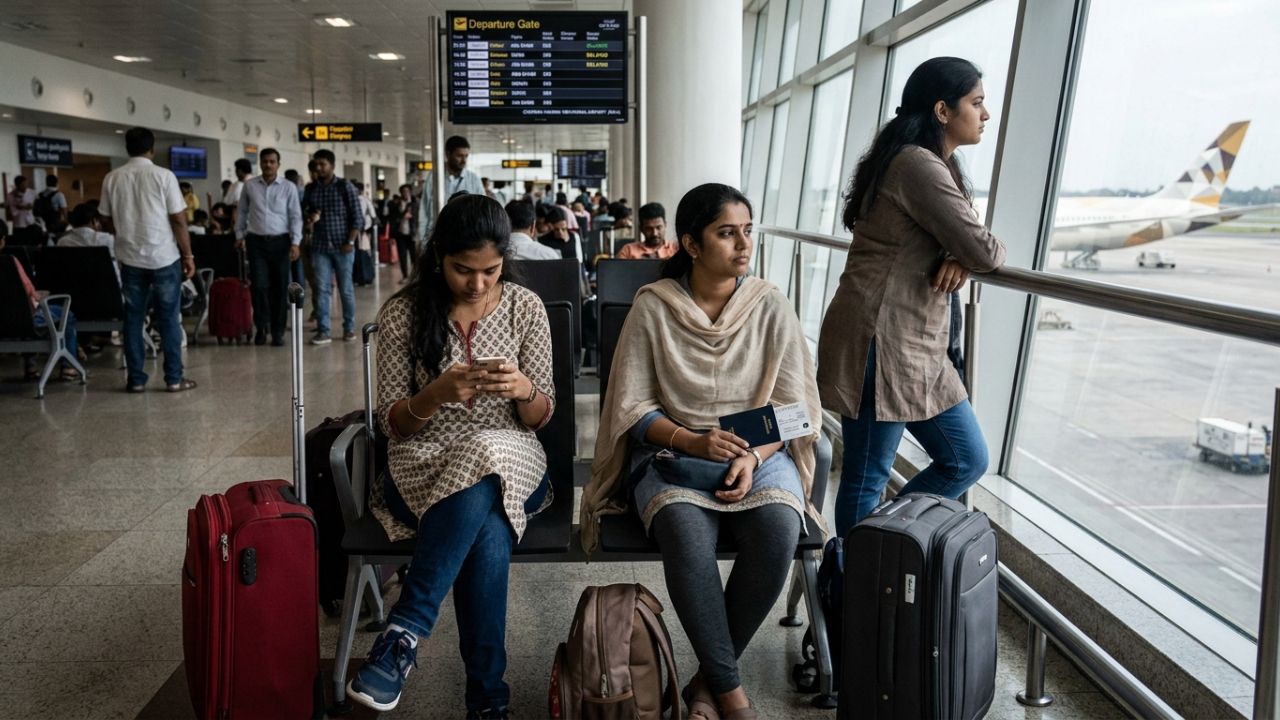
Image generated by AI
Etihad Airways Denies Fire Report on Chennai to Abu Dhabi Flight EY343, Confirms Three-Hour Delay After Technical Issue Triggers Precautionary Emergency Response at Chennai Airport
Published on May 13, 2026
An alarming headline circulated rapidly across aviation news channels on May 12, 2026 — reporting a fire aboard an Etihad Airways flight from Chennai International Airport to Abu Dhabi's Zayed International Airport. The truth, as Etihad Airways moved quickly to confirm, was significantly less dramatic — and importantly, confirmed that no passenger was ever in danger. Flight EY343, scheduled to carry passengers from Tamil Nadu's extraordinary capital to the UAE's gleaming capital city, returned to the gate before departure after engineers identified a technical issue that required assessment before the aircraft could safely proceed. The deployment of emergency response vehicles at Chennai Airport — which sparked the initial fire reports — was a precautionary measure fully in line with standard airport safety protocols for any technical anomaly. A three-hour delay followed as Etihad's engineering teams resolved the issue. No injuries. No fire. No safety threat. Here is the complete, accurate picture of what happened aboard EY343, and everything affected Chennai-to-Abu Dhabi passengers need to know.
Quick Summary:
- Etihad Airways flight EY343 (Chennai to Abu Dhabi) returned to the gate before departure on May 12, 2026 due to a technical issue identified pre-departure.
- Reports of a fire onboard were false — Etihad Airways formally and categorically refuted all fire claims, confirming the emergency vehicle deployment at Chennai Airport was a standard precautionary response to a technical anomaly, not an active fire emergency.
- No injuries, no fire, no safety threat were recorded at any point during the incident.
- Passengers were disembarked as a precautionary measure while Etihad engineering teams assessed and resolved the technical issue.
- Three-hour delay resulted from the required technical evaluation and ground inspection before the aircraft was cleared for departure to Abu Dhabi (AUH).
- Etihad Airways provided passenger support including real-time updates, rebooking assistance, and onward travel coordination for affected travelers.
- Etihad issued a public statement within hours of the incident — a proactive transparency response that successfully contained the spread of misinformation across aviation news channels.
What Actually Happened on Etihad Flight EY343 at Chennai Airport
The sequence of events aboard Etihad Airways Flight EY343 on May 12 began in the most routine way possible — a standard pre-departure sequence at Chennai International Airport (MAA), one of India's busiest international gateways and the primary aviation hub for Tamil Nadu and South India's broader travel market.
Shortly before the scheduled departure to Zayed International Airport (AUH) in Abu Dhabi, Etihad's crew and ground engineering teams identified a technical issue aboard the aircraft. The precise nature of the technical fault has not been publicly specified by the airline — a standard practice, as airlines typically do not disclose detailed engineering fault descriptions in public communications.
What is clearly established: the aircraft returned to the gate before pushback or engine start for takeoff. This is the correct procedural response to any pre-departure technical detection. A fault identified at the gate — rather than at altitude — is managed at the ground level with full access to engineering equipment, spare parts, and technical expertise. It is, in safety terms, the best possible moment for a technical issue to surface.
The deployment of emergency response vehicles from Chennai Airport's fire and rescue services was triggered by the gate return and technical alert notification — not by any actual fire event. This is standard airport protocol worldwide: any technical anomaly aboard a commercial aircraft automatically triggers a precautionary emergency response, with fire tenders and emergency crews deploying to the gate as a precautionary measure regardless of the actual nature of the technical issue.
It was this precautionary emergency vehicle deployment — visible to onlookers, airport workers, and eventually media contacts at Chennai — that gave rise to the erroneous fire reports that circulated online before Etihad's clarification statement could reach news consumers.
The Fire Reports Were False: How Misinformation Spread and How Etihad Stopped It
The rapid spread of false fire reports about Flight EY343 illustrates a well-documented pattern in aviation incident reporting: the visual drama of emergency vehicle deployment at an airport gate — flashing lights, fire tenders, personnel in high-visibility gear — is inherently striking and creates a compelling surface narrative.
That visual surface, absent the context of standard airport safety protocols, is easily misread by witnesses as confirmation of an active emergency. Social media amplification of early incorrect reports — often posted before airline statements are available — can spread a false narrative to thousands of readers before the accurate version has been formally issued.
Etihad Airways issued its clarification statement promptly and unambiguously, categorically denying any fire and explaining that the emergency response was a routine precautionary deployment. The speed and clarity of that communication — a formal airline statement rather than a vague social media response — was effective in containing the misinformation spread and restoring accurate public understanding of the incident.
For the passengers aboard Flight EY343, the misinformation environment added an unnecessary layer of anxiety to what was, in operational terms, a manageable technical delay handled precisely as it should have been.
Etihad Airways EY343: The Chennai–Abu Dhabi Route and Its Passengers
Etihad Airways' Chennai–Abu Dhabi route is one of the UAE national carrier's most important South Asian connections, serving the significant and historically deep-rooted travel flow between Tamil Nadu and the United Arab Emirates.
The Indian expatriate community in the UAE — particularly in Abu Dhabi and Dubai — is one of the largest and most established in the Gulf, with Tamil Nadu contributing a significant proportion of South India's Gulf-bound workforce, business travelers, and family visitors. Flight EY343 serves this community alongside leisure travelers, business passengers, and the large number of travelers using Abu Dhabi as a connection point to onward Etihad destinations in Europe, North America, and Australia.
Chennai International Airport (MAA) — currently undergoing significant capacity expansion — handles a substantial volume of Gulf-bound traffic from Tamil Nadu, with Etihad, Emirates, Air Arabia, IndiGo, and Air India all operating services connecting Chennai to UAE gateway cities.
For the passengers aboard EY343 on May 12, the three-hour delay — while genuinely inconvenient — was absorbed by Etihad's passenger support infrastructure, with the airline proactively managing rebooking, connection protection, and real-time communication throughout the ground hold.
The Safety Protocol Behind the Emergency Vehicle Deployment
The precautionary emergency response at Chennai Airport that triggered the initial fire reports is worth understanding in detail — because it reflects a safety philosophy that should, in fact, reassure rather than alarm air travelers.
International civil aviation safety standards, established by the International Civil Aviation Organization (ICAO) and implemented by India's Directorate General of Civil Aviation (DGCA), require that any commercial aircraft experiencing a technical anomaly prior to departure must notify Airport Rescue and Fire Fighting (ARFF) services. The ARFF response — fire tenders, emergency personnel, medical units — deploys immediately upon notification as a precautionary standby.
This protocol exists specifically because the outcome of any technical issue aboard an aircraft cannot be immediately predicted at the moment of initial detection. A technical fault that turns out to be minor electrical instrumentation could theoretically — in a different scenario — be an early indicator of a more serious condition. The precautionary deployment of emergency services ensures that if the situation escalates, response resources are already positioned at the aircraft.
The activation of emergency services at Chennai Airport in response to the EY343 technical issue was correct, appropriate, and exactly what the safety framework requires. It was an indicator of safety systems working as intended — not of a genuine fire emergency.
Etihad Airways' Engineering Response: Clearing EY343 for Departure
Once passengers were disembarked and the emergency standby was established, Etihad Airways' engineering teams conducted the technical evaluation required to assess the fault and determine the appropriate resolution.
The airline confirmed that the technical issue was identified, assessed, and resolved to the satisfaction of Etihad's maintenance engineers — and that the aircraft was not released for departure until the engineering team had certified it airworthy. This is the fundamental safety baseline that underpins every commercial aviation departure: an aircraft does not leave the gate unless qualified engineers have signed off on its technical status.
The three-hour ground hold reflects the time required to conduct this engineering process correctly rather than quickly. Aviation maintenance does not compress its procedures for schedule recovery. The priority is accuracy and certainty — and Etihad's willingness to hold an aircraft for three hours rather than rush a clearance is the clearest possible signal of a carrier that prioritizes safety above on-time performance metrics.
Guide for Travelers:
- Affected EY343 passengers: Contact Etihad Airways' customer service at 600-555-666 (UAE) or +971-2-599-0000 (international) for rebooking confirmation and compensation inquiry. The Etihad app also provides real-time booking management for disrupted itineraries.
- Abu Dhabi connection passengers: If your EY343 delay caused a missed onward Etihad connection at Zayed International (AUH), Etihad's transfer desk at AUH will rebook you on the next available service without additional charge.
- Understanding your rights: Under India's DGCA passenger rights regulations, passengers on significantly delayed flights (typically 3+ hours) may be entitled to meals, refreshments, and assistance from the airline during the ground hold. Retain receipts for any out-of-pocket expenses incurred during the delay.
- If you're flying Chennai to Abu Dhabi in the future: EY343 is a regular Etihad service. Today's incident was a pre-departure technical detection — the safest possible scenario — and does not reflect any systemic route or aircraft issue.
- For nervous flyers: A technical detection before departure and subsequent gate return is precisely the safety system working correctly. An aircraft that returns to the gate before departure is one that has been caught by safety protocols before any issue could develop at altitude.
- Best time to visit Abu Dhabi: October–April delivers Abu Dhabi's magnificent mild winter climate — ideal for exploring the Sheikh Zayed Grand Mosque, Louvre Abu Dhabi, Yas Island's extraordinary attractions, and the luxury resort beaches of Saadiyat Island.
- Best time to visit Chennai: November–February offers Chennai's ideal visiting weather — comfortable temperatures for exploring the extraordinary Kapaleeshwarar Temple, Marina Beach (one of the world's longest urban beaches), and the rich cultural heritage of Tamil Nadu's ancient Dravidian temple architecture.
- Sign up for real-time Etihad alerts: Register your contact details at etihad.com to receive SMS and email notifications for any future flight status changes on your booking — Etihad's proactive communication on EY343 demonstrated the value of this service.
Related Travel Guides
- Asia's Worst Aviation Day of 2026: 448 Cancellations and 2,942 Delays Across India, China, Japan, and UAE
- Middle East Aviation Crisis: EgyptAir, Saudia, and FlyDubai Cancel 48 Flights Across Cairo, Dubai, and Jeddah
- India Flight Cancellations: IndiGo and SpiceJet Disrupt Delhi, Bengaluru, Kolkata, and Kochi
The story of Etihad Airways Flight EY343 is ultimately not a story of fire or danger — it is a story of aviation safety working precisely as it should. A technical issue was detected before departure. The aircraft returned to the gate. Emergency services deployed as protocol requires. Engineers assessed the fault. The aircraft was cleared only when the team was satisfied it was airworthy. Passengers were supported throughout. And the airline communicated clearly and quickly to correct a false narrative before it could cause disproportionate concern. The Chennai–Abu Dhabi corridor — connecting one of India's most culturally extraordinary cities to one of the Gulf's most magnificent capitals — continues to serve its passengers reliably. Etihad Airways, the UAE's national carrier, has reinforced through this incident that its commitment to passenger safety is not a marketing position. It is the operational reality behind every departure from Chennai, Abu Dhabi, and every airport in its global network.
Disclaimer
This article is for informational and educational purposes only. It does not constitute legal, financial, or professional advice. While we strive to provide accurate and up-to-date information, travel policies, regulations, and conditions change rapidly. Always verify information with official sources before making travel decisions. Nomad Lawyer makes no representations about the accuracy, reliability, completeness, or suitability of the information provided. Readers should consult qualified professionals for advice specific to their circumstances. The views expressed in this article are those of the author and do not necessarily reflect the views of Nomad Lawyer.
Kunal K Choudhary
Co-Founder & Contributor
A passionate traveller and tech enthusiast. Kunal contributes to the vision and growth of Nomad Lawyer, bringing fresh perspectives and driving the community forward.
Learn more about our team →