
Bangkok Flight Disruptions Cause 2,300+ Delays Across 16 Asian Hubs in August 2026
A systemic operational strain at Bangkok's Suvarnabhumi and Don Mueang airports has triggered over 2,300 flight delays and 143 cancellations across 16 Asian aviation hubs.

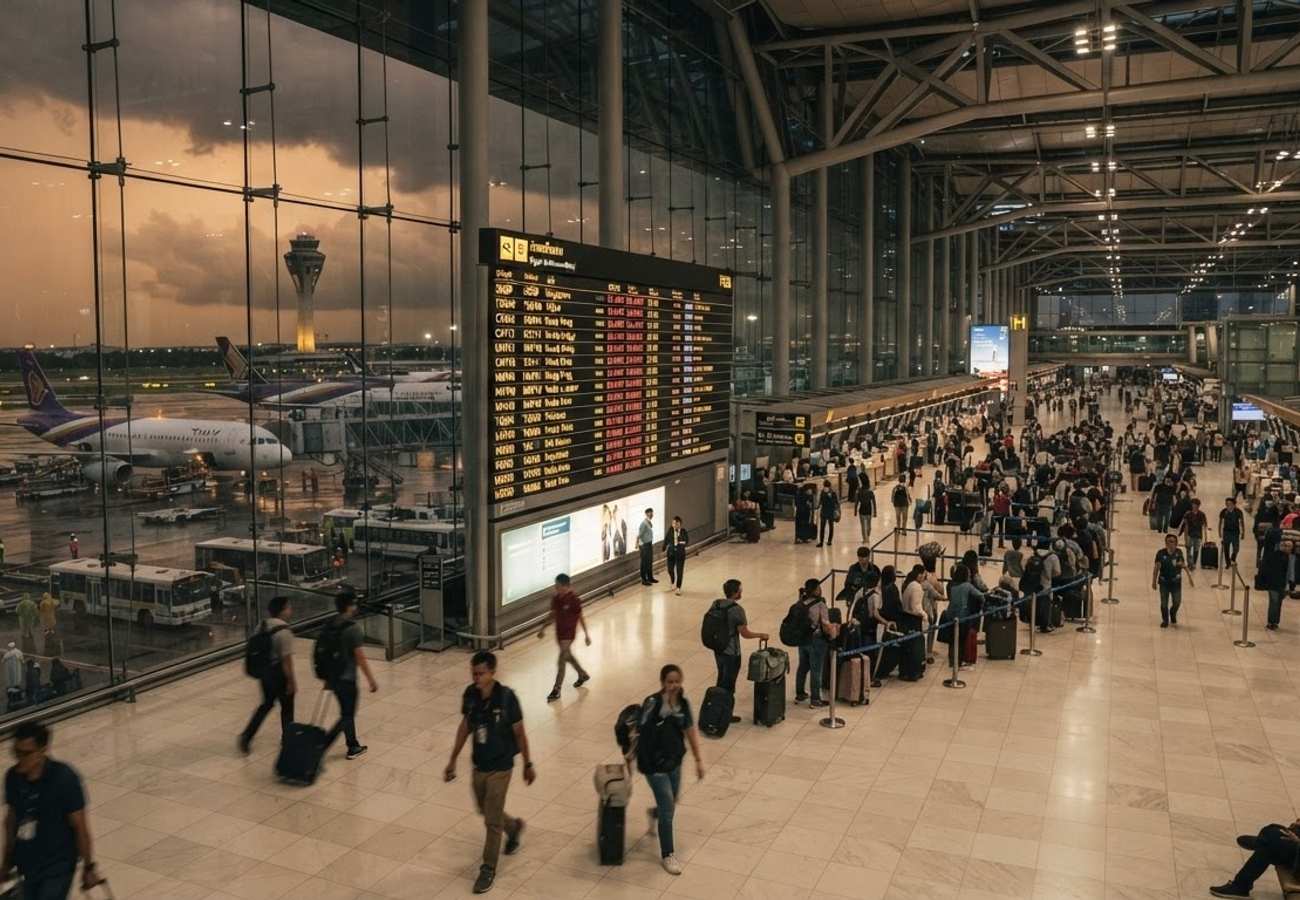
Image generated by AI
Operational bottlenecks at Bangkok’s dual-airport system have triggered a regional cascade, resulting in 2,316 delayed services and 143 cancellations across 16 Asian gateways.
Regional Aviation Strain Centered on Bangkok
Current flight-tracking data and reports from Aeronautical Radio of Thailand indicate a significant disruption in air traffic centered on Bangkok. The city's primary aviation nodes—Suvarnabhumi (BKK) and Don Mueang (DMK)—are currently managing over 2,300 commercial movements daily. On 21 August, the Bangkok Flight Information Region recorded 2,311 commercial flights within a 24-hour window, demonstrating the volatility of the network when schedule shocks occur.
The disruption is not characterized by a total operational shutdown but rather a sustained period of misalignment between capacity, weather, and scheduling buffers. While typical on-time departure rates for trunk routes hover between 80% and 85%, a current spike in delays has compressed ground turnaround buffers, leading to missed connections and equipment rotation failures across the continent.
Impacted Routes and Service Specifications
The most acute pressures are visible on high-traffic corridors and domestic island links. The Bangkok–Singapore route, a critical Southeast Asian artery, has seen consistent instability. For instance, Scoot flight TR611 on 23 August was rescheduled to depart at 20:05—over an hour behind schedule—pushing the Singapore arrival past 23:00 local time.
Domestic connectivity to Thai islands is similarly strained. Bangkok Airways services to Phuket and Koh Samui have faced repeated late departures. The Bangkok–Koh Samui sector is particularly vulnerable due to the private operation of Samui Airport, which limits slot availability and alternative carrier options.
| Route Segment | Primary Impact | Observed Delay/Status | Key Carrier Affected |
|---|---|---|---|
| Bangkok $\rightarrow$ Singapore | Schedule Slide | 30 to 90 Minutes | Scoot (e.g., TR611) |
| Bangkok $\rightarrow$ Koh Samui | Capacity Constraint | Clusters of Cancellations | Bangkok Airways |
| Bangkok $\rightarrow$ Phuket | Operational Strain | Repeated Late Departures | Bangkok Airways |
| Sharjah $\rightarrow$ Bangkok | Rotation Delay | Reduced Turnaround Buffer | Various |
| Bangkok $\rightarrow$ Regional Hubs | Knock-on Effect | 30+ Minute Slips | Multiple Carriers |
Traveler Logistics Guide: Navigating the Disruption
From a ground-level perspective, the best way to navigate this current instability is to treat Bangkok not as a seamless transit point, but as a high-risk node. The interlinked nature of Asian aircraft rotations means a delay in Bangkok almost certainly impacts the subsequent three to four legs of that aircraft's daily schedule.
Booking and Connection Strategy If you are connecting through BKK or DMK, avoid "tight" connections (under 3 hours). Given the current trend of 30-to-90-minute delays on regional routes, a standard two-hour layover is no longer sufficient to guarantee an onward connection, especially when traveling on separate tickets or via low-cost carriers (LCCs) that do not offer protected transfers.
Alternative Routing for Island Destinations For those heading to Koh Samui, the lack of competition at the airport means that once a flight is cancelled, rebooking is difficult. The most reliable workaround is to fly into Surat Thani (URT) and utilize ferry services to reach the islands. While this increases travel time, it removes the dependency on the constrained Samui airport slots.
Digital Transit and Monitoring Passengers should rely on real-time airline apps rather than static airport boards, as departure times are being adjusted frequently. For those entering Thailand, utilizing digital customs and immigration tools can shave critical minutes off the transit time, providing a small but necessary buffer for delayed departures.
Infrastructure Impact Assessment
The current crisis highlights a systemic vulnerability in Asia's "hub-and-spoke" model. Because Bangkok serves as a primary gateway for long-haul flights connecting to East Asia (Tokyo, Seoul) and the Middle East (Sharjah), any localized friction—whether caused by thunderstorms or ground-handling inefficiencies—scales rapidly.
The fact that 16 different airports are feeling the ripple effect of Bangkok's instability suggests that regional scheduling has become too lean. With aircraft cycling through multiple intra-Asia legs daily, there is virtually no resilience in the system to absorb a 30-minute slip. This operational fragility is likely to persist through the end of August as traffic volumes remain near or above 2,200 daily movements.
Regional aviation stability now depends on the ability of hubs to rebuild scheduling buffers before the next peak travel surge.
Related Travel Guides
Disclaimer
This article is for informational and educational purposes only. It does not constitute legal, financial, or professional advice. While we strive to provide accurate and up-to-date information, travel policies, regulations, and conditions change rapidly. Always verify information with official sources before making travel decisions. Nomad Lawyer makes no representations about the accuracy, reliability, completeness, or suitability of the information provided. Readers should consult qualified professionals for advice specific to their circumstances. The views expressed in this article are those of the author and do not necessarily reflect the views of Nomad Lawyer.
Kunal K Choudhary
Co-Founder & Contributor
A passionate traveller and tech enthusiast. Kunal contributes to the vision and growth of Nomad Lawyer, bringing fresh perspectives and driving the community forward.
Learn more about our team →