
Asia's Fuel Crisis Strands Thousands: Sri Lanka, Myanmar, Vietnam, Thailand Face Historic Travel Disruption and Flight Chaos
The 2026 Hormuz Blockade has triggered a catastrophic fuel shortage across Asia, leaving travelers stranded as airlines cancel flights and tourism collapses across Sri Lanka, Myanmar, Vietnam, and Thailand.

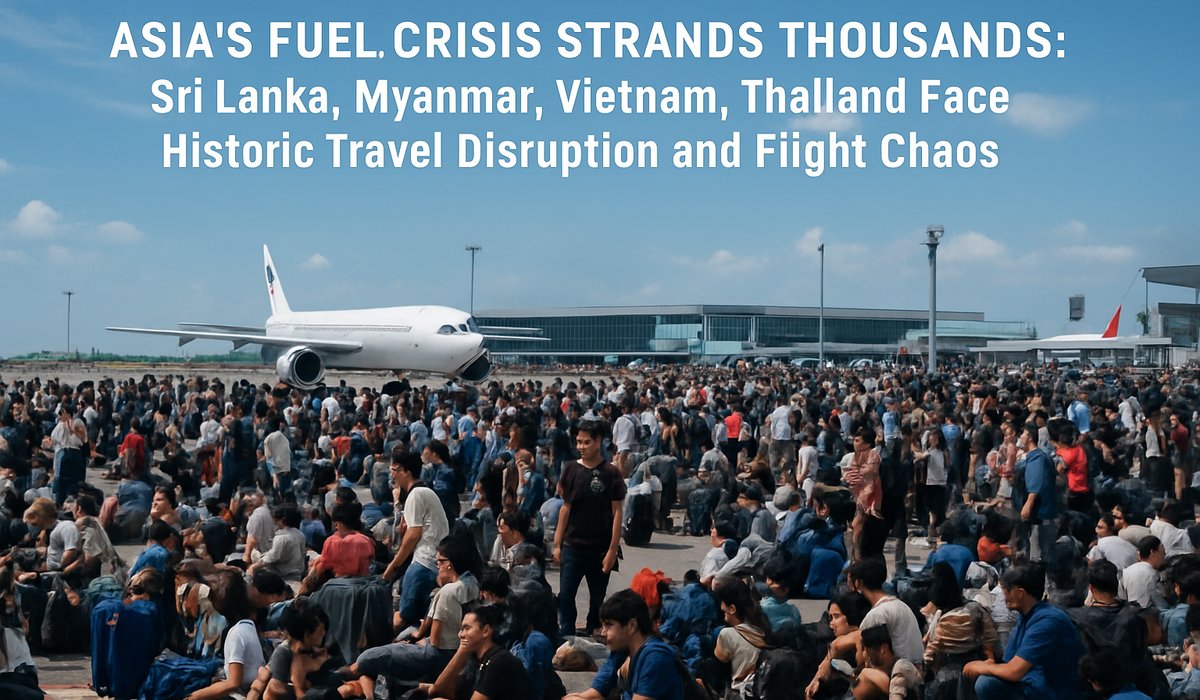
Image generated by AI
The 2026 Hormuz Blockade has plunged Asia into an unprecedented fuel shortage crisis that is systematically dismantling the region's tourism infrastructure and leaving travelers stranded across multiple nations. The escalating tensions in the Middle East have triggered a cascading collapse in aviation and ground transportation across Sri Lanka, Myanmar, Vietnam, Laos, South Korea, and Thailand, with thousands of flights canceled or delayed indefinitely and fuel prices skyrocketing beyond sustainable levels. From Colombo to Bangkok, from Yangon to Ho Chi Minh City, the impact on travelers is immediate, severe, and worsening by the day. What began as a regional energy crisis has evolved into a full-scale travel nightmare that threatens to cripple tourism economies that depend on international visitors and domestic mobility.
Sri Lanka: The Epicenter of Asia's Travel Collapse
Sri Lanka has become the hardest-hit nation in this unfolding disaster, where the government has reintroduced a QR-code-based fuel pass system that severely restricts fuel consumption for both residents and tourists. Private cars are now limited to just 15 liters of fuel per week, while commercial vehicles face severe restrictions unless classified as essential services. Tourists attempting to explore inland destinations like Kandy, Ella, and Nuwara Eliya must now register for a Tourist-Specific QR Code, a bureaucratic barrier that has effectively strangled access to the island's most popular attractions. SriLankan Airlines has been forced to reduce both domestic and international services, with flights to London, Dubai, and New York experiencing frequent cancellations and unpredictable delays due to rising aviation fuel costs and the uncertainty of fuel availability. The airline's operational capacity has contracted dramatically, leaving passengers scrambling to rebook on increasingly expensive alternative flights or facing indefinite travel postponements.
Myanmar and Vietnam: Aviation Sector in Free Fall
Myanmar's aviation crisis has reached critical levels, compounded by the nation's existing political instability and the upcoming Thingyan Water Festival in April 2026, which was expected to drive significant domestic tourism. Instead, the fuel shortage has devastated the sector entirely. Myanmar National Airlines and AirAsia have suspended multiple domestic flights, while international airfares have tripled due to limited fuel availability for long-haul operations. Hotels and resorts throughout Yangon, Bagan, and Inle Lake are increasing prices to offset the cost of running generators during frequent power cuts, with many businesses suspending operations altogether as fuel becomes prohibitively scarce and expensive.
Vietnam Airlines has suspended 23 weekly domestic flights, including critical routes between Ho Chi Minh City and Phu Quoc, leaving island-bound travelers with virtually no transportation options. International flights departing from Hanoi and Ho Chi Minh City now carry fuel surcharges of up to 30% on ticket prices, effectively pricing out budget-conscious travelers and families. Long queues at petrol stations in both cities are causing cascading delays throughout the transportation network, while popular ferry routes to islands have been suspended entirely. According to the International Air Transport Association (IATA), such fuel surcharges represent an unprecedented disruption to Southeast Asian aviation, with ripple effects extending across the entire region's connectivity.
Thailand's Subsidy Removal Triggers Transportation Collapse
Thailand's decision to remove its 33-baht-per-liter fuel subsidy has triggered a sharp spike in fuel prices that is directly impacting travelers throughout Bangkok, Phuket, and Chiang Mai. Taxis and tuk-tuks are now refusing to operate long-distance fares, while public transport services have been reduced by 20% across the kingdom. The upcoming Songkran Festival in April 2026, traditionally one of Thailand's busiest travel periods, is now expected to see even further strain on already-depleted transportation services. Transportation costs have risen dramatically, with taxi fares in Bangkok increasing by as much as 40 percent, and travelers are facing longer waiting times and limited availability of vehicles for hire.
The Broader Collapse: Tourism Economies in Crisis
The fuel shortage is not merely a logistical inconvenience—it represents an existential threat to Asia's tourism-dependent economies. According to the United Nations World Tourism Organization (UNWTO), the region's tourism sector generates hundreds of billions of dollars annually and employs millions of workers across hotels, airlines, transportation services, and hospitality businesses. The current crisis is systematically dismantling this infrastructure. Flight delays today are becoming flight cancellations tomorrow, and the uncertainty is driving travelers to cancel bookings entirely or redirect their travel to other regions. Airlines across the continent are facing fuel rationing that forces them to choose between operating profitable routes or serving essential connectivity needs, a calculation that inevitably disadvantages smaller markets and remote destinations.
The impact extends beyond aviation. Ground transportation networks in Sri Lanka, Myanmar, Vietnam, and Thailand are experiencing severe fuel shortages that have disrupted bus services, train operations, and private vehicle rentals. Tourists who have already arrived in these countries are finding themselves effectively trapped, unable to move between cities or access attractions due to transportation unavailability. The economic multiplier effect is devastating: hotels lose guests, restaurants lose customers, tour operators lose bookings, and entire communities dependent on tourism face economic collapse.
What Travelers Must Do Now
If you are currently planning travel to Asia or are already in the region, immediate action is essential. Book only flexible tickets that allow for changes or cancellations without penalty, as flight schedules are becoming increasingly unpredictable. Check flight statuses obsessively before departing for airports, as cancellations are being announced with minimal notice. If you are in Sri Lanka, Myanmar, Vietnam, or Thailand, avoid non-essential travel between cities and consolidate your itinerary to minimize transportation needs. Register for any required fuel pass systems or tourist-specific permits immediately upon arrival. Consider extending your stay in one location rather than attempting multiple-city itineraries, as ground transportation is becoming unreliable and expensive. Monitor official airline websites and contact your airline directly before traveling, as information from third-party booking sites may lag behind actual operational changes. The U.S. Department of State's travel advisory system is also updating guidance for affected regions, and travelers should consult these resources before finalizing any Asia-bound travel plans.
The 2026 Hormuz Blockade has fundamentally altered the travel landscape across Asia. What was once a region of affordable, accessible tourism has become a zone of uncertainty, expense, and disruption. Travelers must approach Asia-bound journeys with extreme caution, flexibility, and realistic expectations about delays, cancellations, and elevated costs. The crisis shows no signs of abating, and the tourism industry across Sri Lanka, Myanmar, Vietnam, Thailand, and neighboring nations faces months of severe operational challenges ahead.
Related Travel Guides
Disclaimer
This article is for informational and educational purposes only. It does not constitute legal, financial, or professional advice. While we strive to provide accurate and up-to-date information, travel policies, regulations, and conditions change rapidly. Always verify information with official sources before making travel decisions. Nomad Lawyer makes no representations about the accuracy, reliability, completeness, or suitability of the information provided. Readers should consult qualified professionals for advice specific to their circumstances. The views expressed in this article are those of the author and do not necessarily reflect the views of Nomad Lawyer.
Raushan Kumar
Founder & Lead Developer
Full-stack developer with 11+ years of experience and a passionate traveller. Raushan built Nomad Lawyer from the ground up with a vision to create the best travel and law experience on the web.
Learn more about our team →