
Asia Aviation Collapse: 1,860 Delays and 187 Cancellations Trigger Massive Travel Chaos Across Russia, China, Japan, and Indonesia: Airline News
A massive wave of airport disruptions paralyses the Asian aviation network, with 1,860 delays and 187 cancellations crippling hubs in Jakarta, Shanghai, and Moscow.

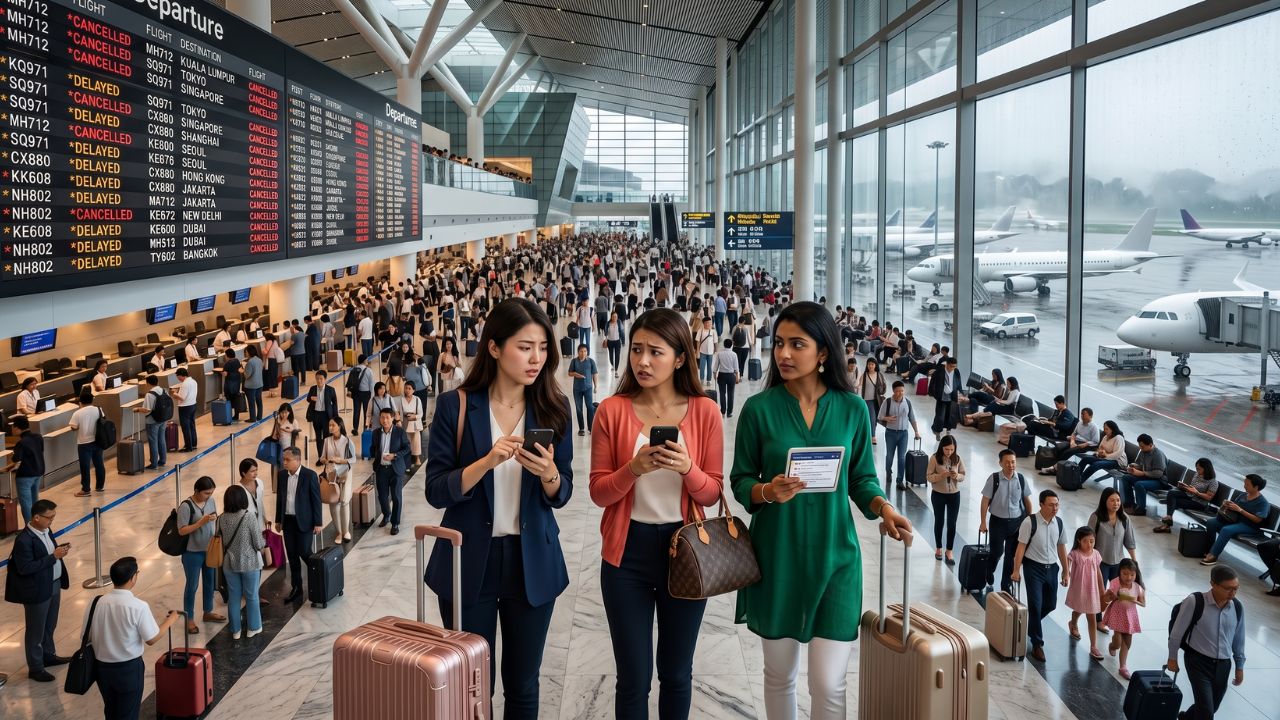
Image generated by AI
In a staggering demonstration of the extreme fragility plaguing the world's highest-density transit corridors, a sweeping operational breakdown across the entire Asian aviation network has triggered unprecedented travel chaos spanning from Moscow to Jakarta. Reported on June 21, 2026, as stranded international executives and desperate vacationers frantically monitor the latest airline news to salvage their itineraries, an aggregate total of 1,860 flight delays alongside 187 outright cancellations has paralyzed the continent. This severe congestion has heavily impacted major carriers, including China Eastern, All Nippon Airways, Japan Airlines, Aeroflot, and Turkish Airlines, creating a massive logistical void across critical hubs in Russia, Kazakhstan, Indonesia, Kuwait, and Saudi Arabia. For travelers attempting to navigate this multi-nation logistical nightmare and secure reliable onward transit without succumbing to the threat of compounding airport disruptions or secondary flight cancellations, understanding the exact operational parameters of this massive Asian breakdown is the ultimate tactical method to bypass today's breaking aviation updates.
By simultaneously crippling domestic feeder networks and vital cross-border transit nodes, this systemic disruption targets the absolute core of Asian connectivity. The massive accumulation of delays—rather than isolated carrier failures—indicates severe infrastructural congestion, forcing hundreds of thousands of passengers into extended terminal wait times at airports ranging from Saint Petersburg and Astana to Jeddah and Fukuoka.
Context: Navigating the Collapse of Trans-Asian Transit
For the modern global traveler, relying on the immense throughput capacity of major Asian hubs is routinely an absolute necessity for accessing both Eastern markets and Middle Eastern connecting corridors.
Historically, the Asian aviation model relies on massive, ultra-high-frequency mega-hubs like Shanghai Pudong, Jakarta Soekarno-Hatta, and Moscow Sheremetyevo to filter traffic across the globe. When operations run smoothly, executing a transfer through these terminals is a highly orchestrated routine. However, when sudden operational bottlenecks strike simultaneously across multiple national borders, the resulting travel chaos instantly severs these critical links. Being trapped in a congested terminal while your departure time slips hour by hour introduces immense physical exhaustion and completely destroys tightly coordinated international itineraries. Today's massive disruption perfectly illustrates the sheer fragility of this interconnected mega-network. The unannounced delay of 1,860 flights immediately trapped passengers across dozens of time zones, forcing carriers like Air China, Batik Air, and IndiGo to scramble regional resources to manage the overflow. This transnational breakdown heavily destabilizes vital corporate and leisure connections, highlighting a systemic vulnerability across the entire Eastern Hemisphere commuter grid.
To secure reliable terminal access, verify the active deployment of replacement aircraft, or track rebooking options prior to facing massive customer service lines, stranded travelers must consult official airline applications. For direct updates regarding how this widespread disruption might shield your onward itinerary from further flight cancellations, travelers should aggressively utilize premium transport networks. To explore live flight tracking and monitor the exact severity of the cascading bottlenecks paralyzing regional airspace, passengers can consult the official FlightAware tracking service.
Section-Wise Breakdown: The Tactical Route Disruption
The Russian and Central Asian Breakdown
Russian airspace is experiencing extreme stress. Sheremetyevo International Airport (SVO) has collapsed under the weight of 66 cancellations and 116 delays, making it the most heavily disrupted hub in the region. Pulkovo Airport (LED) in Saint Petersburg and Vnukovo (VKO) are also suffering, while Koltsovo International Airport (SVX) is battling an agonizing 101 delays. In Central Asia, Astana, Almaty (31 delays), and Tashkent (27 delays) are caught in the ripple effect, heavily impacting Aeroflot and Rossiya Airlines.
The Chinese Capacity Collapse
The Chinese mega-hub infrastructure is severely failing. Shanghai Pudong (PVG) leads the breakdown with an astonishing 131 delays. Guangzhou Baiyun (CAN), Beijing Capital (PEK), Shanghai Hongqiao (SHA), and Chongqing Jiangbei (CKG) are all reporting persistent, severe disruption levels. The sheer volume of delayed traffic has effectively paralyzed China Eastern Airlines (which recorded an extreme 194 delays), Air China, and Hainan Airlines.
The Japanese and Southeast Asian Gridlock
Japan's network is buckling, with Fukuoka Airport (FUK) reporting 113 delays alongside major slowdowns at New Chitose (CTS) and Osaka Itami (ITM). This has decimated the schedules of Japan Airlines (149 delays) and All Nippon Airways (123 delays). Meanwhile, Indonesia is facing extreme congestion: Jakarta Soekarno-Hatta (CGK) reported 156 delays and 18 cancellations, devastating the operations of Batik Air and Lion Air. Neighboring Malaysia is also affected, with Kuala Lumpur (KUL) suffering 64 delays.
Technical Roster: Official Disruption & Route Matrix
To ensure absolute factual accuracy regarding the specific carrier failures, the impacted airports, and the verified operational metrics defining this transnational breakdown, the following matrix details the strictly verified data sourced from global flight analytics:
Official Asian Aviation Disruption Matrix
| Aviation Entity | Metric / Disruption Volume |
|---|---|
| Total Global Cancellations | 187 |
| Total Global Delays | 1,860 |
| Sheremetyevo Airport (SVO) | 66 Cancellations, 116 Delays |
| Jakarta Soekarno-Hatta (CGK) | 18 Cancellations, 156 Delays |
| Shanghai Pudong (PVG) | 131 Delays |
| Fukuoka Airport (FUK) | 113 Delays |
| Koltsovo Airport (SVX) | 101 Delays |
| Kuala Lumpur (KUL) | 64 Delays |
| Almaty (ALA) / Tashkent (TAS) | 31 Delays / 27 Delays |
| China Eastern Airlines | 194 Delays |
| Japan Airlines | 149 Delays |
| All Nippon Airways | 123 Delays |
Data accurately reflects the verified transit disruptions, explicitly recorded delays, and outright cancellations executed by the listed carriers and airports regarding the recent Asian aviation operational environment.
Industry Analysis: The Lethal Impact of Network Constraints
Aviation analysts monitoring the highly congested Asian airspace note that this simultaneous breakdown is a textbook example of "cascading network-wide capacity constraint."
Analysts emphasize that the absolute cornerstone of high-frequency hubs like Jakarta, Shanghai, and Moscow is rapid turnaround efficiency. However, the distribution of nearly 2,000 delays across multiple sovereign nations (stretching from Japan and China to Saudi Arabia, Kuwait, Pakistan, and Uzbekistan) suggests a broader infrastructural issue. When major carriers like All Nippon Airways, IndiGo, Turkish Airlines, SCAT Airlines, and Pakistan International Airlines all experience simultaneous slowdowns without a localized weather event, it indicates severe regional air traffic control congestion or systemic scheduling imbalances. This type of rolling transnational delay creates a horrific environment for connecting passengers, as they remain trapped in transit limbo across multiple borders, waiting for departure slots that continually shift backward as the entire network attempts to flush the backlog.
Actionable Advice for International Travelers
Because sudden, massive delay clusters fundamentally alter the logistics of transcontinental transit, all passengers must execute this strategic travel checklist immediately upon facing an Asian airport disruption:
- Exploit Airline Apps Immediately: Never rely on the physical departure boards in massive terminals like Shanghai Pudong or Jakarta. Use official airline mobile applications to monitor real-time updates and secure rebooking options before the physical customer service lines become impenetrable.
- Expand Layover Buffers: If you are connecting through any of the mentioned hubs (especially SVO, CGK, or PVG), explicitly audit your transfer window. With over 1,860 delays across the network, tight connections of under three hours are virtually guaranteed to fail.
- Execute Digital Rebooking: Do not wait for ground staff. Utilize automated rebooking systems to instantly secure seats on partner airlines (such as shifting from Air China to another Star Alliance partner) to bypass localized congestion.
FAQ: Massive Asian Aviation Disruption Bypass
Which airlines are most impacted by the current Asian travel chaos?
China Eastern Airlines (194 delays), Japan Airlines (149 delays), All Nippon Airways (123 delays), alongside Aeroflot, Air China, and Lion Air, are suffering the highest operational disruptions.
Which Asian airports are experiencing the highest flight cancellations?
Moscow’s Sheremetyevo (SVO) reported 66 cancellations, while Jakarta Soekarno-Hatta (CGK) reported 18 cancellations alongside massive rolling delays.
How can I secure a rebooking during these massive regional delays?
Passengers must actively bypass physical terminal queues by utilizing official airline applications to process immediate digital rebooking or secure alternate routing through secondary, non-congested airports.
The Reality of Fragile Global Transit
The widespread travel chaos triggered by the massive delay cluster across the Asian aviation network proves definitively that succumbing to the severe fragility of modern transcontinental transit is a constant threat. By actively crippling the departure sequences of major hubs from Russia to Indonesia, operational constraints inadvertently collapse the tightly timed itineraries of international travelers. As stranded passengers frantically attempt to secure their terminal access, they must accept a critical new reality: surviving the massive disruptions of modern global transit demands tactical adaptability. Navigating the highly congested Asian transport sector requires a complete refusal to accept passive stranding, and the absolute discipline to aggressively book alternative flight paths when major airports inevitably fail to execute their published schedules.
Key Takeaways
- Massive Disruption: The Asian aviation network suffered a severe breakdown resulting in 1,860 delays and 187 cancellations.
- Russian Collapse: Moscow’s Sheremetyevo Airport suffered 66 cancellations and 116 delays, heavily impacting Aeroflot and Rossiya Airlines.
- Chinese and Japanese Strain: China Eastern Airlines suffered 194 delays, while Japan Airlines recorded 149 delays amid severe hub congestion in Shanghai and Fukuoka.
- Southeast Asian Gridlock: Jakarta Soekarno-Hatta reported 156 delays and 18 cancellations, heavily disrupting Batik Air and Lion Air schedules.
- Digital Defense: Passengers must aggressively use airline apps to monitor shifting departure times and extend their international layover buffers to survive the rolling delays.
Related Travel Guides
Massive Travel Chaos Paralyzes Chicago O'Hare with 1,425 Disruptions
Disclaimer
This article is for informational and educational purposes only. It does not constitute legal, financial, or professional advice. While we strive to provide accurate and up-to-date information, travel policies, regulations, and conditions change rapidly. Always verify information with official sources before making travel decisions. Nomad Lawyer makes no representations about the accuracy, reliability, completeness, or suitability of the information provided. Readers should consult qualified professionals for advice specific to their circumstances. The views expressed in this article are those of the author and do not necessarily reflect the views of Nomad Lawyer.
Kunal K Choudhary
Co-Founder & Contributor
A passionate traveller and tech enthusiast. Kunal contributes to the vision and growth of Nomad Lawyer, bringing fresh perspectives and driving the community forward.
Learn more about our team →