
Over 2,480 Delays and 243 Cancellations Disrupt Asian Air Corridors Across Tokyo, Jakarta, and Dubai

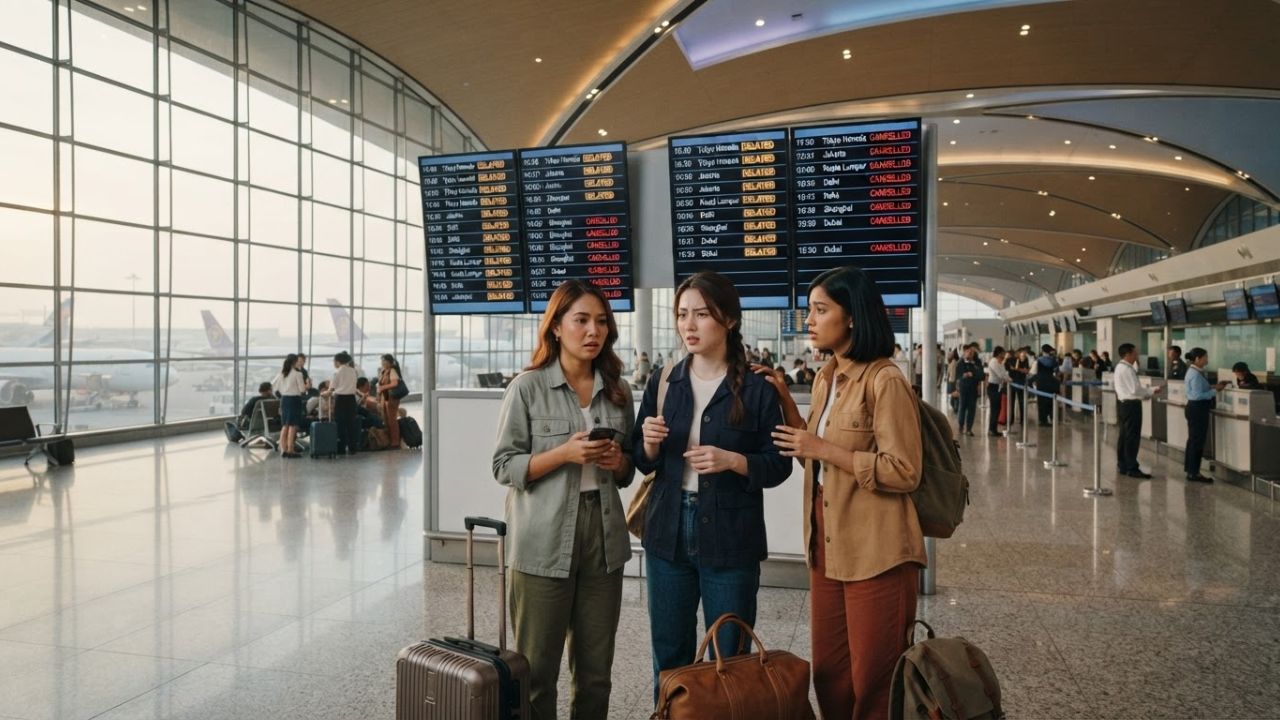
Air corridors across the Asia-Pacific and Middle Eastern regions suffered widespread operational setbacks on September 8, 2026, recording 2,480 flight delays and 243 cancellations as lingering volcanic ash plumes from Indonesia’s Mount Anak Krakatau collided with severe aircraft rotation bottlenecks. Tokyo International Airport (Haneda) absorbed the heaviest concentration of disruptions with 437 delayed flights, while Jakarta’s Soekarno–Hatta International Airport tracked 289 delays and 20 cancellations amid ongoing fleet repositioning.
Aviation telemetry recorded at 3:01 pm ET (September 9 at 3:01 am China Time / GMT+8) confirmed compounding schedule strain radiating from East Asia across Southeast Asia, the Indian subcontinent, and the Arabian Gulf. The operational challenges stemmed from a convergence of physical and logistical bottlenecks: airborne volcanic ash fields across the Sunda Strait requiring wide airspace detours, cumulative aircraft turnaround delays, peak-period runway congestion, and extended schedule recovery procedures across interconnected fleet rotations.
For international business commuters and cultural voyagers connecting through premier regional gateways—including Tokyo, Jakarta, Kuala Lumpur, Dubai, Delhi, and Shanghai—the widespread delays created missed connections, extended layovers, and extensive itinerary revisions.
The Local Trend Revealed: Volcanic Ash Ripple Effects and Hub Congestion
The disruption pattern across Asia underscored the vulnerability of synchronized airline alliances when primary transfer nodes suffer cascading delays. Japan’s premier domestic and international gateway, Tokyo Haneda (HND), recorded the region’s highest disruption total with 437 delays and six cancellations. Dense afternoon schedules and tight gate occupancies amplified minor inbound delays into broad terminal holding patterns.
In Southeast Asia, Indonesia remained a central catalyst of regional airspace friction. Although Jakarta's Soekarno–Hatta International Airport (CGK) had resumed flight operations following safety assessments of Mount Anak Krakatau's eruptive plume, airlines spent the day managing displaced crews and delayed airframes. Jakarta recorded 289 delays and 20 cancellations, with both origin and destination cancellation rates standing at 1%. Further northwest on Sumatra, Kuala Namu International Airport (KNO) recorded 33 delays and four cancellations, reflecting a 3% destination cancellation rate.
| Airport Hub | Country | Delays | Cancellations | Origin Cancel % | Dest. Cancel % |
|---|---|---|---|---|---|
| Tokyo Haneda (HND) | Japan | 437 | 6 | – | – |
| Jakarta Soekarno–Hatta (CGK) | Indonesia | 289 | 20 | 1% | 1% |
| Kuala Lumpur (KUL) | Malaysia | 175 | 6 | – | – |
| Dubai International (DXB) | UAE | 172 | 5 | – | – |
| Indira Gandhi Delhi (DEL) | India | 171 | 2 | – | – |
| Shanghai Pudong (PVG) | China | 138 | 16 | 0% | 1% |
| King Khalid Riyadh (RUH) | Saudi Arabia | 122 | 5 | – | – |
| Hamad International (DOH) | Qatar | 110 | 3 | – | – |
| Chhatrapati Shivaji Mumbai (BOM) | India | 103 | 3 | – | – |
| Manila Ninoy Aquino (MNL) | Philippines | 90 | 6 | – | – |
| Beijing Capital (PEK) | China | 80 | 19 | 2% | 1% |
| Guangzhou Baiyun (CAN) | China | 64 | 9 | 0% | 0% |
| Kunming Changshui (KMG) | China | 55 | 9 | 1% | 0% |
| Chengdu Tianfu (TFU) | China | 38 | 20 | 2% | 1% |
| Kuala Namu (KNO) | Indonesia | 33 | 4 | – | 3% |
Regional secondary airports across China registered notable cancellation ratios as air traffic flow controls were activated. Zhuhai (ZUH) logged a 4% origin and 2% destination cancellation rate, Wuxi (WUX) registered a 3% origin cancellation rate, and Nanjing Lukou (NKG) and Haikou Meilan (HAK) each recorded 2% origin and destination cancellation levels. Inland hubs including Lhasa Gonggar (LXA) and Wuhan Tianhe (WUH) recorded 3% and 2% destination cancellation rates respectively, while Beijing Daxing (PKX), Shanghai Hongqiao (SHA), and Xi’an Xianyang (XIY) preserved stable 0% cancellation baselines.
Airline Impact: Carrier Fleet Strains Across East and South Asia
The day’s operational data highlighted intense pressure on legacy carriers and budget operators alike:
- Japanese Operators: Japan Airlines (JAL) posted the highest single carrier delay total among listed airlines, logging 231 delays (affecting 29% of its flights) and three cancellations. All Nippon Airways (ANA) recorded 146 delays (26% delay rate) and one cancellation, while regional affiliate ANA Wings logged 105 delays (29% delay rate) and three cancellations (1%).
- Indonesian Carriers: Garuda Indonesia recorded 82 delays (34% of operations) and three cancellations (1%). Lion Air Group’s full-service arm, Batik Air, registered 99 delays (31% delay rate) and 14 cancellations (4%).
- Indian Carriers: Low-cost giant IndiGo matched hub pressure in Delhi and Mumbai, logging 171 delays (9% delay rate) and five cancellations. SpiceJet faced severe operational friction, with 33 delays representing 46% of its scheduled flights alongside three cancellations (4%).
- Chinese Airlines: China Eastern reported 137 delays (5%) and 35 cancellations (1%). Air China logged 58 delays (3%) and 29 cancellations (1%). Hainan Airlines recorded seven delays (1%) and 20 cancellations (2%), while Spring Airlines logged 53 delays (9%) and two cancellations, and China Southern recorded 47 delays (2%) and one cancellation.
- Gulf and Southeast Asian Carriers: Qatar Airways experienced 105 delays (16%) and three cancellations. Etihad Airways recorded 84 delays (25%) and one cancellation. Saudia reported 72 delays (13%) and 13 cancellations (2%). Air Arabia recorded 48 delays (21%) and one cancellation. In the Philippines, Philippines AirAsia contended with 24 delays (34%) and six cancellations (8%).
Cultural & Environmental Value: Ecological Hazards and Community Mobility
Volcanic ash dispersion from Mount Anak Krakatau is an environmental reminder of the complex geological setting governing Southeast Asian aviation. Microscopic glass shards and pulverized rock in volcanic ash clouds melt at the extreme combustion temperatures inside modern turbofan engines, creating glassy deposits that threaten engine flameouts and degrade cockpit instrumentation.
Aviation safety authorities—including Indonesia's Directorate General of Civil Aviation (DGCA), the Volcanic Ash Advisory Center (VAAC) Darwin, and the Japan Meteorological Agency—prioritize safety through route diversions. While safety remains non-negotiable, extended airborne holds and wide-angle detours burn thousands of additional gallons of aviation fuel, temporarily expanding the environmental footprint of regional corridors.
Simultaneously, unexpected disruptions redirect passenger flows into local transportation ecosystems. When flights face multi-hour postponements, travelers increasingly turn to electrified high-speed rail corridors, including Japan's Shinkansen network between Tokyo, Nagoya, and Osaka, Indonesia’s Whoosh high-speed railway connecting Jakarta and Bandung, and China's CRH bullet train grid. These rail networks consume up to 80% less energy per passenger-kilometer than short-haul flights, demonstrating how green overland alternatives can alleviate strain on air corridors.
At the same time, travelers stranded during layovers can turn unexpected waiting periods into opportunities to support local family-run eateries, cultural markets, and artisan cooperatives rather than relying solely on international duty-free concessions.
Visitor Insider Tips: Navigating Major Asian Hub Delays
When traveling through key Asian transfer airports during periods of regional network congestion, practical local strategies can make a significant difference:
- Navigating Tokyo Haneda (HND): If you face a long delay at Haneda, take advantage of the terminal’s unique cultural amenities. In Terminal 3, walk through the Edo Ko-michi, an authentic architectural recreation of a 17th-century Tokyo street lined with traditional wooden facades, serving seasonal ramen and soba noodles. For extended layovers, head to the Haneda Airport Garden complex to access Izumi Tenku no Yu, an open-air natural hot spring rooftop onsen offering views of the runways and Mount Fuji on clear days.
- Overcoming Jakarta Soekarno-Hatta (CGK) Congestion: Avoid getting trapped in terminal transit areas during extended Indonesian schedule shifts. Terminal 3 features an expansive Indonesian food hall showcasing regional specialties; order authentic soto betawi (rich beef soup in spiced coconut milk) or nasi uduk paired with fresh sambal. If your flight is delayed past five hours, avoid airport taxis stuck in toll road traffic and board the electrified Airport Rail Link (KA Bandara) directly from the integrated railway station to BNI City Station in central Jakarta in 45 minutes.
- Relaxation and Transit at Dubai (DXB): At Dubai International, travelers navigating layovers in Terminal 3 can retreat to the indoor Zen Gardens located between Gates B7 and B11. Featuring lush tropical flora, tranquil water ponds, and shaded seating benches, it offers quiet respite away from boarding gate announcements. For departures delayed past four hours, the Dubai Metro Red Line departs directly from Terminal 1 and Terminal 3, taking you to Deira's historic gold and spice souks in under 20 minutes.
- Securing Compensation and Rebooking Support: In Indonesia, Ministry of Transportation Regulation PM 89/2015 establishes passenger care requirements for domestic flight disruptions, though natural volcanic events often qualify as force majeure, requiring airlines to provide ticket refunds or free date changes without penalty rather than cash compensation. In Japan, check airline digital desks directly for train ticket substitution vouchers (furikae yuso) on domestic trunk routes when weather or equipment swaps disrupt schedules.
Tourism Outlook: Strengthening Asia’s Multimodal Travel Resilience
The September 8 disruption across Asia highlights the interconnected reality of modern international travel. A geological event in the Sunda Strait or an aircraft repositioning delay at Tokyo Haneda creates ripple effects that touch passengers across China, India, and the Arabian Gulf within hours.
As regional aviation authorities modernize air traffic control systems and expand runway capacity, integrating airport infrastructure directly with high-speed railway stations will remain essential. For international travelers, building flexible transit buffers and leveraging regional rail alternatives will remain key tactics for seamless journeys across Asia.
Related Travel Guides
Disclaimer
This article is for informational and educational purposes only. It does not constitute legal, financial, or professional advice. While we strive to provide accurate and up-to-date information, travel policies, regulations, and conditions change rapidly. Always verify information with official sources before making travel decisions. Nomad Lawyer makes no representations about the accuracy, reliability, completeness, or suitability of the information provided. Readers should consult qualified professionals for advice specific to their circumstances. The views expressed in this article are those of the author and do not necessarily reflect the views of Nomad Lawyer.
Raushan Kumar
Founder & Lead Developer
Full-stack developer with 11+ years of experience and a passionate traveller. Raushan built Nomad Lawyer from the ground up with a vision to create the best travel and law experience on the web.
Learn more about our team →