
Asia Flight Chaos: 6,639 Delays and 212 Cancellations in August 2026
Severe monsoon weather and convective storms trigger 6,639 delays and 212 flight cancellations across Asia, affecting major hubs. Read our safety guide.

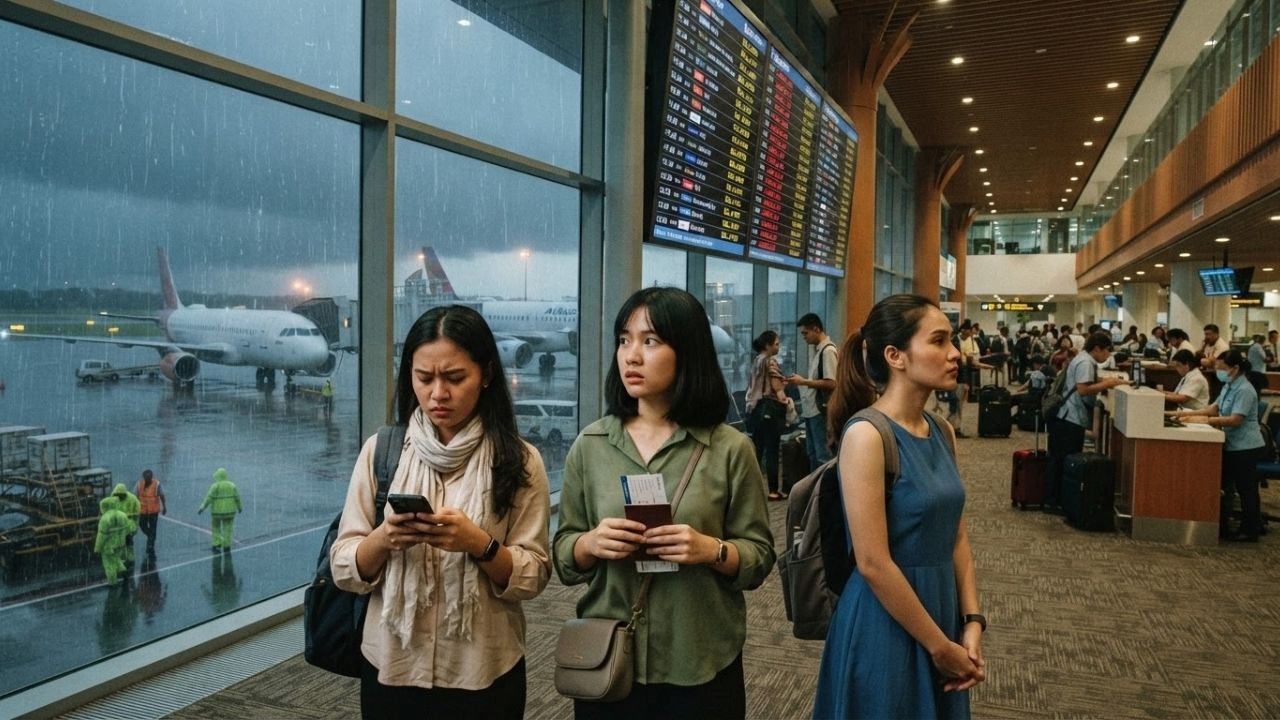
Image generated by AI
A wave of severe monsoon weather and convective storms has triggered major aviation disruptions across Asia, resulting in 6,639 delays and 212 cancellations. Heavy rainfall and restricted visibility have impacted key air corridors, leaving thousands of passengers stranded at hubs like Jakarta, Bangkok, and Dubai.
Weather Bottlenecks and Airspace Pressures
According to data compiled by FlightAware on 30 August 2026 at 5:23 pm ET USA (representing 31 August 2026, 4:24 am Jakarta Time), regional monsoon fronts are the primary cause of the delays:
- South Asian Monsoons: Heavy rains and low visibility across India have limited runway throughput and ground operations.
- Convective Thunderstorms: Summer convective storms in Southern and Eastern China have led to air traffic control (ATC) flow restrictions.
- East Asian Fronts: Active tropical weather in the Western Pacific has impacted flight corridors between Japan, Taiwan, Hong Kong, and mainland China.
Additionally, route adjustments due to airspace restrictions in West Asia have extended block times for transcontinental flights, compressing ground turnaround windows at major Gulf hubs.
Detailed Geographic and Airline Impact Analysis
East Asia: Mainland China, Hong Kong, and Japan
Mainland China and Hong Kong logged the highest total volume of schedule interruptions:
| Airport / Hub | Country / Region | Delays | Cancellations |
|---|---|---|---|
| Shanghai Pudong Int’l | Mainland China | 557 | 7 |
| Guangzhou Baiyun Int’l | Mainland China | 517 | 4 |
| Beijing Capital Int’l | Mainland China | 305 | 2 |
| Shanghai Hongqiao Int’l | Mainland China | 273 | 7 |
| Hong Kong Int’l | Hong Kong SAR | 243 | 1 |
| Hangzhou Xiaoshan Int’l | Mainland China | 219 | 1 |
| Chongqing Jiangbei Int’l | Mainland China | 141 | 1 |
| Kunming Changshui Int’l | Mainland China | 141 | 8 |
| Nanjing Lukou Int’l | Mainland China | 138 | 2 |
| Xi’an Xianyang Int’l | Mainland China | 137 | 6 |
| Chengdu Tianfu Int’l | Mainland China | 135 | 12 |
| Beijing Daxing Int’l | Mainland China | 133 | 4 |
| Chengdu Shuangliu Int’l | Mainland China | 127 | 3 |
| Haikou Meilan Int’l | Mainland China | 106 | 1 |
| Qingdao Jiaodong Int’l | Mainland China | 91 | 2 |
| Zhengzhou Xinzheng Int’l | Mainland China | 85 | 1 |
| Tokyo Int’l (Haneda) | Japan | 124 | 1 |
| Fukuoka Airport | Japan | 41 | 3 |
| Hakodate Airport | Japan | 5 | 4 |
| Okadama (Sapporo Airfield) | Japan | 2 | 6 |
Chinese carriers experienced substantial delay volumes, led by:
- China Eastern: 603 delays (22% of operations), 2 cancellations (0%)
- China Southern Airlines: 428 delays (16%), 3 cancellations (0%)
- Air China: 338 delays (16%), 1 cancellation (0%)
- Spring Airlines: 131 delays (20%), 2 cancellations (0%)
- Sichuan Airlines: 126 delays (14%), 2 cancellations (0%)
- Hainan Airlines: 119 delays (13%), 1 cancellation (0%)
- Juneyao Airlines: 104 delays (25%), 1 cancellation (0%)
- Shanghai Airlines: 95 delays (26%), 1 cancellation (0%)
- Tianjin Airlines: 71 delays (16%), 1 cancellation (0%)
- China Express Airlines: 60 delays (12%), 4 cancellations (0%)
- LJ Air: 7 delays (14%), 1 cancellation (2%)
In Japan, regional airlines recorded:
- Japan Airlines: 65 delays (8%), 1 cancellation (0%)
- ANA Wings: 33 delays (9%), 2 cancellations (0%)
- Jetstar Japan: 8 delays (7%), 3 cancellations (2%)
- Hokkaido Air System: 0 delays (0%), 6 cancellations (15% of operating schedule)
South Asia and Southeast Asia
Indian hubs faced weather-related slowdowns, monitored by the Directorate General of Civil Aviation (DGCA):
- Indira Gandhi Int’l (Delhi): 163 delays, 7 cancellations
- Chatrapati Shivaji Int’l (Mumbai): 87 delays, 4 cancellations
- Chennai Int’l: 59 delays, 3 cancellations
- Netaji Subhash Chandra Bose Int’l (Kolkata): 38 delays, 3 cancellations
- Pune / Lohegaon Air Force Base: 9 delays, 5 cancellations
Indian carriers reported the following disruptions:
- IndiGo: 170 delays (8%), 6 cancellations (0%)
- SpiceJet: 34 delays (32% delay rate), 9 cancellations (8% rate)
- Akasa Air: 7 delays (4%), 3 cancellations (1%)
Other regional operations included:
- Pakistan International Airlines: 8 delays (13%), 1 cancellation (1%)
- Drukair-Royal Bhutan Airlines: 1 delay (7%), 2 cancellations (14%)
- Azerbaijan Airlines: 15 delays (10%), 1 cancellation (0%)
Across Southeast Asia, primary gateways experienced high congestion:
- Jakarta Soekarno-Hatta Int’l (Indonesia): 269 delays, 10 cancellations
- Suvarnabhumi Bangkok Int’l (Thailand): 248 delays, 1 cancellation
- Kuala Lumpur Int’l (Malaysia): 219 delays, 5 cancellations
- Manila Int’l (Philippines): 214 delays, 2 cancellations
- Singapore Changi: 202 delays, 1 cancellation
- Ngurah Rai/Bali Int’l (Indonesia): 124 delays, 2 cancellations
- Sultan Hasanuddin Int’l (Indonesia): 88 delays, 4 cancellations
- Juanda Int’l (Indonesia): 83 delays, 2 cancellations
- Sultan Mahmud Badaruddin II (Indonesia): 18 delays, 4 cancellations
- Halim Perdanakusuma Int’l (Indonesia): 13 delays, 4 cancellations
Southeast Asian carriers saw the following numbers:
- AirAsia (Malaysia): 91 delays (17%), 8 cancellations (1%)
- PAL Express (Philippines): 37 delays (20%), 4 cancellations (2%)
- MAI (Myanmar): 18 delays (28%), 2 cancellations (3%)
- Indonesia AirAsia: 12 delays (12%), 1 cancellation (1%)
West Asia and Middle East Hubs
Transcontinental transit gateways in West Asia and the Middle East faced significant schedule pressure:
- Dubai Int’l (UAE): 436 delays, 7 cancellations
- Istanbul Airport (Türkiye): 252 delays, 1 cancellation
- King Khalid Int’l (Riyadh, Saudi Arabia): 109 delays, 12 cancellations
- King Abdulaziz Int’l (Jeddah, Saudi Arabia): 89 delays, 12 cancellations
- Sharjah Int’l (UAE): 86 delays, 2 cancellations
- Abha Regional (Saudi Arabia): 24 delays, 6 cancellations
- Gizan Regional (Saudi Arabia): 0 delays, 8 cancellations
- Najran Domestic (Saudi Arabia): 0 delays, 6 cancellations
Middle Eastern carriers recorded:
- Etihad Airways: 147 delays (41%), 1 cancellation (0%)
- FlyDubai: 146 delays (43%), 2 cancellations (0%)
- Pegasus Airlines (Türkiye): 122 delays (15%), 1 cancellation (0%)
- Air Arabia: 69 delays (26%), 2 cancellations (0%)
- Israir (Israel): 52 delays (53%), 2 cancellations (2%)
- Saudia: 41 delays (7%), 22 cancellations (3%)
- Gulf Air (Bahrain): 13 delays (8%), 3 cancellations (2%)
Local Insider Secrets for Stranded Travelers
If you find yourself stuck at one of the affected hubs today, use these practical tips:
- Changi Snooze Etiquette: At Singapore Changi (202 delays), do not block charging docks in free snooze lounges if you are not sleeping. For quiet resting zones, visit the T3 Butterfly Garden or the T1 rooftop pool.
- Cheap Dining in Bangkok: Skip the expensive concourse dining at Suvarnabhumi (248 delays). Go to the basement level (Level 1, near the airport rail link) to eat at the "Magic Food Point" local food court, which uses paper coupons purchased at the entry counter.
- Jakarta Airport Hotel: If stranded overnight at Soekarno-Hatta (269 delays, 10 cancellations), check into the Jakarta Airport Hotel located directly inside Terminal 2E, eliminating the need to take shuttle buses.
- Delhi Lounge Access: Delhi's Terminal 3 lounges experience long queues during delays. Use the Encalm Lounge in the food court level, or pre-book transit hotel rooms inside the terminal.
- Dubai Sleeping Pods: If transiting through Dubai International (436 delays), look for the "Sleep 'n Fly" sleeping pods in Terminal 3 (Concourses A, B, and C) to rest without checking into a full hotel.
Sustainable Practices and Passenger Welfare
Flight delays place a high level of stress on airport workers, gate agents, and flight crews. Travelers can support the local service economy by purchasing food from independent airport cafes, using airport transit hotels, and tipping shuttle drivers and cleaning staff.
To reduce the environmental footprint during long delays, utilize municipal water refill stations located throughout hubs like Changi and Haneda rather than buying single-use plastic bottles. If domestic flight corridors are blocked in Indonesia, consider using land-based transit alternatives—such as the high-speed Whoosh train connecting Jakarta and Bandung—to bypass regional airport congestion.
Related Travel Guides
- Breaking Airline News: Severe Travel Chaos Paralyzes Charlotte Douglas International Airport as American Airlines and Frontier Suffer Massive Flight Cancellations and Delays
- Malaysia Airlines Adds April 2026 Flights on Kuala Lumpur-London Route as Asia-Europe Travel Surges 10%+ Year-on-Year
- Breaking Airline News: Flydubai Deploys Massive Pokhara Expansion to Shield Global Travelers from Kathmandu Transit Chaos
Disclaimer
This article is for informational and educational purposes only. It does not constitute legal, financial, or professional advice. While we strive to provide accurate and up-to-date information, travel policies, regulations, and conditions change rapidly. Always verify information with official sources before making travel decisions. Nomad Lawyer makes no representations about the accuracy, reliability, completeness, or suitability of the information provided. Readers should consult qualified professionals for advice specific to their circumstances. The views expressed in this article are those of the author and do not necessarily reflect the views of Nomad Lawyer.
Raushan Kumar
Founder & Lead Developer
Full-stack developer with 11+ years of experience and a passionate traveller. Raushan built Nomad Lawyer from the ground up with a vision to create the best travel and law experience on the web.
Learn more about our team →