
Argentina Launches Tren Solar de la Quebrada: Latin America's First Solar-Electric Train in Jujuy 2026
Argentina debuts the Tren Solar de la Quebrada, the first solar-electric passenger rail service in Latin America, transforming tourism in the UNESCO-listed Quebrada de Humahuaca valley.

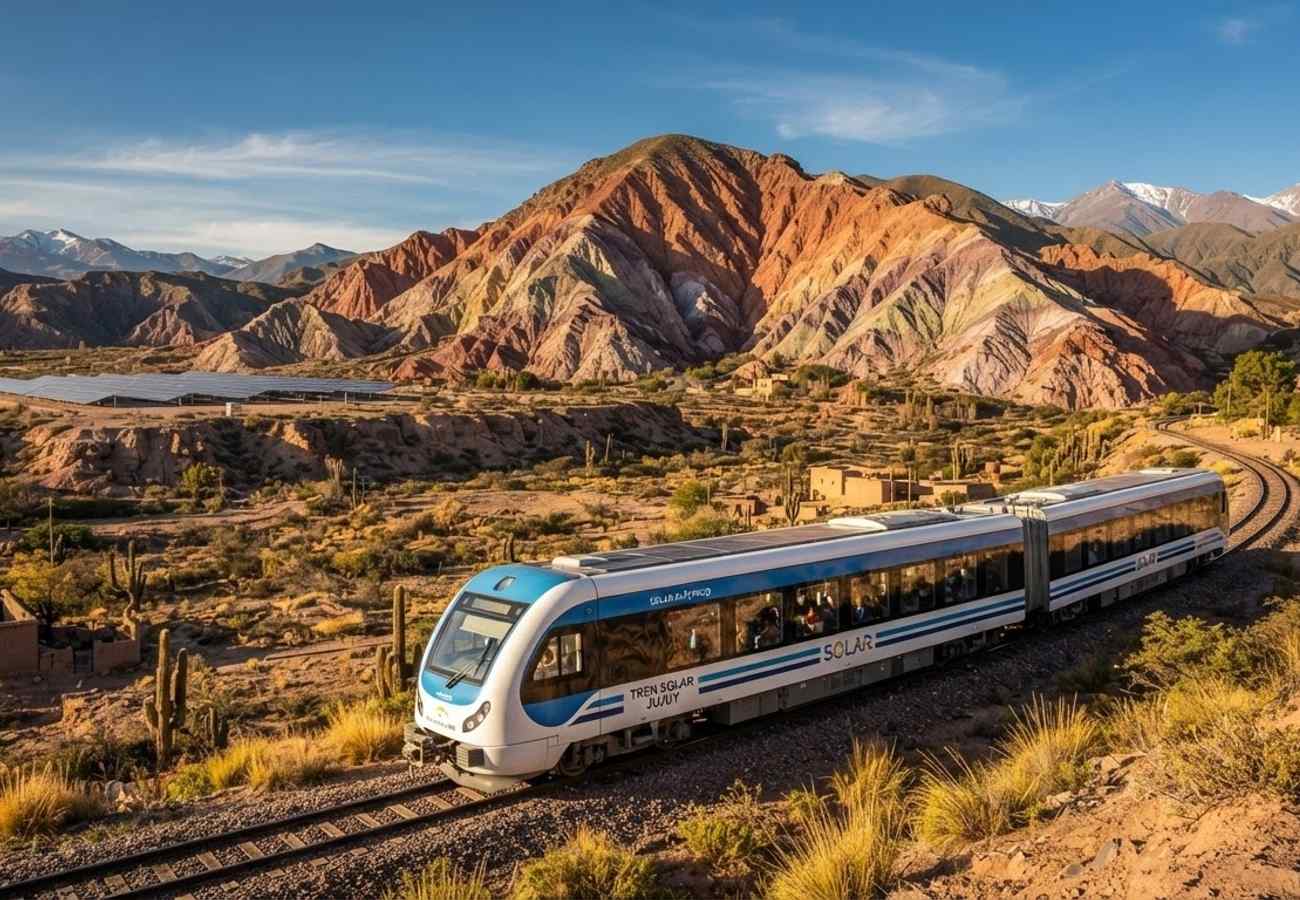
Image generated by AI
Argentina has deployed the Tren Solar de la Quebrada, the first solar-electric passenger train in Latin America, integrating 6 MW of solar capacity to service the UNESCO World Heritage Quebrada de Humahuaca valley.
Solar-Electric Rail Infrastructure and Technical Specifications
The Tren Solar de la Quebrada marks a shift toward decarbonized transit in the Andean region. Manufactured by CRRC Tangshan in China, the rolling stock consists of modern articulated two-car designs optimized for sightseeing, featuring expansive panoramic windows for unobstructed views of the Jujuy Province's geological formations.
The propulsion system relies on high-capacity 352 kWh lithium iron phosphate battery packs. To ensure a carbon-neutral energy cycle, the railway is supported by dedicated solar photovoltaic generation plants with a total capacity of 6 MW, paired with stationary battery storage stations.
To maintain operational efficiency on steep Andean gradients, the train utilizes a regenerative braking system that recovers energy during descents. Furthermore, the infrastructure incorporates ultra-fast charging technology, allowing the train to replenish power during station stops in approximately 25 minutes.
Route Specifications and Service Area
The service currently operates on the historic Ramal C section of the General Belgrano Railway. The initial operational phase covers a 42-kilometre corridor connecting key cultural and natural landmarks.
| Station/Stop | Key Attraction/Significance | Regional Note |
|---|---|---|
| Volcán | Southern Gateway & Craft Centre | Entry point for regional artisan traditions |
| Tumbaya | Colonial Heritage Sites | Historic Andean settlement |
| Purmamarca | Cerro de los Siete Colores | Globally recognized "Hill of Seven Colors" |
| Maimará | Paleta del Pintor | High-altitude vineyards and colorful peaks |
| La Posta de Hornillos | Colonial-era Heritage | Historical cultural evolution site |
| Tilcara | Archaeological Sites & Markets | Northern endpoint for Andean cultural experiences |
Traveler Logistics Guide: Navigating the Quebrada
From a ground-level perspective, the best way to navigate this route is to treat Volcán as your primary logistics hub for the southern entry. Because the train operates on a specific tourism corridor, scheduling is tighter than standard regional rail.
Booking and Access Travelers should verify availability through official provincial tourism portals in Jujuy. Given that the service has already moved over 90,000 passengers, peak-season tickets (especially for Purmamarca) can sell out quickly.
Layover and Connection Strategy The 25-minute charging windows at stations are designed to align with passenger boarding and brief sightseeing stops. However, for those wishing to explore the archaeological sites in Tilcara or the vineyards in Maimará, it is recommended to coordinate local transfers or "last-mile" transport, as the train follows a fixed rail corridor.
Digital and Customs Policies While the train operates internally within Argentina, travelers heading further north toward the planned Bolivian extension should ensure their passports are up to date and monitor current cross-border transit regulations between Argentina and Bolivia.
Regional Connectivity and Infrastructure Impact
The introduction of the solar train is a catalyst for social and economic development in the Jujuy Province. One-third of the passenger capacity is reserved for social responsibility programs, providing free or subsidized travel for indigenous populations and rural communities. This ensures that the economic benefits of tourism reach the residents who preserve the region's 10,000-year-old cultural heritage.
The long-term strategic goal involves a massive infrastructure revival. Plans are underway to extend the route northward to Humahuaca and eventually to La Quiaca. This expansion aims to restore approximately 300 kilometres of historic international railway, potentially reconnecting Argentina with Bolivia and creating a seamless, green transit corridor across the Andes.
A blueprint for the future of heritage tourism through carbon-neutral innovation.
Related Travel Guides
Disclaimer
This article is for informational and educational purposes only. It does not constitute legal, financial, or professional advice. While we strive to provide accurate and up-to-date information, travel policies, regulations, and conditions change rapidly. Always verify information with official sources before making travel decisions. Nomad Lawyer makes no representations about the accuracy, reliability, completeness, or suitability of the information provided. Readers should consult qualified professionals for advice specific to their circumstances. The views expressed in this article are those of the author and do not necessarily reflect the views of Nomad Lawyer.
Raushan Kumar
Founder & Lead Developer
Full-stack developer with 11+ years of experience and a passionate traveller. Raushan built Nomad Lawyer from the ground up with a vision to create the best travel and law experience on the web.
Learn more about our team →