
Airlines Integrate Artificial Intelligence to Redesign Customer Touchpoints and Corporate Travel
Airlines deploy artificial intelligence to automate passenger touchpoints, while LATAM invests $360 million in premium business travel cabins.

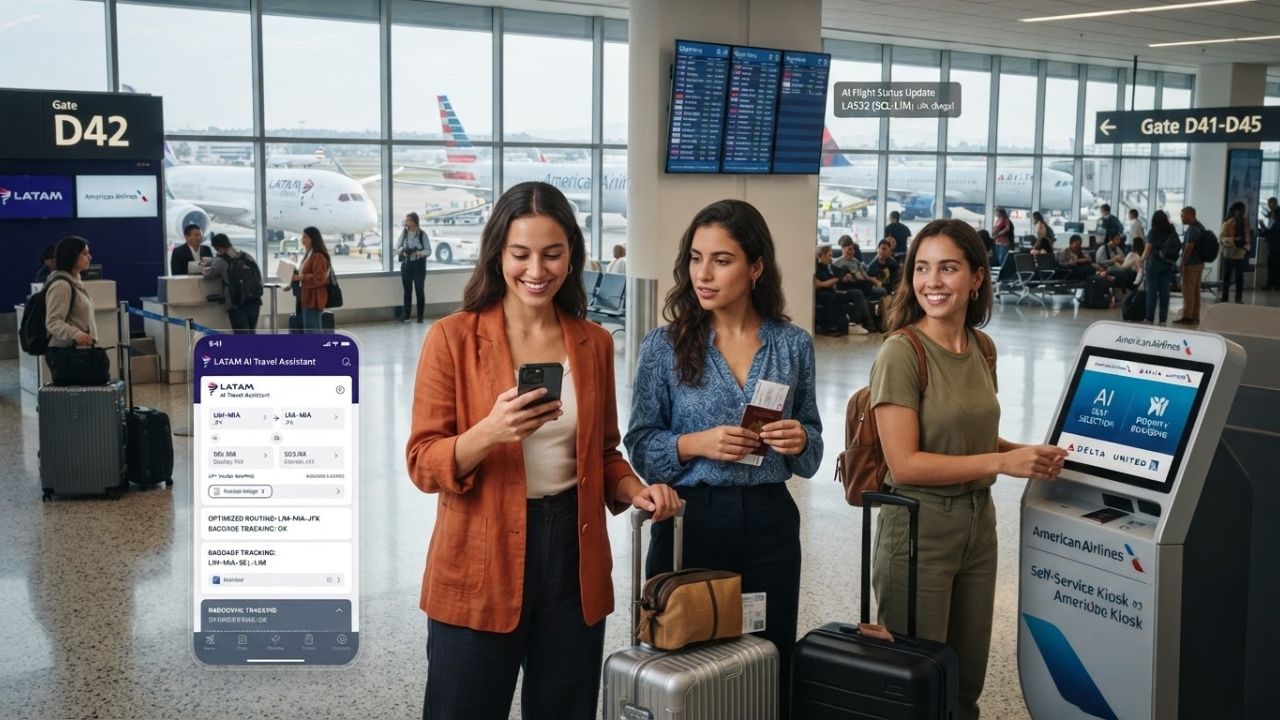
Image generated by AI
Airlines across South and North America are deploying artificial intelligence and investing in premium cabins to streamline customer touchpoints, with LATAM investing over $360 million in premium business travel and Delta rolling out AI-driven concierge systems.
LATAM Airlines: Corporate Growth and Premium Investments
Speaking at the 2026 Global Business Travel Association (GBTA) Convention in Chicago, Mauricio Veloso, Managing Director of Corporate Sales & Strategy at LATAM Airlines, reported consistent corporate travel demand growth in 2025 compared with 2024, with solid expansion continuing into 2026. This recovery in face-to-face business travel comes despite the availability of remote meeting platforms, as corporate clients continue to prioritize in-person negotiations.
To meet these demands, LATAM is investing more than $360 million in Premium Business suites featuring sliding doors, 18-inch screens, and flat beds. The airline has also allocated over $100 million for a new Premium Economy product set to launch next year. In addition, close to 100% of the carrier's narrow-body fleet features Wi-Fi connectivity, which is now being installed on wide-body aircraft.
LATAM's joint venture with Delta Air Lines has developed more than 250 joint corporate accounts in 2026, offering travel buyers a single point of contact. The airline is also expecting new single-aisle aircraft in 2027 to operate longer routes at lower costs. Following post-pandemic adjustments, LATAM has restructured its workforce from close to 55,000 employees to approximately 42,000 to 43,000 staff, focusing on operational agility and direct customer relations.
Artificial Intelligence Integration Across the Passenger Journey
Beyond physical cabin upgrades, airlines are integrating machine learning and data analytics to optimize customer interactions. Rather than using automation solely for back-office operations, airlines are deploying technology across direct passenger touchpoints, including search, booking, rebooking, and flight updates.
LATAM uses an AI-powered virtual travel planning agent to help customers search destinations and obtain flight quotations. The carrier also uses natural-language bots to resolve standard customer service cases and identify critical service issues early.
North American Carriers Implement AI for Disruption Management
North American airlines are applying machine learning to passenger support systems. American Airlines has integrated machine learning to provide automated rebooking options on its website and mobile app during flight disruptions. The carrier has also tested a generative AI-powered conversational assistant to handle plan adjustments during severe weather, alongside predictive models that propose brief flight holds to prevent passengers from missing tight connections.
Delta Air Lines is piloting Delta Concierge, an AI-powered assistant within the Fly Delta app, which offers SkyMiles members real-time answers about baggage tracking, gates, and eCredits. Behind the scenes, Delta uses AI to route bags with short connection times and optimize gate decisions.
United Airlines is using AI to provide proactive flight updates and smart baggage tracking to passengers, while using predictive analytics to optimize workflow systems for ground crews. Meanwhile, Alaska Airlines has introduced a generative AI travel search tool on its website to help travelers explore destinations based on interests rather than static route maps.
Sustainable Tech and Operational Footprint Reduction
The application of artificial intelligence in gating and flight routing directly supports environmental conservation. By optimizing taxi paths and reducing airport gate bottlenecks, AI helps minimize ground fuel consumption and aircraft emissions. Transitioning to digital boarding passes and app-based notifications also reduces paper waste, aligning with eco-friendly travel practices.
Companies are encouraging corporate travel managers to build balanced travel policies that combine essential business travel with direct, fuel-efficient flights. Using data-driven forecasting helps destinations manage visitor flows and prevent over-tourism in popular historic centers.
Local Insider Travel Strategies
- Leverage Mobile Applications: Download your airline's official app (such as Fly Delta or the American Airlines App) before arriving at the airport. Real-time updates on baggage and gate changes load faster on mobile apps than on airport departure boards.
- Utilize Digital Wallets: Use digital account features, like the LATAM Wallet, to store compensation credits or refunds, which can be applied instantly online for upgrades or future flights.
- Plan for Off-Peak Transit: Schedule corporate departures for Tuesday mornings or Wednesday afternoons when business-focused hubs (such as Chicago O'Hare) experience lower passenger volumes, minimizing the risk of automated rebooking delays.
Long-Term Outlook for Aviation Technology
The transition toward customer-centered artificial intelligence indicates a long-term shift in the aviation sector. Rather than treating AI as an isolated tool, carriers are embedding machine learning into every stage of the traveler's journey. This digital integration, combined with premium cabin investments and fleet upgrades, will define the competitive landscape of international travel, providing business and leisure travelers with more reliable and personalized journeys.
Related Travel Guides
Disclaimer
This article is for informational and educational purposes only. It does not constitute legal, financial, or professional advice. While we strive to provide accurate and up-to-date information, travel policies, regulations, and conditions change rapidly. Always verify information with official sources before making travel decisions. Nomad Lawyer makes no representations about the accuracy, reliability, completeness, or suitability of the information provided. Readers should consult qualified professionals for advice specific to their circumstances. The views expressed in this article are those of the author and do not necessarily reflect the views of Nomad Lawyer.
Raushan Kumar
Founder & Lead Developer
Full-stack developer with 11+ years of experience and a passionate traveller. Raushan built Nomad Lawyer from the ground up with a vision to create the best travel and law experience on the web.
Learn more about our team →