
998 Flights Delayed Across Germany's Major Airports as Summer Travel Chaos Strikes Frankfurt, Munich, Berlin
Nearly 1,000 flight delays and 40 cancellations crippled Germany's six busiest airports on July 1, 2026, affecting Lufthansa, Ryanair, Emirates, and more during peak summer travel season.

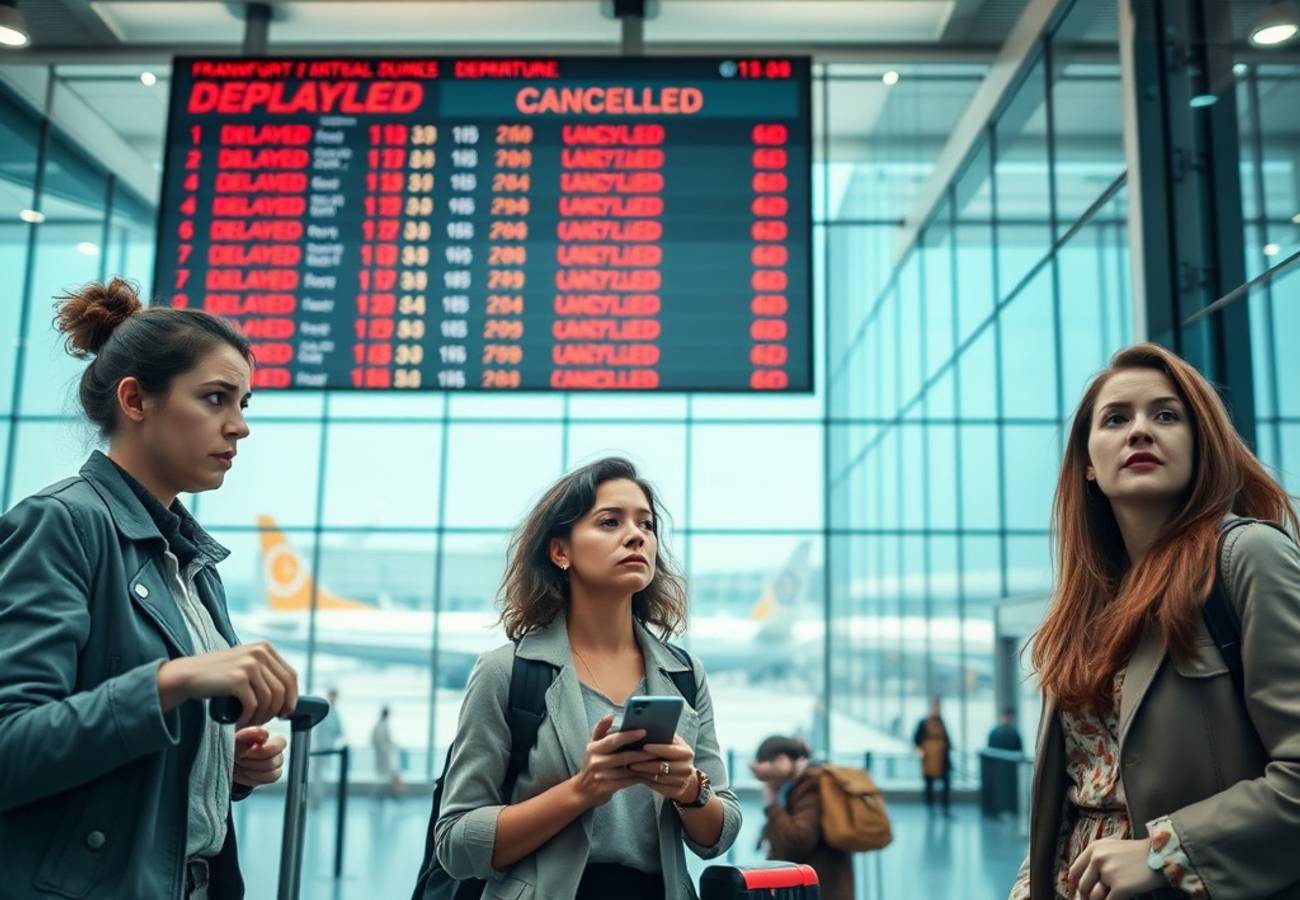
Image generated by AI
The Day Nearly 1,000 Flights Ground to a Halt
July 1, 2026 marked a cascading aviation crisis across Germany's entire airport network. Six of Europe's busiest aviation hubs—Frankfurt International, Munich International, Berlin Brandenburg, Düsseldorf, Hamburg, and Hanover—collectively recorded 998 flight delays and 40 cancellations, stranding hundreds of travelers and rippling disruptions across continental airspace.
What started as operational friction at one or two airports snowballed into a system-wide breakdown affecting every major carrier operating through German airspace: Lufthansa, Eurowings, Condor, Ryanair, EasyJet, British Airways, Air France, KLM, Turkish Airlines, Emirates, and Qatar Airways all reported significant schedule impacts.
For families launching long-awaited summer vacations, business travelers sprinting to critical meetings, and international passengers connecting through Germany's network, the day became a masterclass in aviation vulnerability.
Reddit: "My connection through Frankfurt was delayed 6 hours. Missed my entire week in Barcelona. Airlines just kept passing the blame around." — r/travel
Frankfurt Bears the Heaviest Blow
As Europe's busiest international connecting hub, Frankfurt Airport bore the brunt of the disruption.
The airport's operational scorecard told the story:
- 355 delayed flights
- 5 cancellations
- Cascading effects across dozens of transatlantic and Asian connection routes
Frankfurt's role as a global transfer point means delays don't simply inconvenience local passengers—they trigger a domino effect across international networks. A single delayed arrival from New York or Shanghai compounds into missed connections to Madrid, Rome, or Warsaw. Tightly coordinated scheduling leaves zero buffer for recovery when aircraft and crews fall behind.
The airport's 355 delays represented roughly one in four of all flights processed that day.
Munich's 19 Cancellations Signal Deliberate Schedule Cuts
Germany's second-largest airport, Munich International, recorded 270 delays and 19 cancellations—the highest cancellation rate among all six airports.
The higher cancellation figure suggests airlines made deliberate scheduling decisions rather than simply operating behind schedule. When delays cascade beyond recovery windows, operators often cancel downstream flights to reset crew rotations and aircraft positioning. Munich's 19 cancellations indicate conditions deteriorated significantly enough to trigger these defensive measures.
This strategy reduces downstream disruption but leaves passengers scrambling for alternative routing, rebooking, or compensation claims.
Berlin Brandenburg Disrupts Germany's Capital Region
The airport serving Berlin and surrounding regions reported:
- 138 delays
- 7 cancellations
For a capital city airport, Berlin Brandenburg's operational challenges carry broader implications. Government travel, diplomatic movements, tourism, and regional business connectivity all depend on reliable service. The delays cascaded through European regional hubs as aircraft and crews trickled in late from the capital.
Düsseldorf, Hamburg, and Hanover Add to the Cascade
Düsseldorf International Airport (western Germany's industrial gateway) recorded:
- 128 delays
- 3 cancellations
Hamburg Airport (serving northern Germany and Scandinavia):
- 79 delays
- 3 cancellations
Hanover/Langenhagen International:
- 28 delays
- 3 cancellations
While disruption levels were lower than Frankfurt or Munich, these regional hubs still felt the downstream pressure of aircraft arriving late from larger European networks.
The Full Scale of Disruption
| Airport | Delays | Cancellations |
|---|---|---|
| Frankfurt International | 355 | 5 |
| Munich International | 270 | 19 |
| Berlin Brandenburg | 138 | 7 |
| Düsseldorf International | 128 | 3 |
| Hamburg | 79 | 3 |
| Hanover/Langenhagen | 28 | 3 |
| TOTAL | 998 | 40 |
The ratio of delays to cancellations (24:1) reveals that airlines prioritized operating flights over cutting schedules—a strategy that prolonged passenger waits but maintained network connectivity.
Why Summer Amplifies These Vulnerabilities
Germany's aviation system operates near maximum capacity during July and August. According to DFS Deutsche Flugsicherung, the country's air traffic control authority, summer passenger volumes routinely exceed winter traffic by 40-60%.
Contributing factors to widespread delays include:
- Peak holiday passenger demand stretching ground handling resources
- Aircraft rotation delays from previous destinations compounding throughout the day
- European airspace congestion from simultaneous peak demand across the continent
- Weather disruptions in other European regions affecting German connectivity
- Crew scheduling constraints when crew duty times extend beyond planned windows
- Ground service bottlenecks during simultaneous departure waves
A single aircraft delayed by 45 minutes on its morning flight can cascade into five or six delayed departures by evening as crew rest requirements shift and downstream passengers miss connections.
Germany's Regulatory Framework and Response Mechanisms
Aviation operations in Germany fall under the Federal Ministry for Digital and Transport (BMDV), which oversees compliance with EU air traffic regulations. DFS Deutsche Flugsicherung manages all air traffic control and airspace utilization to balance safety with operational efficiency.
Passenger rights are protected under EU Regulation 261/2004, which entitles delayed passengers to compensation:
- Flights delayed 3+ hours: €250-€600 depending on distance
- Flights canceled with less than 14 days' notice: €250-€600
- Airlines must provide meal vouchers, hotel accommodations, and communication for significant delays
Practical Steps for Travelers in Similar Situations
When facing major airport disruptions, passengers should:
- Monitor airline notifications obsessively before departing for the airport
- Verify flight status on official airport websites rather than relying on carrier apps alone
- Arrive earlier than normal for international flights during peak seasons
- Maintain digital and physical boarding passes as backup documentation
- Document all expenses incurred due to delays for compensation claims
- Request rebooking immediately if cancellations occur—don't wait in queues
- Stay flexible on alternative routing when original itineraries become impossible
Germany's Network Proved Resilient Despite Massive Scale
Despite 998 delays and 40 cancellations, Germany's airports continued processing thousands of aircraft movements. The vast majority of scheduled flights ultimately operated, reflecting the collective effort of Lufthansa, Ryanair, EasyJet, and dozens of other carriers, ground service providers, security personnel, and air traffic controllers working to restore schedules.
For travelers caught in the disruption, the experience meant extra hours in terminals, revised departure windows, and unexpected itinerary changes. Yet behind every delayed departure were aviation professionals systematically working to keep passengers moving safely toward their destinations.
As Germany enters its busiest summer travel period, similar scenarios remain inevitable. Preparation, flexibility, and real-time communication will be travelers' most valuable assets.
Germany's aviation network bends under summer pressure—but breaking remains surprisingly rare.
Related Travel Guides
Disclaimer
This article is for informational and educational purposes only. It does not constitute legal, financial, or professional advice. While we strive to provide accurate and up-to-date information, travel policies, regulations, and conditions change rapidly. Always verify information with official sources before making travel decisions. Nomad Lawyer makes no representations about the accuracy, reliability, completeness, or suitability of the information provided. Readers should consult qualified professionals for advice specific to their circumstances. The views expressed in this article are those of the author and do not necessarily reflect the views of Nomad Lawyer.
Preeti Gunjan
Contributor & Community Manager
A passionate traveller and community builder. Preeti helps grow the Nomad Lawyer community, fostering engagement and bringing the reader experience to life.
Learn more about our team →