
Airbus A380: Five Operational Advantages That Set It Apart From Today's Aircraft Fleet
Breaking airline news and aviation industry updates for 2026.

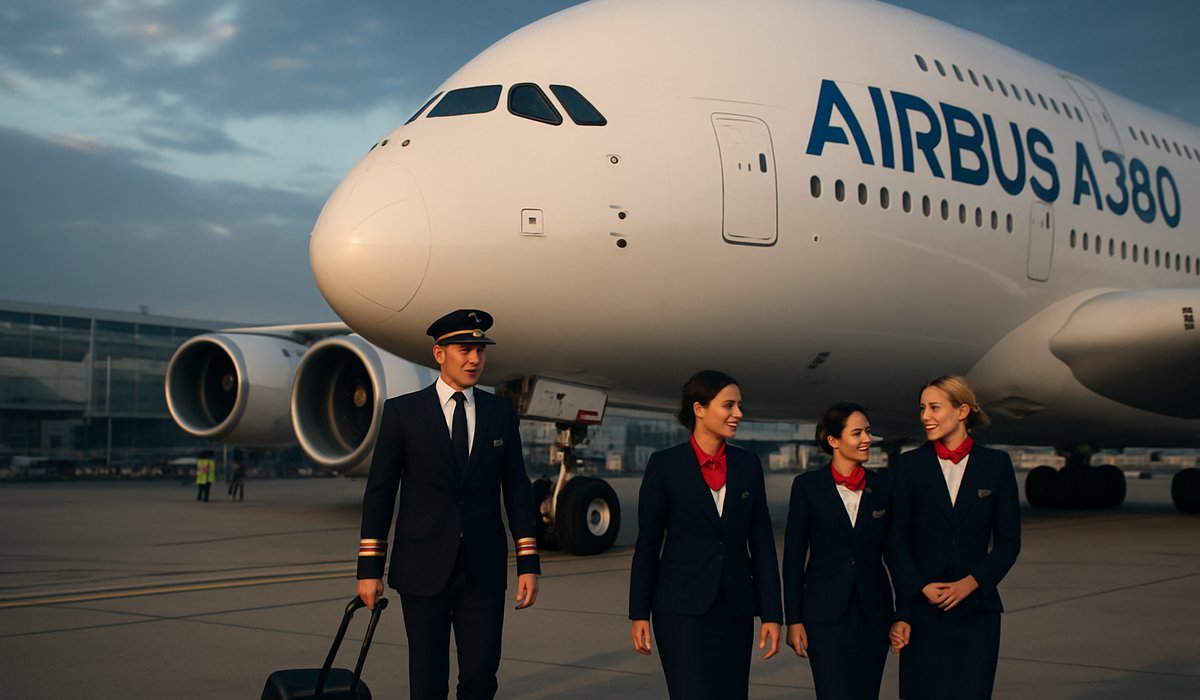
Image generated by AI
Airbus A380: Five Operational Advantages That Set It Apart From Today's Aircraft Fleet
Despite production challenges and pandemic pressures, the superjumbo jet remains uniquely positioned for carriers who have mastered its deployment
The A380's Unmatched Passenger Capacity Reshapes Route Economics
The Airbus A380 stands alone in commercial aviation for its extraordinary seating capacity, accommodating nearly twice the passenger volume of a Boeing 787 on identical routes. This architectural advantage fundamentally transforms route profitability for airlines willing to invest in the aircraft's substantial operational overhead. While the superjumbo failed to achieve the industry-wide adoption or financial success that the legendary Boeing 747 once commanded, select carriers have leveraged this capacity advantage to dominate high-demand international corridors where the volume justifies the investment.
Beyond Raw Capacity: Distinctive Operational Capabilities
The A380's superiority extends well beyond passenger numbers. The aircraft enables airlines to execute operational strategies that remain impossible for competing aircraft in today's fleet. Its dual-deck configuration, advanced fuel efficiency relative to its size, and unique airport compatibility create a distinct competitive positioning for carriers operating long-haul, high-density routes.
Pandemic Stress Tests and Selective Retirement Decisions
The COVID-19 crisis exposed critical vulnerabilities in A380 economics. Several carriers found themselves unable to efficiently fill the aircraft during demand contraction, leading to permanent fleet retirements. However, airlines that maintained A380 operations successfully positioned themselves for rapid capacity recovery as international travel rebounded, demonstrating the aircraft's operational flexibility when demand justifies its deployment.
The Profitability Challenge That Defines the A380 Era
Airbus never achieved profitability on the A380 program—a fundamental reality that underscores the aircraft's niche market positioning. Unlike the 747, which revolutionized long-haul travel economics, the A380 emerged into an aviation landscape increasingly favored twin-engine wide-body efficiency. Yet for carriers including Emirates, Singapore Airlines, and British Airways, the A380 remains strategically valuable precisely because competitors cannot replicate its capabilities.
Strategic Value in Premium Route Competition
Airlines operating the A380 today compete on a different plane than those flying conventional wide-body fleets. The ability to offer premium cabin configurations, multiple first-class and business-class decks, and unparalleled passenger volume on flagship routes creates competitive advantages that purely economic aircraft cannot match. This positioning proves particularly valuable for legacy carriers defending premium long-haul markets against emerging competitors.
The A380's story reflects broader aviation industry trends: the triumph of operational specialization over universal solutions, the enduring value of capacity in premium markets, and the financial constraints that now limit investment in revolutionary aircraft programs.
FAQ: Understanding the Airbus A380's Role in Modern Aviation
Q: How does the Airbus A380 passenger capacity compare to competing wide-body aircraft? A: The A380 accommodates nearly double the passengers of a Boeing 787, with typical configurations seating 555 passengers compared to the 787's 242-330 range, making it the world's largest commercial passenger airliner.
Q: Why did Airbus lose money on A380 production despite massive passenger capacity? A: The aircraft's enormous size created operational complexity, high fuel consumption per flight, and limited airport compatibility, making it profitable only on ultra-high-demand routes that few airlines operate consistently.
Q: Which airlines currently operate the Airbus A380 fleet? A: Major operators include Emirates (world's largest A380 operator), Singapore Airlines, British Airways, Lufthansa, Air France, and Korean Air, primarily deploying the aircraft on flagship international routes.
Q: How did the COVID-19 pandemic affect A380 operations and retirement rates? A: Several carriers permanently retired their A380 fleets due to inability to fill seats during demand collapse, while committed operators like Emirates maintained operations and benefited from rapid capacity advantages during recovery.
Q: What operational advantages does the A380 offer beyond passenger capacity? A: The dual-deck configuration enables premium cabin segregation, the large volume supports diverse cabin layouts, and for select routes, the aircraft delivers unmatched per-flight efficiency on ultra-high-demand corridors.
Related Travel Guides
External Resources
Disclaimer
This article is for informational and educational purposes only. It does not constitute legal, financial, or professional advice. While we strive to provide accurate and up-to-date information, travel policies, regulations, and conditions change rapidly. Always verify information with official sources before making travel decisions. Nomad Lawyer makes no representations about the accuracy, reliability, completeness, or suitability of the information provided. Readers should consult qualified professionals for advice specific to their circumstances. The views expressed in this article are those of the author and do not necessarily reflect the views of Nomad Lawyer.
Raushan Kumar
Founder & Lead Developer
Full-stack developer with 11+ years of experience and a passionate traveller. Raushan built Nomad Lawyer from the ground up with a vision to create the best travel and law experience on the web.
Learn more about our team →