
338 Flights Cancelled, 4,106 Delays Paralyze US Airways as SkyWest, Republic, Envoy Air, GoJet Ground Operations Nationwide
Major US carriers including SkyWest, Republic, Envoy Air, and GoJet grounded 338 flights and recorded 4,106 delays across 60+ airports. Chicago O'Hare hit hardest with 99-102 cancellations.

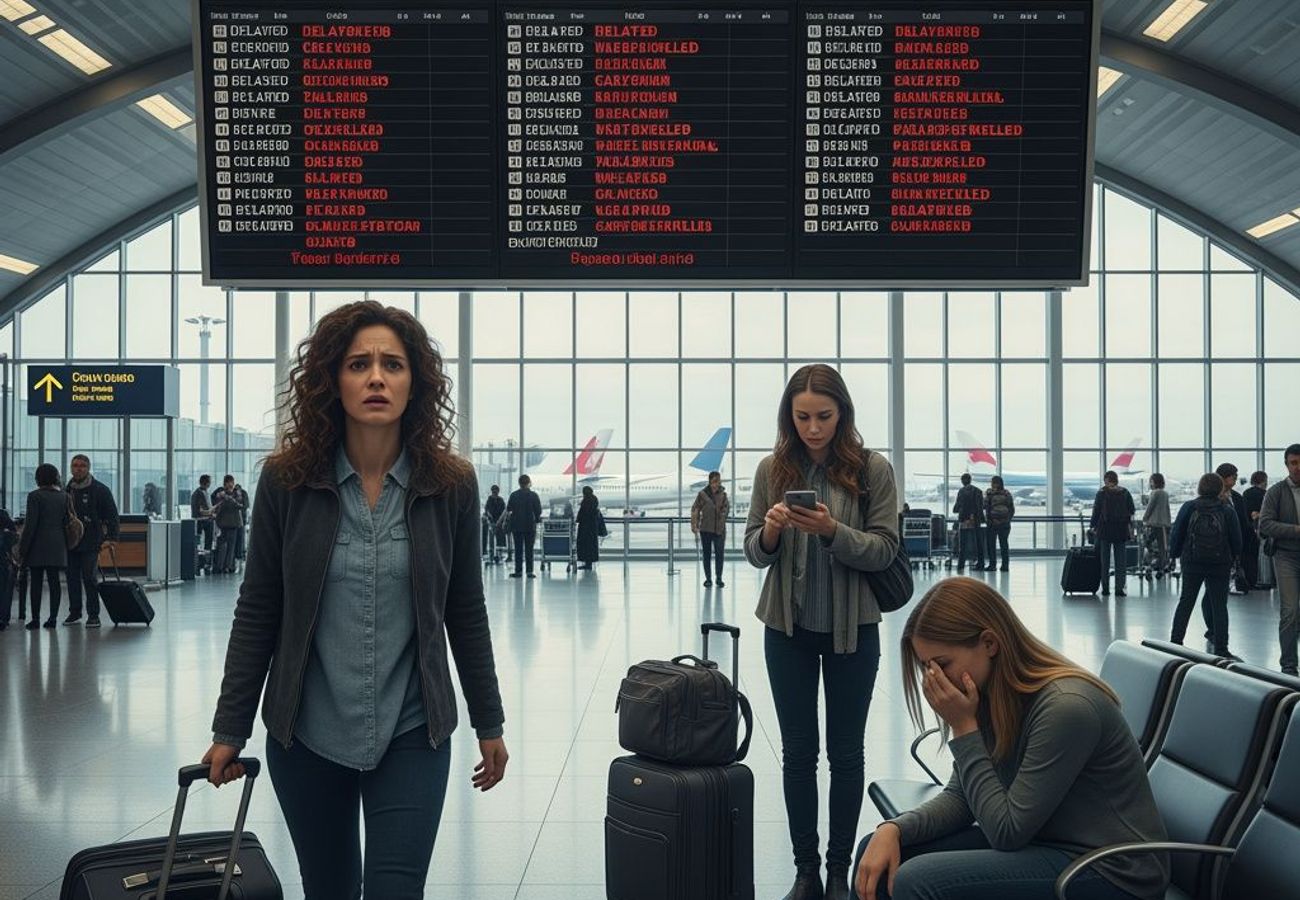
Image generated by AI
The Perfect Storm: When America's Airlines Ground 338 Flights in a Single Day
What started as a quiet Tuesday morning turned into an aviation nightmare across the United States. On June 18, 2026, the skies above America fractured as SkyWest, Republic, Envoy Air, GoJet, American Airlines, and other regional carriers grounded 338 flights while recording a staggering 4,106 delays across more than 60 airports nationwide.
The cascading operational failures disrupted travel from coast to coast, leaving thousands of passengers stranded, rebooked, or facing uncertainty on the tarmac.
Reddit: "I was supposed to be in Boston tonight. Now I'm sitting at O'Hare with no rebooking options until tomorrow. This is absolute chaos." — r/travel
Chicago Bears the Brunt: O'Hare and Midway in Meltdown
The data told a brutal story of concentrated disruption: Chicago O'Hare International Airport (ORD) recorded 99 to 102 cancellations—nearly one-third of all grounded flights nationwide. Just 25 miles away, Chicago Midway International Airport (MDW) added 37 to 41 cancellations to the regional carnage.
Together, these two Chicago hubs absorbed more operational damage than entire regions elsewhere in the country.
The concentration was stunning. No other airport even came close to O'Hare's devastation. Louisville Muhammad Ali International Airport (SDF) and Hartsfield-Jackson Atlanta International Airport (ATL) each reported only 6 cancellations, while Denver (DEN), Boston Logan (BOS), Nashville (BNA), and Detroit (DTW) ranged between 4 and 7 grounded flights each.
The disparity suggested that whatever struck the Chicago region—whether weather, air traffic control constraints, or cascading crew scheduling failures—hit with particular ferocity.
A Nationwide Ripple Effect
But Chicago wasn't alone. The disruption was a genuinely national crisis.
Seattle-Tacoma International (SEA) reported 4 cancellations and 100 delays. John F. Kennedy International (JFK) in New York grounded 4 flights while recording 44 delays. Phoenix Sky Harbor (PHX) faced 3 cancellations and 72 delays. Las Vegas Harry Reid (LAS) logged 3 cancellations and 54 delays.
The delay numbers painted an even grimmer picture. According to FlightAware's real-time tracking data, delays exceeded cancellations at virtually every airport—a sign that while some flights were abandoned outright, the majority simply sat on aprons or in holding patterns, burning fuel and passenger patience.
Chicago O'Hare's delay count alone reached 551 to 585 flights—meaning for every cancellation, there were roughly six delayed operations fighting for scarce runway slots and gate assignments.
Reddit: "My flight's been delayed three times. We've pushed back from the gate twice. They won't tell us anything. This is 2026 and airlines still can't communicate." — r/flying
The Carrier Breakdown: Which Airlines Shouldered the Load?
The source of the cancellations pointed to regional carrier failures rather than mainline legacy carriers, though American Airlines operations suffered broadly across its regional partner network.
SkyWest, Republic, and Envoy Air—all major regional carriers operating under American Eagle, Republic, and Envoy Air flight codes for mainline carriers—bore significant responsibility for the groundings. GoJet, another regional operator, contributed to the disruption cascade.
These carriers operate narrow-body aircraft on short- to medium-haul routes, serving the backbone of America's connectivity. When they fail, entire route networks collapse. A grounded Bombardier CRJ or Embraer E170 on a regional route can trigger upstream delays as crew assignments, aircraft positioning, and downstream connections misalign.
The scale suggested a systemic operational issue—not isolated mechanical failures, but something more fundamental. Staff shortages? Unexpected weather? Air traffic control delays cascading from a single congested hub? The carriers released minimal detail to media.
The Geographic Footprint: 60+ Airports from Coast to Coast
The disruption touched virtually every major metropolitan area in the United States:
Eastern Seaboard: LaGuardia (LGA), JFK, Newark (EWR), Boston Logan (BOS), Philadelphia (PHL), Baltimore-Washington (BWI), Reagan National (DCA), Charlotte Douglas (CLT)
Southeast: Atlanta (ATL), Nashville (BNA), Miami (MIA), Orlando (MCO), Memphis (MEM)
Midwest: Chicago O'Hare (ORD), Chicago Midway (MDW), Detroit (DTW), Indianapolis (IND), St. Louis (STL), Columbus (CMH), Cleveland Hopkins (CLE), Milwaukee Mitchell (MKE)
Texas Corridor: Dallas Love Field (DAL), Dallas-Fort Worth (DFW), Houston Hobby (HOU), Houston Bush (IAH)
West: Denver (DEN), Phoenix Sky Harbor (PHX), Las Vegas (LAS), Los Angeles (LAX), Seattle-Tacoma (SEA), San Diego (SAN)
Secondary Hubs: Pittsburgh (PIT), Kansas City (MCI), Buffalo Niagara (BUF), Cincinnati (CVG), Providence (PVD), Lexington (LEX), South Bend (SBN), Fargo (FAR), Traverse City (TVC), Springfield-Branson (SGF)
The breadth of disruption indicated a problem that transcended regional weather systems or localized operational hiccups.
What the Numbers Really Mean for Travelers
A 4,106-delay figure deserves translation: each delay represents a cascading impact on passengers, crew fatigue, aircraft positioning, and downstream connections.
A three-hour delay on a regional flight can invalidate tight connections on cross-country flights. A crew member stuck on an unexpected delay becomes unavailable for their next scheduled assignment, forcing last-minute crew scrambling. An aircraft trapped in Chicago can't position to Denver, Los Angeles, or Miami for its next day's schedule.
Multiply this across 4,106 individual delay events, and you're looking at tens of thousands of passengers directly affected and hundreds of thousands impacted through knock-on effects—cancelled hotel reservations, missed business meetings, spoiled vacation plans, child care failures.
According to the U.S. Department of Transportation's aviation statistics division, operational disruptions of this scale cost the aviation industry approximately $30,000 to $50,000 per canceled flight when accounting for crew repositioning, fuel burn, crew meal expenses, and customer compensation.
With 338 cancellations, the economic damage exceeded $10 million for carriers and passengers combined on a single day.
The Questions Airlines Won't Easily Answer
What precipitated such a synchronized failure across multiple carriers? Several hypotheses emerge:
Weather cascade: A significant storm system could have degraded operations at Chicago, triggering a network-wide domino effect as crews, aircraft, and passengers failed to position for downstream connections.
Crew scheduling collapse: Regional carriers operate on razor-thin crew margins. A single unexpected absence can cascade into cascading cancellations across an entire region.
Air traffic control constraints: Severe convective weather, staffing shortages, or runway closures at major hubs can choke national capacity within hours.
Mechanical failures: Multiple unscheduled maintenance events on a carrier's fleet could ground significant numbers of aircraft.
System failures: Software outages, crew management system failures, or booking engine crashes have been known to paralyze carrier operations.
As of publication, the affected carriers had issued minimal public statements beyond automated notices to affected passengers.
What Happens Next: The Rebooking Avalanche
The real test of airline operational resilience happens after the grounding. With 338 flights cancelled, those 50,000+ passengers (assuming average loads of 150 passengers per regional flight) need rebooking.
Regional carriers operate with limited schedule flexibility. They can't simply add flights; aircraft and crew must be positioned, fuel must be arranged, and gate slots must be available. The rebooking process could stretch across 24 to 48 hours for the most impacted routes.
Passengers booked on nonstop flights will face unwanted connections. Premium cabin passengers will see downgrade cascades as high-yield bookings are protected during rebooking.
For business travelers, the disruption threatens tight meeting schedules. For leisure travelers, vacation schedules collapse. For freight and cargo operations dependent on belly capacity, the disruption ripples through supply chains.
The airline industry's resilience—or lack thereof—is about to be tested across multiple metrics simultaneously.
The skies over America are watching whether these carriers can execute a comeback as dramatic as their failure was complete.
Related Travel Guides
Disclaimer
This article is for informational and educational purposes only. It does not constitute legal, financial, or professional advice. While we strive to provide accurate and up-to-date information, travel policies, regulations, and conditions change rapidly. Always verify information with official sources before making travel decisions. Nomad Lawyer makes no representations about the accuracy, reliability, completeness, or suitability of the information provided. Readers should consult qualified professionals for advice specific to their circumstances. The views expressed in this article are those of the author and do not necessarily reflect the views of Nomad Lawyer.
Kunal K Choudhary
Co-Founder & Contributor
A passionate traveller and tech enthusiast. Kunal contributes to the vision and growth of Nomad Lawyer, bringing fresh perspectives and driving the community forward.
Learn more about our team →